

German president says Europe is worried over tensions in the disputed South China Sea
Advertisement
Read this article for free:
or
Already have an account? Log in here »
To continue reading, please subscribe:

Digital Subscription
One year of digital access for only $205*
- Enjoy unlimited reading on winnipegfreepress.com
- Read the E-Edition, our digital replica newspaper
- Access News Break, our award-winning app
- Play interactive puzzles
*First annual payment billed as $205.00 + GST for one year. This annual subscription will automatically renew at $233.00 + GST every 52 weeks (10% off the regular annual price of $259.35). Offer available to new and qualified returning subscribers only. Cancel any time.
To continue reading, please subscribe:
Add Free Press access to your Brandon Sun subscription for only an additional
$1 for the first 4 weeks*
- Enjoy unlimited reading on winnipegfreepress.com
- Read the E-Edition, our digital replica newspaper
- Access News Break, our award-winning app
- Play interactive puzzles
*Your next Brandon Sun subscription payment will increase by $1.00 and you will be charged $17.95 plus GST for four weeks. After four weeks, your payment will increase to $24.95 plus GST every four weeks.
Read unlimited articles for free today:
or
Already have an account? Log in here »
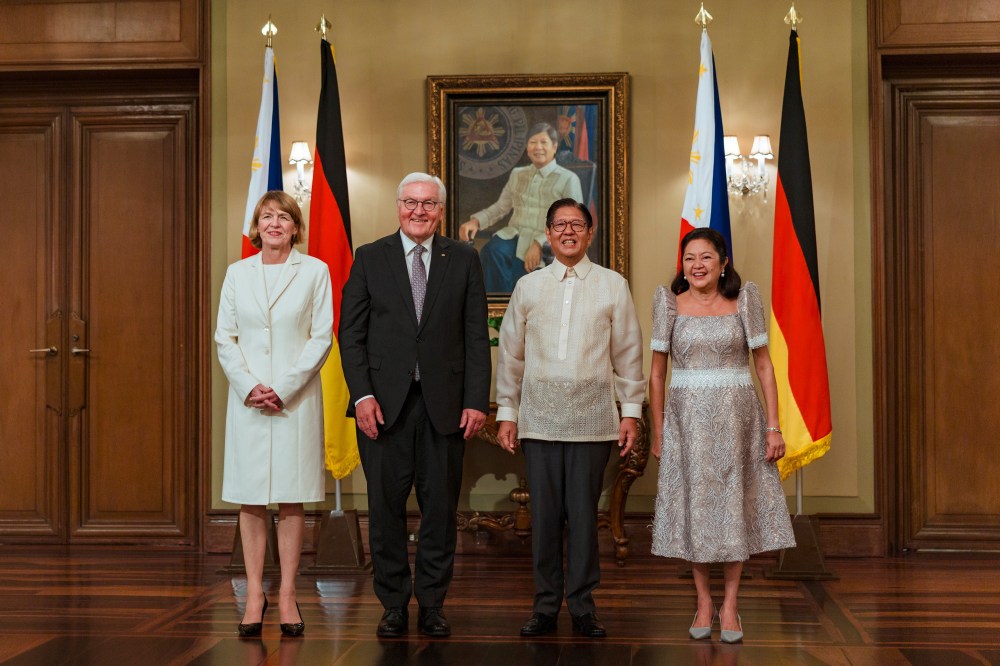
MANILA, Philippines (AP) — German President Frank-Walter Steinmeier said in the Philippines on Tuesday that Europe is worried over tensions in the disputed South China Sea where a major flare-out could endanger freedom of navigation as has happened in the Strait of Hormuz.
In a joint appearance with Philippine President Ferdinand Marcos Jr. in Manila, where Steinmeier is on a state visit, the German president referenced the blockade of the Hormuz as a result of the Iran war and said European leaders were concerned about continuing territorial confrontations in the South China Sea, particularly between the Philippines and China.
The United States lays no claims to the South China Sea but has repeatedly warned it’s obligated to help defend the Philippines, its oldest treaty ally in Asia, if Filipino forces, ships and aircraft come under an armed attack.
China has repeatedly warned the U.S. not to meddle with the disputes, which also involve Vietnam, Malaysia, Brunei and Taiwan.
“The situation in the South China Sea … continues to be tense and that gives us cause to be concerned because the Indo-Pacific, in particular the region of Southeast Asia, is one of the most economically dynamic regions of the world,” Steinmeier said through an interpreter.
“If incidents occur in that part of the world that is also cause for great concern in Europe,” Steinmeier said. “Violations of the international law of the sea endanger the freedom of navigation as the blockade of the Strait of Hormuz has brought home to us recently in a very drastic manner.”
The closure of the Strait of Hormuz, which led to global spikes in fuel and fertilizer prices, was among the issues Steinmeier and Marcos discussed in a closed-door meeting.
Steinmeier did not blame any country for tensions in the South China Sea, a key global trade route, but Germany has previously said China’s actions in the disputed waters violate the rights of coastal states like the Philippines and threaten freedom of navigation.
While visiting Manila in 2024, then German Foreign Minister Annalena Baerbock said China’s actions, which have led to minor collisions with Philippine vessels at sea, are of concern to Germany and other European countries “because such risky maneuvers violate rights and opportunities for economic development of your own country and other littoral states.”
China’s claims “are not covered by international law,” Baerbock said then while calling for a peaceful resolution to the disputes. She visited the Philippine coast guard headquarters in Manila and boarded a patrol ship, where she briefly flew one of surveillance drones donated by Germany.
Steinmeier on Tuesday pledged Germany’s continued support to the Philippine coast guard, which has been a front line guardian of Manila’s territorial interests and had figured in several altercations in the waters with Chinese forces.
Marcos thanked Steinmeier and Germany “for consistently and publicly expressing its support for Philippine efforts to uphold the rule of law in the South China Sea, including by calling on all parties to abide by the final and binding 2016 Arbitral Award.”
The 2016 arbitration ruling, citing the 1982 U.N. Convention of the Law of the Sea, invalidated China’s expansive claims in the South China Sea. Beijing did not participate in the arbitration initiated by the Philippines, rejected its outcome and continues to defy it.