

Georgia’s QR codes for counting votes likely to remain for midterms as lawmakers delay action
Advertisement
Read this article for free:
or
Already have an account? Log in here »
To continue reading, please subscribe:

Digital Subscription
One year of digital access for only $205*
- Enjoy unlimited reading on winnipegfreepress.com
- Read the E-Edition, our digital replica newspaper
- Access News Break, our award-winning app
- Play interactive puzzles
*First annual payment billed as $205.00 + GST for one year. This annual subscription will automatically renew at $233.00 + GST every 52 weeks (10% off the regular annual price of $259.35). Offer available to new and qualified returning subscribers only. Cancel any time.
To continue reading, please subscribe:
Add Free Press access to your Brandon Sun subscription for only an additional
$1 for the first 4 weeks*
- Enjoy unlimited reading on winnipegfreepress.com
- Read the E-Edition, our digital replica newspaper
- Access News Break, our award-winning app
- Play interactive puzzles
*Your next Brandon Sun subscription payment will increase by $1.00 and you will be charged $17.95 plus GST for four weeks. After four weeks, your payment will increase to $24.95 plus GST every four weeks.
Read unlimited articles for free today:
or
Already have an account? Log in here »
ATLANTA (AP) — A day after postponing plans to redraw Georgia’s congressional and legislative districts, state lawmakers were poised Thursday to delay making any changes to the state’s current vote-counting method.
That would mean the system, which relies on a QR code to tally the votes, will remain in place for the November election, an outcome some voting rights advocates preferred to avoid creating confusion at polling sites.
Georgia’s governor, Republican Brian Kemp, had placed redistricting and the state’s election system on the agenda for a special legislative session. On Wednesday — the first day of the session — lawmakers rejected his call for redistricting for the 2028 election, citing concerns about moving too quickly after a U.S. Supreme Court decision weakened federal Voting Rights Act protections for minority voters.
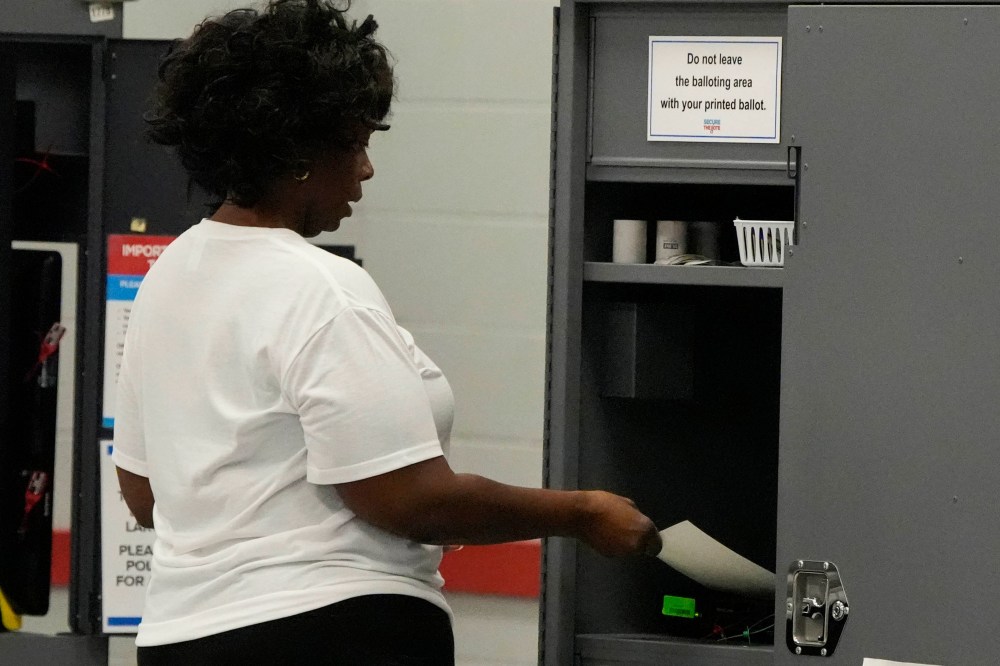
On Thursday, they advanced legislation that would postpone a looming deadline to change the election system used throughout the political battleground state.
That system relies on a QR code printed on ballots to tally the votes. It has drawn the ire of President Donald Trump, who claimed without evidence that voting machines in Georgia deleted or switched votes in the 2020 election. Trump narrowly lost the state to Democrat Joe Biden that year.
Legislators passed a law two years ago barring the use of the QR code for the official vote count beyond July 1 of this year, but no replacement method of tabulating votes was ever implemented. Lawmakers were expected to try to come up with a new system during the special session but instead appear set to punt the issue until later.
A bill advanced Thursday by state senators would extend the July 1 deadline to Jan. 1, 2028. It also would create a committee to recommend “specifications, standards, and requirements” for a new voting system.
“We feel that this gets us into a position to clarify and provide certainty to our election officials and to our electorate,” Republican state Sen. Max Burns, who co-authored the legislation, told lawmakers.
County election officials have received conflicting advice about how to count votes in case the legislature fails to extend the deadline or implement a new voting system.
Burns said the governor’s office and leaders in the state House had agreed to the Senate proposal, which passed out of two committees Thursday. The full Senate is scheduled to consider it on Saturday.
Georgia voting machines have been the subject of conspiracy theories, which manufacturer Dominion Voting Systems fought vigorously in court. But election integrity advocates also have raised concerns about the machines, arguing that they are vulnerable to hacking and that voters cannot be sure their selections are accurately reflected because people can’t read QR codes.
Trump singled out those machines, which also are used in at least some counties in more than a dozen states, in his first executive order on elections shortly after he took office for his second term in January 2025. That order has been blocked by multiple courts and is not being enforced.
Under the new legislation, the committee tasked with recommending a new voting system would have until Jan. 31, 2027, to report its findings. State lawmakers would be responsible for funding, buying and implementing it for the 2028 election cycle.
The committee would be made up of three people appointed by the governor, three members of the Senate and three members of the House.