

Federal judge dismisses Justice Department lawsuit seeking detailed voter data from Maryland
Advertisement
Read this article for free:
or
Already have an account? Log in here »
To continue reading, please subscribe:

Digital Subscription
One year of digital access for only $205*
- Enjoy unlimited reading on winnipegfreepress.com
- Read the E-Edition, our digital replica newspaper
- Access News Break, our award-winning app
- Play interactive puzzles
*First annual payment billed as $205.00 + GST for one year. This annual subscription will automatically renew at $233.00 + GST every 52 weeks (10% off the regular annual price of $259.35). Offer available to new and qualified returning subscribers only. Cancel any time.
To continue reading, please subscribe:
Add Free Press access to your Brandon Sun subscription for only an additional
$1 for the first 4 weeks*
- Enjoy unlimited reading on winnipegfreepress.com
- Read the E-Edition, our digital replica newspaper
- Access News Break, our award-winning app
- Play interactive puzzles
*Your next Brandon Sun subscription payment will increase by $1.00 and you will be charged $17.95 plus GST for four weeks. After four weeks, your payment will increase to $24.95 plus GST every four weeks.
Read unlimited articles for free today:
or
Already have an account? Log in here »
COLUMBUS, Ohio (AP) — The Trump administration’s attempts to obtain state-level voter data have suffered yet another legal blow.
U.S. District Court Judge Stephanie Gallagher last week dismissed a Justice Department lawsuit against Maryland that sought access to the state’s voter records.
Gallagher, appointed by Republican President Donald Trump during his first term, wrote that she “joins every court to have addressed this issue” in concluding that the unredacted voter registration file “is not a record or paper that a state must produce to the United States.”
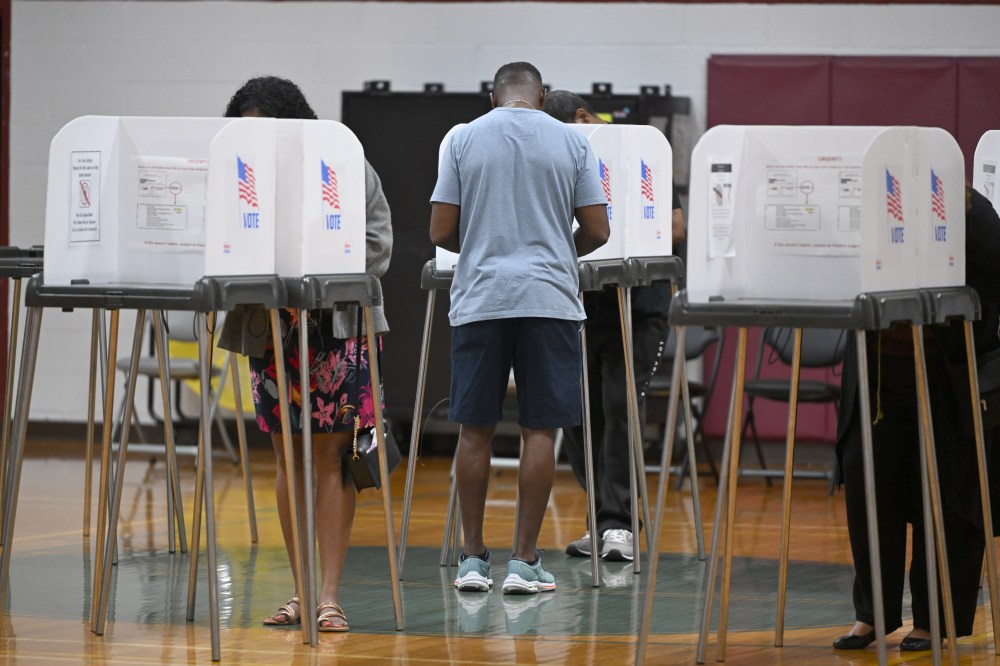
With the dismissal Thursday in Maryland, the number of states where the Justice Department has lost similar cases comes to nine. The department has sued to force release of detailed state voter data — which includes dates of birth, addresses, driver’s license numbers and partial Social Security numbers — in 30 states and the District of Columbia.
In addition to Maryland, judges have rejected those attempts in Arizona, California, Maine, Massachusetts, Michigan, Oregon, Rhode Island and Wisconsin. In Georgia, a judge dismissed a Justice Department lawsuit because it had been filed in the wrong city, prompting the government to refile elsewhere.
In the Maryland case, the Justice Department tried to cite an opinion written by its own legal counsel’s office that it had the right to the state voter records under federal civil rights law, but Gallagher was not persuaded.
“The Court will not interpret the (Civil Rights Act) contrary to its text simply because an office of the party advancing that interpretation has adopted it,” she wrote.
In explaining their push for the records, federal officials have said that they need the voter data to ensure that states are complying with federal election laws related to maintaining voter registration lists, even though states already have detailed processes to do that. In the case out of Rhode Island, a Justice Department attorney acknowledged that the department was seeking unredacted voter roll information so it could be shared with the Department of Homeland Security to check citizenship status.
On Monday, a federal judge found that the Homeland Security program to check citizenship, referred to as SAVE, violated federal privacy laws and was wrongly identifying eligible voters as noncitizens. She ruled that the system could no longer be used.
Democratic and some Republican officials have objected to the Justice Department requests for detailed voter data and said such a demand violates state and federal privacy laws.
But at least 13 states have either provided or promised to provide their voter registration lists to the department, according to the Brennan Center for Justice and Associated Press reporting: Alaska, Arkansas, Indiana, Louisiana, Mississippi, Nebraska, Ohio, Oklahoma, South Carolina, South Dakota, Tennessee, Texas and Wyoming.