

Myanmar torches $600 million in seized heroin, meth and other drugs
Advertisement
Read this article for free:
or
Already have an account? Log in here »
To continue reading, please subscribe:

Digital Subscription
One year of digital access for only $205*
- Enjoy unlimited reading on winnipegfreepress.com
- Read the E-Edition, our digital replica newspaper
- Access News Break, our award-winning app
- Play interactive puzzles
*First annual payment billed as $205.00 + GST for one year. This annual subscription will automatically renew at $233.00 + GST every 52 weeks (10% off the regular annual price of $259.35). Offer available to new and qualified returning subscribers only. Cancel any time.
To continue reading, please subscribe:
Add Free Press access to your Brandon Sun subscription for only an additional
$1 for the first 4 weeks*
- Enjoy unlimited reading on winnipegfreepress.com
- Read the E-Edition, our digital replica newspaper
- Access News Break, our award-winning app
- Play interactive puzzles
*Your next Brandon Sun subscription payment will increase by $1.00 and you will be charged $17.95 plus GST for four weeks. After four weeks, your payment will increase to $24.95 plus GST every four weeks.
Read unlimited articles for free today:
or
Already have an account? Log in here »
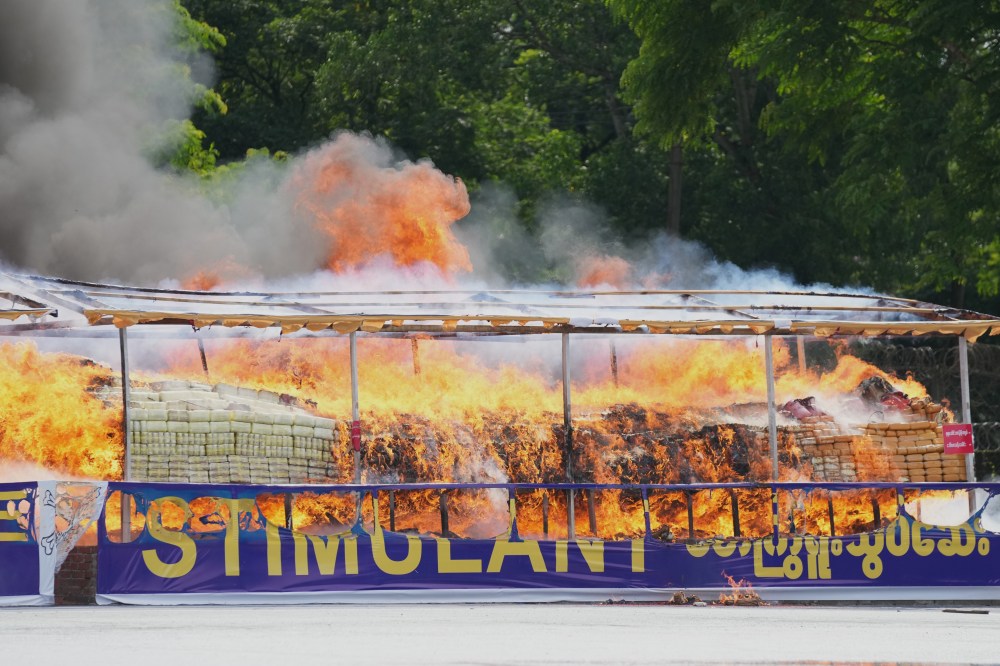
YANGON, Myanmar (AP) — Thick clouds of black smoke billowed into the sky on the outskirts of Myanmar’s largest city Friday as authorities burned more than 50 tons of heroin, opium, ketamine, methamphetamine, marijuana and crystal meth — some $600 million of confiscated illegal drugs destroyed nationwide.
Myanmar, also known as Burma, has a long history of drug production linked to political and economic insecurity caused by decades of armed conflict.
It has been a major source of illegal drugs destined for East and Southeast Asia, despite repeated efforts to crack down, and has long been one of the world’s largest producers of heroin and methamphetamine.
Violent political unrest in Myanmar following the military takeover in 2021 — which has led into a civil war between the military government and its pro-democracy opponents, as well as ethnic armed groups — has caused an increase in drug production, according to experts.
In January, the military government claimed the country’s largest-ever seizures of illicit drugs and drug-manufacturing equipment, taken from a total of 12 drug production sites during a series of raids in the northern part of Shan state.
This year, the street value of drugs destroyed was more than double last year’s total, Police Lt. Col. Aung Myat Soe, of Yangon’s Anti-Narcotics Police Force, told reporters at a bus station compound on the edge of the city where drugs were being burned.
In Yangon alone, some $321 million worth of 31 different types of drugs were set ablaze, Aung Myat Soe said.
Events were also held in Mandalay, and in Taunggyi, the capital of eastern Myanmar’s Shan state — areas closer to where the drugs are produced — to mark the United Nations’ International Day Against Drug Abuse and Illicit Trafficking.
Many areas of Myanmar are controlled by long-established militias organized by the country’s various ethnic groups, many of which are involved in fighting against the military-run government in a bloody civil war, alongside pro-democracy groups that sprang up after the military seized control of the country from democratically-elected Aung San Suu Kyi in 2021.
In elections that concluded earlier this year, which international observers said were neither free nor fair with major opposition groups banned, the military leaders won a landslide victory.
The government claims the country’s militias use illicit drugs to fund their insurgencies and are unwilling to engage in any peace process because they do not want to give up the lucrative drug trade.
Some groups are known to be involved in the drug trade currently and in the past, but others also have sought to crack down on narcotics.
The Ta’ang National Liberation Army, for example, which captured significant swaths of the northern part of Shan state in the civil war before signing a ceasefire in October with the military, announced Thursday that it would destroy about $5.5 million worth of seized drugs in the group’s controlled-area.