

Italy displays paintings from an ancient Etruscan tomb, its latest cultural acquisition
Advertisement
Read this article for free:
or
Already have an account? Log in here »
To continue reading, please subscribe:

Digital Subscription
One year of digital access for only $205*
- Enjoy unlimited reading on winnipegfreepress.com
- Read the E-Edition, our digital replica newspaper
- Access News Break, our award-winning app
- Play interactive puzzles
*First annual payment billed as $205.00 + GST for one year. This annual subscription will automatically renew at $233.00 + GST every 52 weeks (10% off the regular annual price of $259.35). Offer available to new and qualified returning subscribers only. Cancel any time.
To continue reading, please subscribe:
Add Free Press access to your Brandon Sun subscription for only an additional
$1 for the first 4 weeks*
- Enjoy unlimited reading on winnipegfreepress.com
- Read the E-Edition, our digital replica newspaper
- Access News Break, our award-winning app
- Play interactive puzzles
*Your next Brandon Sun subscription payment will increase by $1.00 and you will be charged $17.95 plus GST for four weeks. After four weeks, your payment will increase to $24.95 plus GST every four weeks.
Read unlimited articles for free today:
or
Already have an account? Log in here »
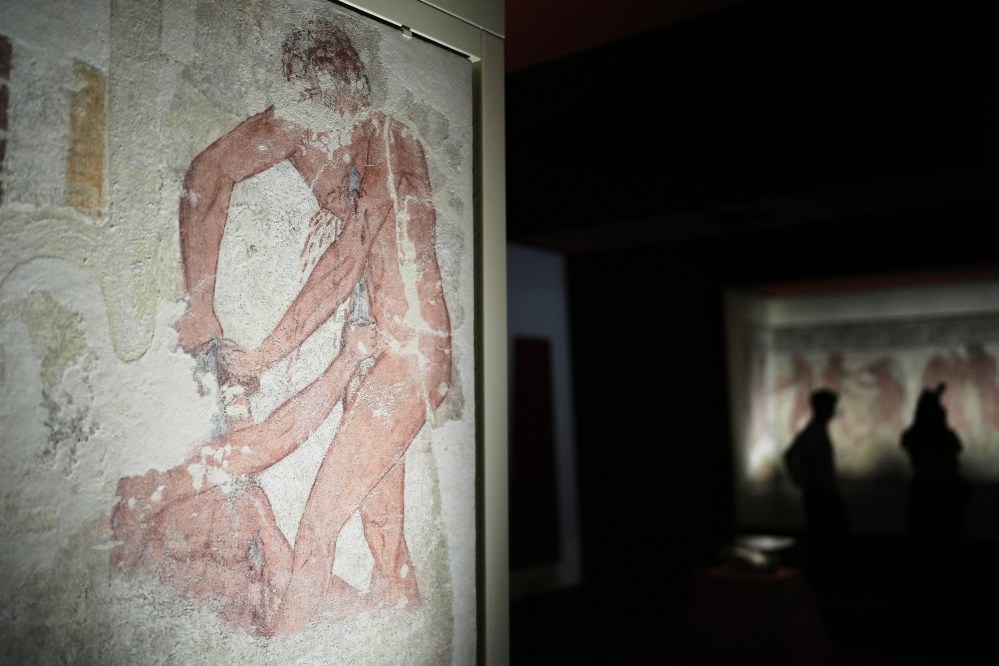
ROME (AP) — Italy on Tuesday put on display one of the best known examples of Etruscan painting, panels from a tomb that it acquired for 15 million euros ($17 million) in the Culture Ministry’s buying spree of big-ticket pieces of the country’s cultural heritage.
The ministry announced in May that it had acquired the fresco panels, dating from the 4th century, from members of the Torlonia family, one of Italy’s ancient noble families whose vast collection of antiquity has long been kept out of the public domain.
The Francois Tomb was discovered in 1857 by the French archaeologist Alessandro Francois in Vulci, on land owned by the Torlonia family. The frescoes were detached from the necropolis in 1863 and became part of the Torlonia private collection, while the contents of the tomb were divided up among Francois, colleagues and the family.
The Italian government has been trying to get possession of the tomb since 1921, as part of its effort to bring back into the Italian public patrimony artifacts and antiquities that were acquired or looted during the boom of archaeological excavations in the 1800s and beyond.
The Etruscan Civilization occupied swaths of what is today central Italy for centuries was a major Mediterranean trading power. Much of it was destroyed by the subsequent Roman Empire.
The tomb is opening to the public Wednesday at Rome’s Villa Giulia National Etruscan Museum. Alongside the fresco panels are jewels, Etruscan vases and other items that were discovered inside the tomb, now belong in museum collections around the world and were loaned to Italy for the exhibition.
The tomb marks the Culture Ministry’s third major acquisition this year of expensive, culturally important artworks. It paid $14.9 million for Antonello da Messina’s “ Ecce Homo” and around $35 million for a rare portrait by Caravaggio depicting Maffeo Barberini, the future Pope Urban VIII.
The funds have come from the ministry’s annual budget for acquisitions, but Culture Minister Alessandro Giuli has prioritized buying fewer, bigger-ticket items of cultural importance rather than smaller, lesser artworks and antiquities, officials said.
“In recent months, the Ministry of Culture has invested a great deal of money in acquiring masterpieces,” said Massimo Osanna, director general of Italian museums in the ministry.
Giuli has said the tomb is a “fundamental” part of Italian history that was now being returned to the Italian public to enjoy.
Luana Toniolo, director of the Villa Giulia museum, called the tomb one of the greatest masterpieces of antiquity and Etruscan painting, and one of the best preserved. Among other things, the paintings depict the sacrifice of Trojan prisoners and battles of Etruscan heroes.
“It is a vast book of stone and color that tells us about families, warriors, gods and heroes — both Etruscans and Greeks — and recounts Greek myths reinterpreted through an Etruscan lens,” she said.
___
Associated Press journalist Silvia Stellacci in Rome contributed.