

People camp outside court to get scarce public seats in hearing on Charlie Kirk’s killing
Advertisement
Read this article for free:
or
Already have an account? Log in here »
To continue reading, please subscribe:

Digital Subscription
One year of digital access for only $205*
- Enjoy unlimited reading on winnipegfreepress.com
- Read the E-Edition, our digital replica newspaper
- Access News Break, our award-winning app
- Play interactive puzzles
*First annual payment billed as $205.00 + GST for one year. This annual subscription will automatically renew at $233.00 + GST every 52 weeks (10% off the regular annual price of $259.35). Offer available to new and qualified returning subscribers only. Cancel any time.
To continue reading, please subscribe:
Add Free Press access to your Brandon Sun subscription for only an additional
$1 for the first 4 weeks*
- Enjoy unlimited reading on winnipegfreepress.com
- Read the E-Edition, our digital replica newspaper
- Access News Break, our award-winning app
- Play interactive puzzles
*Your next Brandon Sun subscription payment will increase by $1.00 and you will be charged $17.95 plus GST for four weeks. After four weeks, your payment will increase to $24.95 plus GST every four weeks.
Read unlimited articles for free today:
or
Already have an account? Log in here »
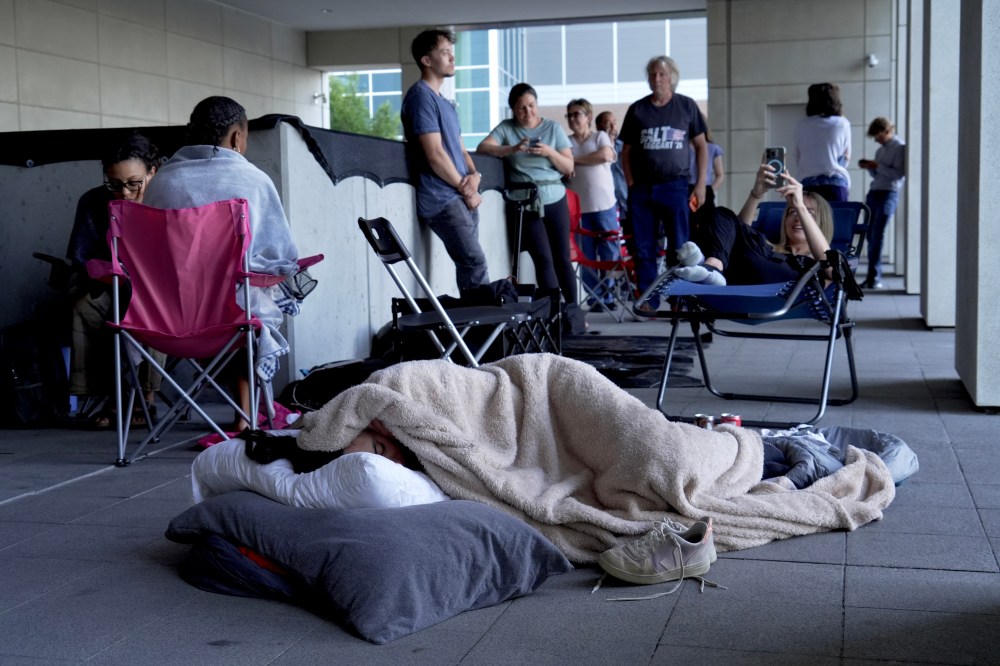
PROVO, Utah (AP) — Folding chairs, sleeping pads and blankets litter the entrance to the Utah courthouse each day before a preliminary hearing for the man charged with killing conservative activist Charlie Kirk.
People have been lining up early — sometimes sleeping there overnight — in hopes of getting a wristband that will allow them access to the courtroom. The 14 coveted seats reserved for the public are first come, first served.
The weeklong preliminary hearing for Tyler Robinson has attracted intense national and significant international attention. Wall-to-wall media coverage through livestreams and daily updates has fueled the mix of curiosity and scrutiny that has prompted many spectators to angle for a spot in the courtroom.
The hearing is expected to wrap up Friday. State District Judge Tony Graf then will decide whether prosecutors have presented enough evidence to bring Robinson to trial on an aggravated murder charge.
Spectators have to follow courthouse rules
Chris Palmer, the court’s director of security, warned Thursday morning that people can no longer bring tents or other camping supplies to the courthouse steps. And there’s no jumping the line or saving places, he told those waiting outside.
Once inside, there are more rules spectators must follow aside from simply being respectful.
“These people come here to get justice,” Palmer told those waiting. “They don’t need to feel like they’re under a microscope when somebody’s sitting behind them or ahead of them.”
It’s a kind of controlled chaos, as sheriff’s deputies and court staff hand out wristbands each morning. Beyond the line, reporters and bloggers are armed with cellphones, scanning the entrances in hopes of documenting the arrival of Kirk’s family or Robinson’s, or other notable names, such as the president’s son Donald Trump Jr.
Earlier in the week, court staff warned that wristbands for public seating were being labeled because security discovered some people bought colored wristbands to sneak in.
Standing in line is worth it for some
Joshua Carr, a local who described himself as an independent journalist, was first in line Thursday. A friend of his arrived at 9 p.m. the night before to hold the spot until Carr arrived at 2:30 a.m.
Carr has been covering the case and the conspiracy theories that surround it for a few months.
“Being in the courtroom is a different thing because you’re able to actually feel the emotions, see the expressions on people’s faces that aren’t shown in the public feed,” he said.
Billie Webb, who made the trip from Salt Lake City, has been following the investigation since Kirk was shot Sept. 10 and attended hearings earlier this year on motions filed by prosecutors and defense attorneys.
Webb arrived at 5 a.m. Wednesday and found herself eighth in line because the proceedings didn’t start until the afternoon. She missed the cutoff Thursday despite showing up at 3 a.m. but said she was “absolutely determined” to get in Friday.
Like others, Webb was interested in hearing a recorded law enforcement interview with Robinson’s roommate and romantic partner, Lance Twiggs, noting that attorneys had argued much of Wednesday over whether it would be made public.
Webb also wants to be there if the case goes to trial.
“If I have to camp for 24 hours, I will,” she said.
Other court cases have drawn massive public turnout
Public and media frenzy over high-profile cases is nothing new. It’s usually driven by celebrity, politics, race or sensational crime elements.
One early example was the 1935 trial in New Jersey of the man charged with kidnapping and killing legendary aviator Charles Lindbergh’s baby, which drew crowds and cameras.
O.J. Simpson’s double murder case captured attention in the 1990s. It was widely referred to by the public and the media as the “Trial of the Century.”
More recently, public lines, protests and media presence have followed cases that include Derek Chauvin, the former police officer who was sentenced in 2021 to more than two decades in prison for the death of George Floyd in Minneapolis.
That same year, people were lining up for seats in a Manhattan federal courtroom for the trial of British socialite Ghislaine Maxwell. She was convicted of luring teenage girls to be sexually abused by the American millionaire Jeffrey Epstein. ___ Montoya Bryan reported from Albuquerque, New Mexico.