

Nicaragua strips lawyers from practicing in ongoing crackdown on dissent
Advertisement
Read this article for free:
or
Already have an account? Log in here »
To continue reading, please subscribe:

Digital Subscription
One year of digital access for only $205*
- Enjoy unlimited reading on winnipegfreepress.com
- Read the E-Edition, our digital replica newspaper
- Access News Break, our award-winning app
- Play interactive puzzles
*First annual payment billed as $205.00 + GST for one year. This annual subscription will automatically renew at $233.00 + GST every 52 weeks (10% off the regular annual price of $259.35). Offer available to new and qualified returning subscribers only. Cancel any time.
To continue reading, please subscribe:
Add Free Press access to your Brandon Sun subscription for only an additional
$1 for the first 4 weeks*
- Enjoy unlimited reading on winnipegfreepress.com
- Read the E-Edition, our digital replica newspaper
- Access News Break, our award-winning app
- Play interactive puzzles
*Your next Brandon Sun subscription payment will increase by $1.00 and you will be charged $17.95 plus GST for four weeks. After four weeks, your payment will increase to $24.95 plus GST every four weeks.
Read unlimited articles for free today:
or
Already have an account? Log in here »
MEXICO CITY (AP) — Nicaragua’s government has stripped masses of lawyers of their licenses to practice in recent days, in what a United Nations expert described Friday as a “purge of the legal profession” aimed at eroding the country’s final shreds of democratic checks and balances.
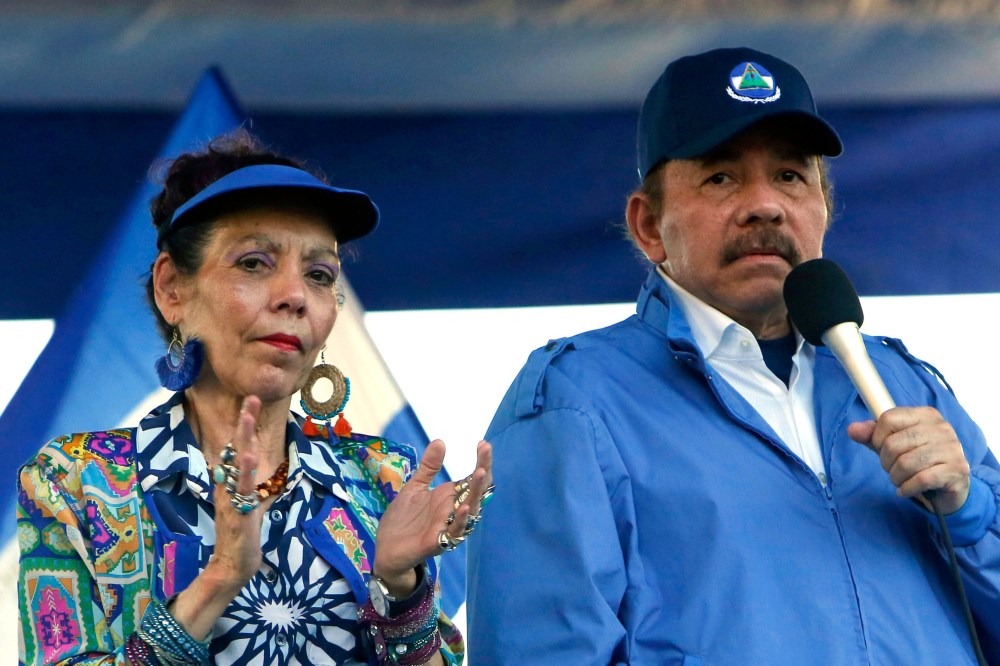
The government of husband-and-wife copresidents, Daniel Ortega and Rosario Murillo, has been carrying out an all-out crackdown on dissent since mass social protests in 2018 that the government violently repressed.
Since then, the government has imprisoned adversaries, religious leaders, journalists and others, forcing thousands to flee the country. It has stripped hundreds of their Nicaraguan citizenship and possessions. Since 2018, it has also shut down more than 5,000 organizations, largely religious groups, but also local rotary clubs and scouting organizations.
In recent days, lawyers noticed that their licenses to practice law in Nicaragua were removed without explanation from the Supreme Court of Justice’s registry, according to Reed Brody, an American human rights lawyer and member of a U.N. panel of experts on the Central American country, and other lawyers whose certifications were revoked.
There was no official notification by the government, and Nicaragua’s government did not respond to a request for comment by The Associated Press.
Brody said the full scope was not immediately clear, but it “would certainly appear to be at least hundreds, if not thousands of lawyers.”
“This follows the pattern that we’ve been seeing for years. First, they closed the NGOs, the universities, the independent media, you know, they’ve gone after the churches, and now it seems the legal profession,” Brody said. “Anyone who might stand between the government and citizens.”
Brody said he knew of at least 20 lawyers who had been affected.
Juan Diego Barberena, a lawyer and human rights defender exiled in Costa Rica since 2022, was among those stripped of his official certification and said he knew of at least 25 more colleagues like him.
On Thursday, Barberena tried to access his legal accreditation on the government’s database, and said his name and license number were wiped clean from the system.
“This is a means of exercising totalitarian control over the legal profession,” Barberena said. “This means that the dictatorship can decide who gets to practice and who doesn’t.”
The move echoes other steps the government has taken in recent years. Many Nicaraguan exiles stripped of their citizenship and rendered “stateless” have reported similar stories of themselves or family members going to search for their birth certificates and other legal documents in official databases and being told they don’t exist.
But Barberena and Brody said the move this week by authorities went a step further, noting that those erased from the system were not just dissenters. Some were simply Nicaraguans living abroad. Others practiced criminal or family law that didn’t touch on politics, while some were government sympathizers, Barberena said.
Brody framed it, rather, as a move to whittle away at any last remaining shred of independence in a judicial system already firmly under control of Ortega and Murillo.
“On one hand, it’s an arbitrary measure to punish political dissent,” Barberena said. “On the other, it’s the dictatorship looking medium-term and wanting to prevent lawyers, experts, and academics from participating in the future of the country’s institutions.”
___
Follow AP’s coverage of Latin America and the Caribbean at https://apnews.com/hub/latin-america