

Philippines commemorates 2016 South China Sea ruling rejected by Beijing
Advertisement
Read this article for free:
or
Already have an account? Log in here »
To continue reading, please subscribe:

Digital Subscription
One year of digital access for only $205*
- Enjoy unlimited reading on winnipegfreepress.com
- Read the E-Edition, our digital replica newspaper
- Access News Break, our award-winning app
- Play interactive puzzles
*First annual payment billed as $205.00 + GST for one year. This annual subscription will automatically renew at $233.00 + GST every 52 weeks (10% off the regular annual price of $259.35). Offer available to new and qualified returning subscribers only. Cancel any time.
To continue reading, please subscribe:
Add Free Press access to your Brandon Sun subscription for only an additional
$1 for the first 4 weeks*
- Enjoy unlimited reading on winnipegfreepress.com
- Read the E-Edition, our digital replica newspaper
- Access News Break, our award-winning app
- Play interactive puzzles
*Your next Brandon Sun subscription payment will increase by $1.00 and you will be charged $17.95 plus GST for four weeks. After four weeks, your payment will increase to $24.95 plus GST every four weeks.
Read unlimited articles for free today:
or
Already have an account? Log in here »
MANILA, Philippines (AP) — The Philippines commemorated on Friday the anniversary of a 2016 arbitration ruling, which invalidated China’s expansive claims in the disputed South China Sea and which Washington and other allies have used as a rallying call against Beijing’s growing assertiveness.
China refused to join the arbitration initiated by the Philippines in 2013, and rejected as a sham the July 12, 2016 ruling by a tribunal established under the United Nations Convention on the Law of the Sea.
Beijing continues to defy the decision and defend its claims to virtually the entire sea passage, a key global trade route where the territorial standoffs, which also involve the Philippines, Vietnam, Malaysia, Brunei and Taiwan, have long been feared as one of Asia’ most active flashpoints.
The United States has repeatedly called on China to comply with the ruling. Both the former Biden and current Trump administrations have warned that Washington is obligated to defend the Philippines, its oldest treaty ally in Asia, if Filipino forces, vessels or aircraft come under an armed attack in the disputed waters.
Territorial confrontations in the disputed waters have become more prevalent in recent years, particularly between Chinese and Philippine and Vietnamese forces and fishing fleets.
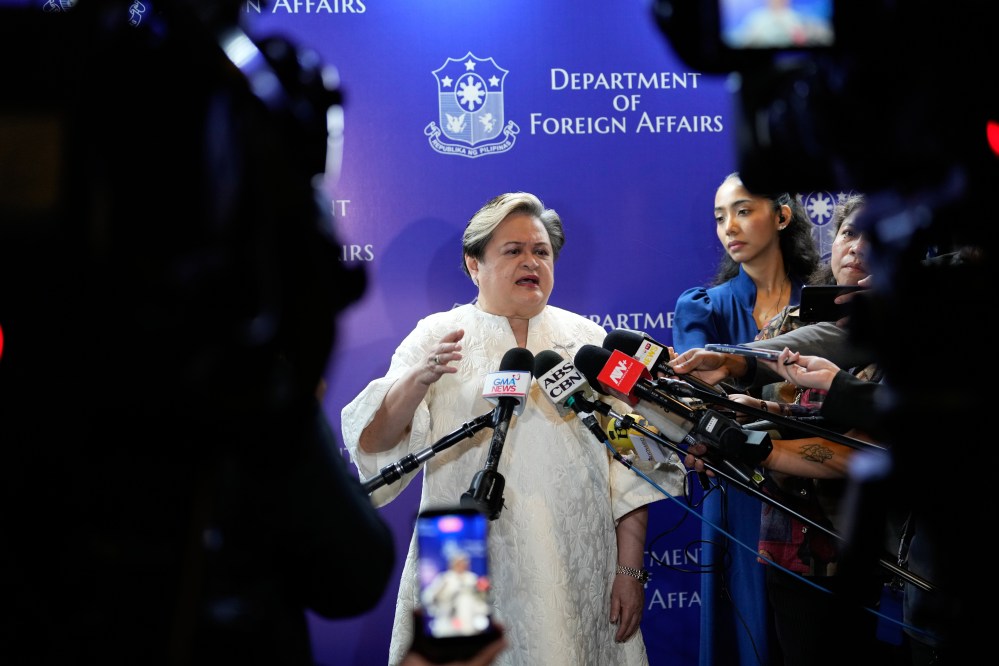
Philippine Foreign Secretary Maria Theresa Lazaro said Thursday the ruling is legally binding, comparing it to a lighthouse.
“When the waters grow turbulent, when unilateral claims cloud the horizon and when the shadow of coercion looms, nations need something far more permanent than political convenience,” Lazaro said. “They need a lighthouse.”
Australian Foreign Minister Penny Wong criticized China, saying Australia would “continue to register our concerns about China’s vessels engaging in destabilizing and dangerous conduct in the South China Sea.”
China did not immediately issue a reaction, but in a statement issued recently through its embassy in Manila, Beijing said it would never recognize the ruling, which it called “illegal, null and void.”
“The award will not alter the historical and factual basis for China’s sovereignty over the islands of the South China Sea and their adjacent waters,” the Chinese embassy in Manila said, adding that the ruling “will not weaken China’s resolve and determination to safeguard its sovereignty and maritime rights and interests.”
The arbitration tribunal largely decided in favor of the Philippines. It ruled that under the 1982 U.N. Convention on the Law of the Sea, “there was no legal basis for China to claim historic rights to resources” in the South China Sea outside of its regular territorial areas recognized under the convention.
The convention, largely regarded as the treaty governing the world’s oceans and seas, took effect in 1994 and has been ratified by more than 170 countries and parties, including China and the Philippines.
___
Joeal Calupitan and Aaron Favila in Manila, Philippines contributed to this report.