

Solar-powered tricycles help Cubans navigate fuel shortages and blackouts
Advertisement
Read this article for free:
or
Already have an account? Log in here »
To continue reading, please subscribe:
Digital Subscription
One year of digital access for only $1.44 a week*
- Enjoy unlimited reading on winnipegfreepress.com
- Read the E-Edition, our digital replica newspaper
- Access News Break, our award-winning app
- Play interactive puzzles
*Billed as $5.77 plus GST every four weeks. After 52 weeks, price increases to the regular rate of $19.95 plus GST every four weeks. Offer available to new and qualified returning subscribers only. Cancel any time.
To continue reading, please subscribe:
Add Free Press access to your Brandon Sun subscription for only an additional
$1 for the first 4 weeks*
- Enjoy unlimited reading on winnipegfreepress.com
- Read the E-Edition, our digital replica newspaper
- Access News Break, our award-winning app
- Play interactive puzzles
*Your next Brandon Sun subscription payment will increase by $1.00 and you will be charged $17.95 plus GST for four weeks. After four weeks, your payment will increase to $24.95 plus GST every four weeks.
Read unlimited articles for free today:
or
Already have an account? Log in here »
HAVANA (AP) — Cuba’s iconic vintage cars have all but disappeared and in their place, small electric tricycles — most of them made in China — have become the primary means of transportation for hundreds of thousands of Cubans grappling with a prolonged fuel crisis.
These are no ordinary electric tricycles — many Cubans have outfitted them with solar panels, allowing the vehicles to recharge without relying on the island nation’s strained power grid.
The three-wheelers are a far cry from the old-timers that only a year ago cruised the streets spewing clouds of black smoke.
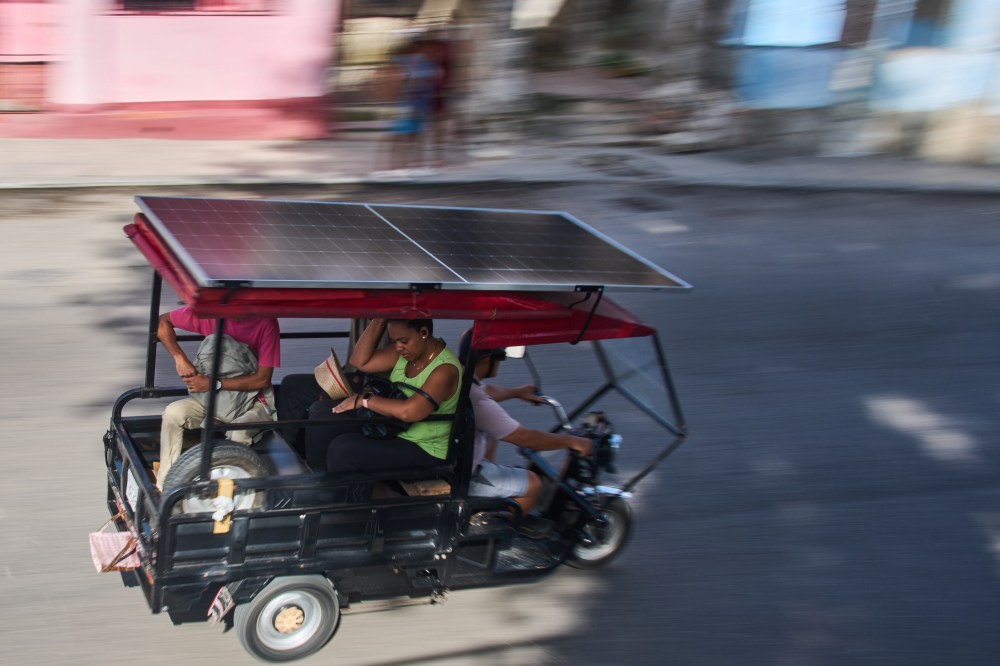
“This is how people get around now,” said 40-year-old Liecer de la Cruz, who owns one of these vehicles.
The tricycles, with a cost between $2,000 and $4,000, are used to transport goods and serve fixed routes once covered by buses.
While their price is out of reach for most Cubans, many have sold their older gasoline-powered cars to buy the tricycles. Others got them from relatives abroad, where they are generally cheaper, and some small-business owners even used their profits to invest in them, expecting to recoup the cost.
In January, U.S. President Donald Trump threatened to impose tariffs on countries that sell oil to Cuba, which produces only about 40% of the fuel it needs. Since then, just a single oil tanker has arrived on the island, in late March — down from about eight a month previously.
The impact on daily life in Cuba has been significant.
Rolling blackouts have worsened, exacerbating hardships in a country whose economy has been in crisis for five years. Shortages of food and medicine have deepened, and public transportation has been sharply reduced.
Amid the crisis, electric tricycles have become indispensable. They transport goods, serve fixed routes once covered by buses and, in some Havana neighborhoods, they are used to collect garbage.
People with heavy shopping bags can catch rides on the tricycles — a slow, hot and uncomfortable ride. But it’s better than walking.
“If you can pay for it, you just take it; otherwise you can’t go anywhere,” said Berta Ferrer, a 52-year-old clerk at a store in central Havana where she works four days a week.
She pays about 500 Cuban pesos — less than $1 — for the ride, a significant expense in a country where monthly salaries average about $10 for state workers and roughly $40 for private-sector employees.
Electric tricycles from Chinese brands such as Zonsen and Jinpeng have become a common sight on Cuba’s streets. Many are bought in countries such as Panama and shipped to the island by relatives or importers for resale, and they run on gel or lithium batteries. Under an agreement with China, the Vedca brand is assembled in Cuba.
Some owners have installed solar panels on the awnings over seats of the tricycle, allowing them to recharge on the go and keep operating despite the island’s energy crisis.
“There are so many tricycles in Havana that you can’t spend 10 minutes on a street without seeing countless numbers of them pass by,” said 29-year-old engineer Carlos Álvarez, who owns a workshop specializing in electric vehicles.
He spoke as he was installing a mounting bracket for a solar panel on one of the tricycles and acknowledged the investment can be costly — about $500 — but said it pays off quickly as it helps owners cope with fuel shortages and blackouts.
Ricardo Quintero, an engineer who owns one of the tricycles, said he uses it to transport produce to the vegetable stand he runs with his family.
“I think this is here to stay,” he said, looking at his three-wheeler.
___
Follow AP’s coverage of Latin America and the Caribbean at https://apnews.com/hub/latin-america