

Turkey says defense pact with Saudi Arabia and Pakistan is not aimed at Iran or any other country
Advertisement
Read this article for free:
or
Already have an account? Log in here »
To continue reading, please subscribe:

Digital Subscription
One year of digital access for only $205*
- Enjoy unlimited reading on winnipegfreepress.com
- Read the E-Edition, our digital replica newspaper
- Access News Break, our award-winning app
- Play interactive puzzles
*First annual payment billed as $205.00 + GST for one year. This annual subscription will automatically renew at $233.00 + GST every 52 weeks (10% off the regular annual price of $259.35). Offer available to new and qualified returning subscribers only. Cancel any time.
To continue reading, please subscribe:
Add Free Press access to your Brandon Sun subscription for only an additional
$1 for the first 4 weeks*
- Enjoy unlimited reading on winnipegfreepress.com
- Read the E-Edition, our digital replica newspaper
- Access News Break, our award-winning app
- Play interactive puzzles
*Your next Brandon Sun subscription payment will increase by $1.00 and you will be charged $17.95 plus GST for four weeks. After four weeks, your payment will increase to $24.95 plus GST every four weeks.
Read unlimited articles for free today:
or
Already have an account? Log in here »
ANKARA, Turkey (AP) — A defense agreement between Saudi Arabia, Pakistan and Turkey is not aimed against Iran or any other country, Turkey’s foreign minister said Saturday, describing the pact as an important step toward regional stability.
Saudi Crown Prince Mohammed bin Salman, Turkish President Recep Tayyip Erdogan and Pakistan’s Prime Minister Shehbaz Sharif signed the agreement in the Saudi holy city of Mecca on Friday. It states that an attack on one would be considered an attack on all three.
The “Mecca Joint Defense Agreement” brings together oil-rich Saudi Arabia and nuclear power Pakistan as well as Turkey, which has NATO’s second-largest army and a rapidly growing defense industry. It deepens cooperation and deterrence at a time of increased regional uncertainty and threats from the war in Iran.
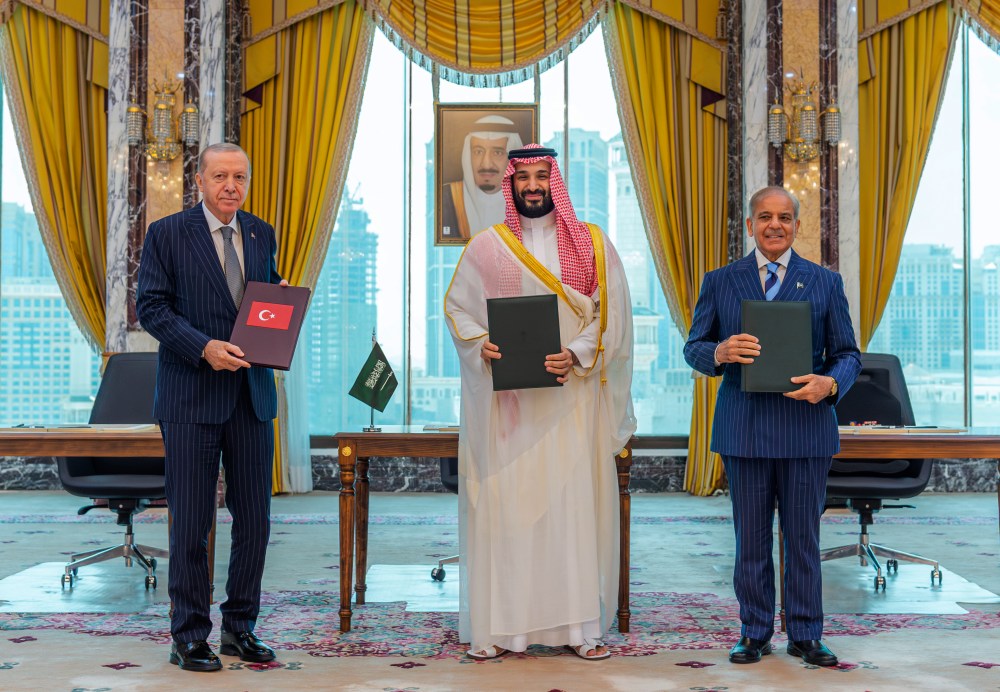
In an interview with Turkey’s state-run Anadolu Agency, Turkey’s Foreign Minister Hakan Fidan insisted that the three countries do not view any particular state as an adversary unless they take hostile action against them.
“We don’t have anything written down — nothing we’ve signed — that defines a common threat,” Fidan said. “Any country that does not attack us is not a target for us.”
The Turkish minister described the agreement’s clause on mutual defense as being “technically the same” as NATO’s Article 5, under which an attack on one of the 32 members is considered an attack on them all.
Asked how the mechanism would work, Fidan said a member would need to formally request help and that the other two countries’ assistance could range from intelligence sharing to logistic support — or the deployment of military units depending on the threat.
“These are multi‑layered matters that vary according to the scale of the threat,” Fidan said. “This is the perspective we have set out so far in our work.”
The Turkish minister said other nations — which he did not name — have expressed interest in joining the agreement, adding that he expects Egypt, which he described as a “natural partner,” to participate “at the next stage.”
Under the deal, the foreign and defense ministers of the three countries, along with their military chiefs, would hold regular committee meetings. The three countries would also establish a secretariat, to be based in Saudi Arabia, Fidan said.