

Morocco beefs up security at Ceuta and Melilla borders after online calls for new crossings
Advertisement
Read this article for free:
or
Already have an account? Log in here »
To continue reading, please subscribe:

Digital Subscription
One year of digital access for only $205*
- Enjoy unlimited reading on winnipegfreepress.com
- Read the E-Edition, our digital replica newspaper
- Access News Break, our award-winning app
- Play interactive puzzles
*First annual payment billed as $205.00 + GST for one year. This annual subscription will automatically renew at $233.00 + GST every 52 weeks (10% off the regular annual price of $259.35). Offer available to new and qualified returning subscribers only. Cancel any time.
To continue reading, please subscribe:
Add Free Press access to your Brandon Sun subscription for only an additional
$1 for the first 4 weeks*
- Enjoy unlimited reading on winnipegfreepress.com
- Read the E-Edition, our digital replica newspaper
- Access News Break, our award-winning app
- Play interactive puzzles
*Your next Brandon Sun subscription payment will increase by $1.00 and you will be charged $17.95 plus GST for four weeks. After four weeks, your payment will increase to $24.95 plus GST every four weeks.
Read unlimited articles for free today:
or
Already have an account? Log in here »
CASABLANCA, Morocco (AP) — Morocco said Wednesday it has beefed up security along its border with Spain as calls resurfaced on social media for mass crossings into the Spanish city of Ceuta, raising concerns of another surge, similar to the one last month when tens of thousands of migrants rushed the border.
Spain’s Civil Guard insisted that the border will remain closed and Defense Minister Margarita Robles warned against any new attempt at a mass entry into Spain’s North African exclaves.
Messages are circulating in Moroccan social media groups for a new rush on Ceuta’s border on Saturday. The source of the messages is unclear.
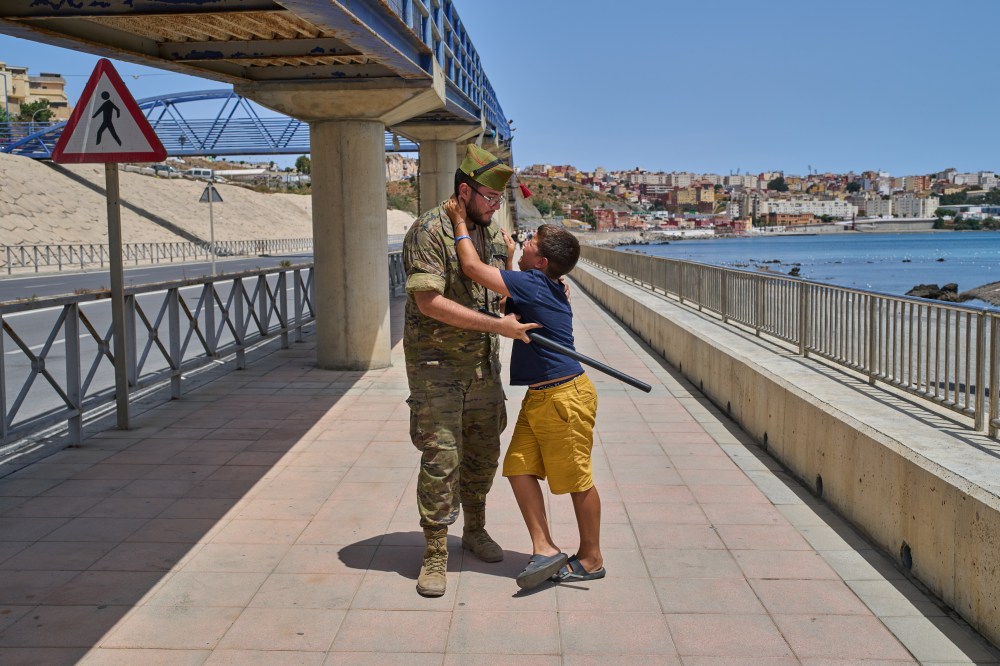
In late July, some 72,000 migrants swam or climbed over the border breakwater to reach the Spanish city, fueled by economic hardship and by false rumors circulating online about an open border. Nearly all have since returned to Morocco, but the surge had political repercussions around Europe.
At least 80 people died in the attempt, according to official tallies. Human rights groups have reported higher figures.
Would-be migrants are now also being urged to cross into Melilla, another Spanish autonomous city on the northern coast of Africa. Together, Ceuta and Melilla form the European Union’s only land borders with Africa.
The Moroccan Interior Ministry said in Wednesday’s statement that “all necessary measures have been taken to counter” any new “illegal crossing attempt.” It said the security monitoring is part of a “system of continuous vigilance — particularly in areas near the Ceuta and Melilla crossings.”
The Interior Ministry did not immediately respond to questions about the number of personnel deployed or the equipment being used.
Videos shared on social media show hundreds of police officers in riot gear deployed on the Moroccan side of the border, alongside water cannons and ambulances. Local news site Hespress said equipment for deploying tear gas and stun grenades had also been brought to the border.
A senior Moroccan diplomat previously said that more than 20,000 Moroccan security personnel are deployed along the border with Ceuta each day, at a cost of hundreds of millions of dollars. The diplomat was not authorized to speak to the media and spoke on condition of anonymity.
The Interior Ministry also said Moroccan authorities had arrested and were investigating “a group of people suspected of carrying out incitement activities.” It did not elaborate.
Robles, visiting Ceuta, said it was “everyone’s responsibility to deal with those who are directing these movements, including through social media,” and called “any aggression against Ceuta or Melilla … an aggression against Spain as a whole.”
“This must be absolutely clear: what happened cannot happen again,” she said.
Spain’s Civil Guard shared a message on social media seemingly aimed at migrants, in French and Spanish.
“Neither the border with Spain is open; nor will it be. There are new containment barriers. If you cross them, you will be returned. Don’t let yourself be deceived,” it said.
The Instagram post was accompanied by a photo of a containment barrier in Ceuta that was constructed in the immediate aftermath of the July 31 border breach.
___
Associated Press writer Suman Naishadham in Medinaceli, Spain, contributed to this report.