

Russia summons Japanese envoy following Putin’s visit to disputed islands
Advertisement
Read this article for free:
or
Already have an account? Log in here »
To continue reading, please subscribe:

Digital Subscription
One year of digital access for only $205*
- Enjoy unlimited reading on winnipegfreepress.com
- Read the E-Edition, our digital replica newspaper
- Access News Break, our award-winning app
- Play interactive puzzles
*First annual payment billed as $205.00 + GST for one year. This annual subscription will automatically renew at $233.00 + GST every 52 weeks (10% off the regular annual price of $259.35). Offer available to new and qualified returning subscribers only. Cancel any time.
To continue reading, please subscribe:
Add Free Press access to your Brandon Sun subscription for only an additional
$1 for the first 4 weeks*
- Enjoy unlimited reading on winnipegfreepress.com
- Read the E-Edition, our digital replica newspaper
- Access News Break, our award-winning app
- Play interactive puzzles
*Your next Brandon Sun subscription payment will increase by $1.00 and you will be charged $17.95 plus GST for four weeks. After four weeks, your payment will increase to $24.95 plus GST every four weeks.
Read unlimited articles for free today:
or
Already have an account? Log in here »
MOSCOW (AP) — Russia’s Foreign Ministry on Tuesday summoned the Japanese ambassador to protest Tokyo’s condemnation of President Vladimir Putin’s trip to the Kuril Islands, the Moscow-controlled Pacific archipelago that is claimed by both countries.
Last week, Putin visited Iturup, one of the four southernmost islands of the chain, which Japan calls the Northern Territories. The Soviet Union took them from Japan in the final days of World War II, and the dispute has kept the countries from signing a peace treaty formally ending their hostilities.
Japan’s Prime Minister Sanae Takaichi said Putin’s visit, his first to the islands, was “incompatible with the Japanese position on the Northern Territories” and was “absolutely unacceptable.” She said the visit was a further blow to already-strained ties between the two countries over Ukraine, and that Moscow should understand the consequences.
Japanese Foreign Minister Toshimitsu Motegi said Tokyo “strongly protests” Putin’s visit to Iturup, which Japan calls Etorofu, noting that “the Northern Territories, including Etorofu Island, are Japan’s inherent territory both historically and from the perspective of international law.”
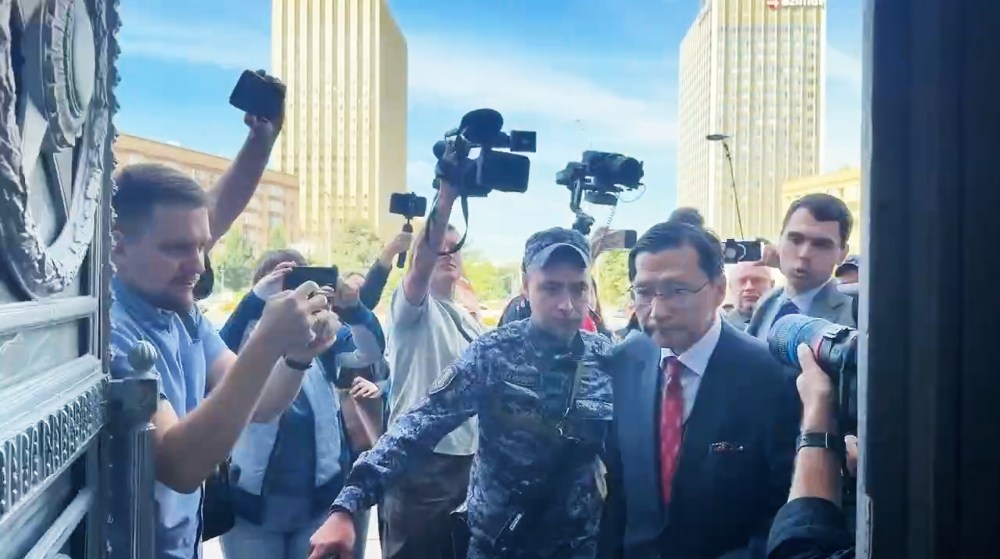
On Tuesday, Russia’s Deputy Foreign Minister Mikhail Galuzin met with Japanese Ambassador Akira Muto to lodge a formal protest over the “anti-Russia” statements by Takaichi and Motegi.
“Russia’s sovereignty and jurisdiction over the southern Kuril Islands are absolutely unshakable,” Galuzin told Muto, according to the Foreign Ministry.
“These territories passed to our country as a result of World War II that was enshrined in the relevant agreements of the Allied Powers and the U.N. Charter,” the ministry said. “Any attempts by the Japanese side to directly or indirectly call this obvious reality into question are absolutely unacceptable and unlawful.”
Galuzin told the ambassador that in view of Tokyo’s adherence to Western sanctions against Russia and its support for Ukraine, “Moscow reserves the right to take appropriate countermeasures.”
The Japanese Embassy said in a statement that Muto, during his approximately 20-minute meeting with Galuzin, “appropriately explained the Japanese position on the Northern Territories and President Putin’s recent visit.”
It gave no other details, including how Muto responded to Galuzin’s comment on Russia’s territorial claim of the islands or if Japan is considering taking a retaliatory step, citing the sensitivity of the issue.
Decades of diplomatic efforts to negotiate a settlement haven’t produced any visible results. Moscow over the years has also bolstered its military presence on the Kurils in moves that appeared to underscore its firm stance in the dispute.
Speaking last week aboard a Russian warship taking part in the drills in the Pacific, Putin said Moscow previously “had developed constructive relations with a number of Japanese leaders, including the tragically deceased former Prime Minister Shinzo Abe, who did much to bring Japan and Russia closer together, to align our positions.”
Japan imposed sanctions on Russia after it sent troops into Ukraine in February 2022 and “listed Russia as a source of primary threats,” a change in that constructive relationship, he added.
Russia remains ready “to cooperate with all its neighbors, including Japan and other states in the region,” Putin said.