

Kazakhstan’s pro-government party wins parliamentary election, boosting president’s grip on power
Advertisement
Read this article for free:
or
Already have an account? Log in here »
To continue reading, please subscribe:

Digital Subscription
One year of digital access for only $205*
- Enjoy unlimited reading on winnipegfreepress.com
- Read the E-Edition, our digital replica newspaper
- Access News Break, our award-winning app
- Play interactive puzzles
*First annual payment billed as $205.00 + GST for one year. This annual subscription will automatically renew at $233.00 + GST every 52 weeks (10% off the regular annual price of $259.35). Offer available to new and qualified returning subscribers only. Cancel any time.
To continue reading, please subscribe:
Add Free Press access to your Brandon Sun subscription for only an additional
$1 for the first 4 weeks*
- Enjoy unlimited reading on winnipegfreepress.com
- Read the E-Edition, our digital replica newspaper
- Access News Break, our award-winning app
- Play interactive puzzles
*Your next Brandon Sun subscription payment will increase by $1.00 and you will be charged $17.95 plus GST for four weeks. After four weeks, your payment will increase to $24.95 plus GST every four weeks.
Read unlimited articles for free today:
or
Already have an account? Log in here »
Kazakhstan’s pro-government Adilet Party won a landslide victory in a parliamentary election, officials announced Monday, a result expected to further strengthen President Kassym-Jomart Tokayev’s grip on power in Central Asia’s largest nation.
Adilet, which is led by the former head of Tokayev’s presidential administration, won 71% of Sunday’s vote, Kazakhstan’s central electoral commission said, according to preliminary results.
The second-place Auyl Party won 6.26% of the vote, with three other parties – the Nationwide Social Democratic Party, Respublica and Aq Jol – reaching the 5% threshold needed to win a place in parliament.
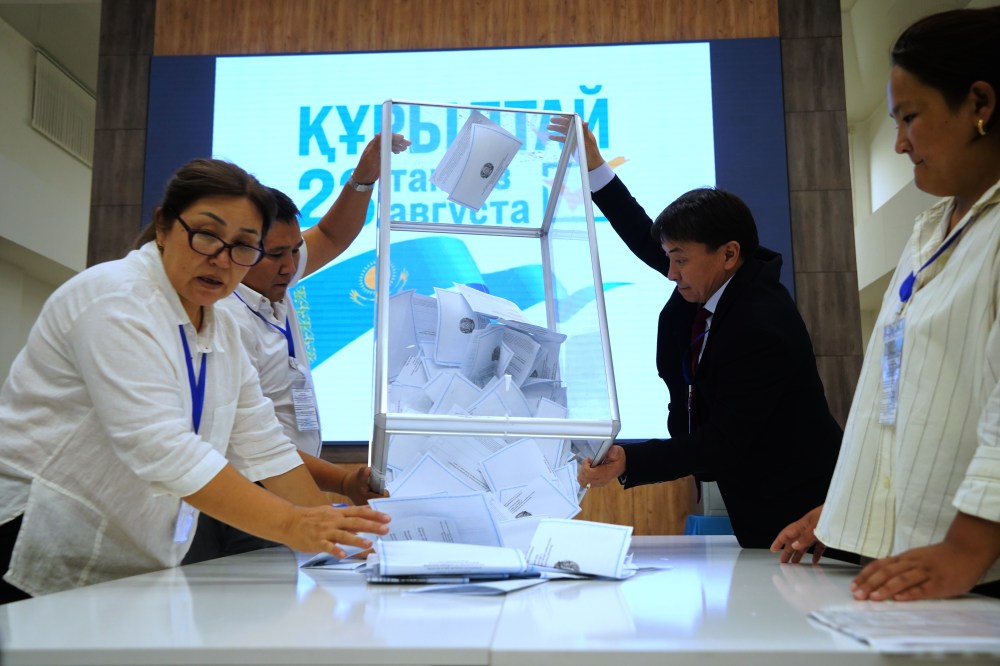
Election monitors for the Organization for Security and Cooperation in Europe said the vote was marred by a lack of distinct political opposition, with “all contesting parties supporting the incumbent president’s policies.”
Some 74% of the country’s 12.6 million eligible voters took part in the election, the central electoral commission said. Officials tried to boost turnout by having some voters travel to the polls by parachutes and hot air balloons.
The election was the first to choose lawmakers for the new single-chamber parliament, known as the Kurultai. It is the culmination of a constitutional overhaul initiated by Tokayev in March, when 87% of voters supported a referendum to merge the two chambers of parliament.
The vote also gave the president authority to appoint key officials, subject to lawmakers’ approval.
Last month, Kazakhstan’s Constitutional Court ruled that the amendments effectively reset the clock on Tokayev’s previous terms in office, clearing the way for him to seek another seven-year term when his mandate expires in 2029.
The decision echoes those seen in several former Soviet republics, including Russia, Belarus, Uzbekistan and Tajikistan, where leaders have used new or amended constitutions to revise statutory term limits.
The 73-year-old Tokayev, a former Soviet official and Kazakh diplomat who previously worked at the United Nations, has been in office since 2019.
He has sought to maintain a balance between Moscow and the West since sanctions were imposed on Russia over the war in Ukraine. Tokayev has justified the constitutional changes by citing the need for rapid decision-making in a fast-changing world.
The election comes at a difficult economic moment for Kazakhstan, where inflation hit 10.2% in February and tax increases have fueled public discontent.
Analysts say the economic strain has made authorities wary of a repeat of the unrest of January 2022, when fuel price protests spiraled into violence that left dozens of protesters and police officers dead — a scenario Tokayev is seeking to guard against by concentrating power in his own hands.
The vote also took place against a backdrop of intensifying crackdowns on press freedom. Media organizations have urged Tokayev to drop criminal charges against several journalists under house arrest and to revise legislation to ensure freedom of speech. Authorities have opened roughly 10 criminal cases against independent journalists and popular bloggers.