

Migrant boat found adrift near Spain’s Canary Islands with 5 dead and dozens missing
Advertisement
Read this article for free:
or
Already have an account? Log in here »
To continue reading, please subscribe:
Digital Subscription
One year of digital access for only $1.44 a week*
- Enjoy unlimited reading on winnipegfreepress.com
- Read the E-Edition, our digital replica newspaper
- Access News Break, our award-winning app
- Play interactive puzzles
*Billed as $5.77 plus GST every four weeks. After 52 weeks, price increases to the regular rate of $19.95 plus GST every four weeks. Offer available to new and qualified returning subscribers only. Cancel any time.
To continue reading, please subscribe:
Add Free Press access to your Brandon Sun subscription for only an additional
$1 for the first 4 weeks*
- Enjoy unlimited reading on winnipegfreepress.com
- Read the E-Edition, our digital replica newspaper
- Access News Break, our award-winning app
- Play interactive puzzles
*Your next Brandon Sun subscription payment will increase by $1.00 and you will be charged $17.95 plus GST for four weeks. After four weeks, your payment will increase to $24.95 plus GST every four weeks.
Read unlimited articles for free today:
or
Already have an account? Log in here »
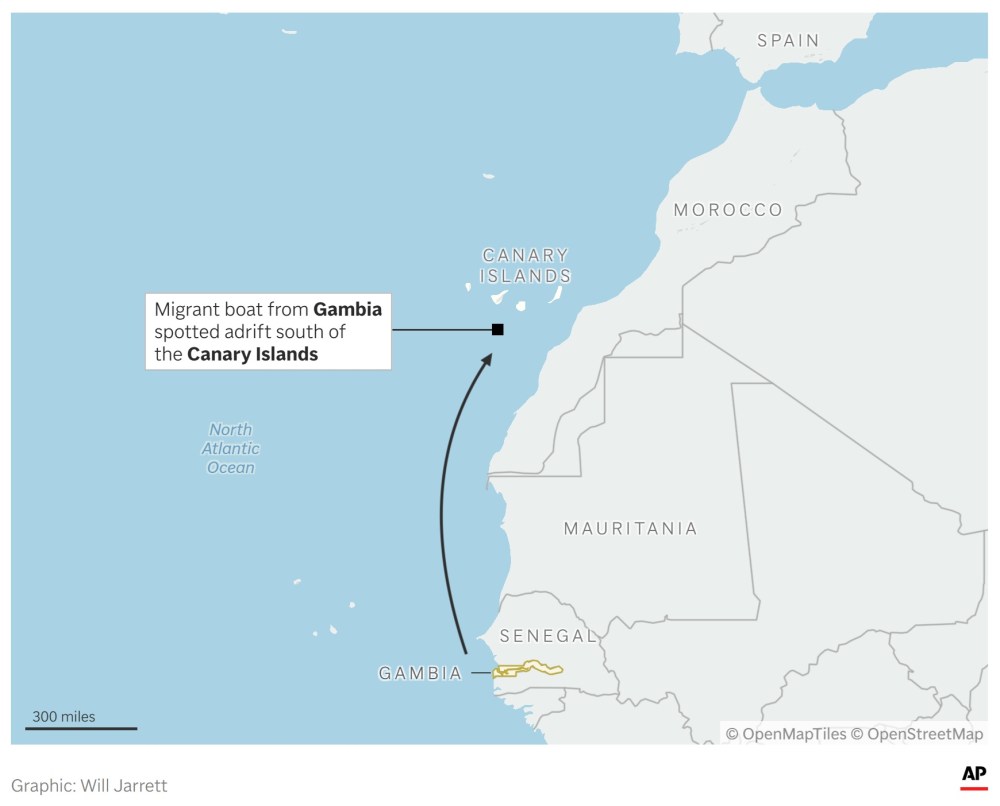
BARCELONA, Spain (AP) — A boat carrying West African migrants went adrift in the Atlantic Ocean and left at least five people dead and dozens more feared dead before the vessel was spotted and assisted, Spanish rescuers said Thursday. Forty-four people were brought to safety in the Canary Islands.
Spain’s Maritime Rescue Service said Thursday that one of its planes had spotted a “precarious” boat drifting about 120 kilometers (70 miles) south of the island of Gran Canaria on Wednesday afternoon.
Three survivors were evacuated by helicopter to a hospital on the island. The remaining 41 migrants were brought to safety by boat and disembarked early Thursday in the port of Arguineguín, where they were being cared for by the Red Cross.
All of the survivors were men, some underage, and came from Mali or Senegal, said José Antonio Rodríguez Verona, a spokesperson for the Red Cross in the Canaries.
The survivors were disoriented and dehydrated, with many collapsing or vomiting upon reaching land, Rodríguez Verona told The Associated Press. While it was difficult to get precise information given their fragile state of health, migrants reported leaving Gambia and being stranded at sea for “many, many days.” Some estimated they had been at sea for nearly a month. Running out of provisions, they fell ill from drinking seawater.
The survivors also told the Red Cross that more than 100 people were originally on board, including women and a baby. As people died on the journey, survivors tossed their bodies in the ocean until they had no more strength to do so.
Spain’s Maritime Rescue Service said in a statement that it was not able to retrieve the remains of the five dead found inside the boat due to strong winds and waves that were 2.5 meters (8 feet) high.
Helena Maleno, founder of the migrant rights group Walking Borders, which monitors deaths and disappearances on migration routes to Spain, said that 83 people had died on the voyage, including three women and a baby. In a post on X, Maleno said the boat had departed Gambia 27 days ago.
Maleno and her NGO are frequently contacted by relatives of missing migrants and often relay calls for help and rescue to Spanish authorities.
Maleno and Walking Borders did not immediately respond to requests for comment.
The West African Atlantic route to Spain’s Canary Islands is one of the deadliest crossings to Europe. While arrivals to the Spanish archipelago have fallen significantly in the past year, tens of thousands of people have died or gone missing in recent years, with several migrant boats getting lost and drifting all the way across the Atlantic to the Americas.
Madi Jobarteh, director of the Gambia-based Edward Francis Small Centre for Rights and Justice, said limited opportunities are a major driver of irregular migration.
“With a huge young population, most of whom are not in education, employment or training, the tendency to migrate is high,” Jobarteh said.
Efforts to curb irregular migration will fail without better economic conditions, he said, noting that many educated and skilled West Africans also leave in search of jobs, healthcare, education and basic services.
Gambia’s information minister, Ismaila Ceesay, declined to comment on the dead and missing migrants. A spokesperson for Gambia’s Immigration Department did not respond to a request for comment.
___
Abdoulie John in Serrekunda, Gambia, contributed.