

Serbia’s ruling populists propose President Vucic switch to prime minister after election
Advertisement
Read this article for free:
or
Already have an account? Log in here »
To continue reading, please subscribe:

Digital Subscription
One year of digital access for only $205*
- Enjoy unlimited reading on winnipegfreepress.com
- Read the E-Edition, our digital replica newspaper
- Access News Break, our award-winning app
- Play interactive puzzles
*First annual payment billed as $205.00 + GST for one year. This annual subscription will automatically renew at $233.00 + GST every 52 weeks (10% off the regular annual price of $259.35). Offer available to new and qualified returning subscribers only. Cancel any time.
To continue reading, please subscribe:
Add Free Press access to your Brandon Sun subscription for only an additional
$1 for the first 4 weeks*
- Enjoy unlimited reading on winnipegfreepress.com
- Read the E-Edition, our digital replica newspaper
- Access News Break, our award-winning app
- Play interactive puzzles
*Your next Brandon Sun subscription payment will increase by $1.00 and you will be charged $17.95 plus GST for four weeks. After four weeks, your payment will increase to $24.95 plus GST every four weeks.
Read unlimited articles for free today:
or
Already have an account? Log in here »
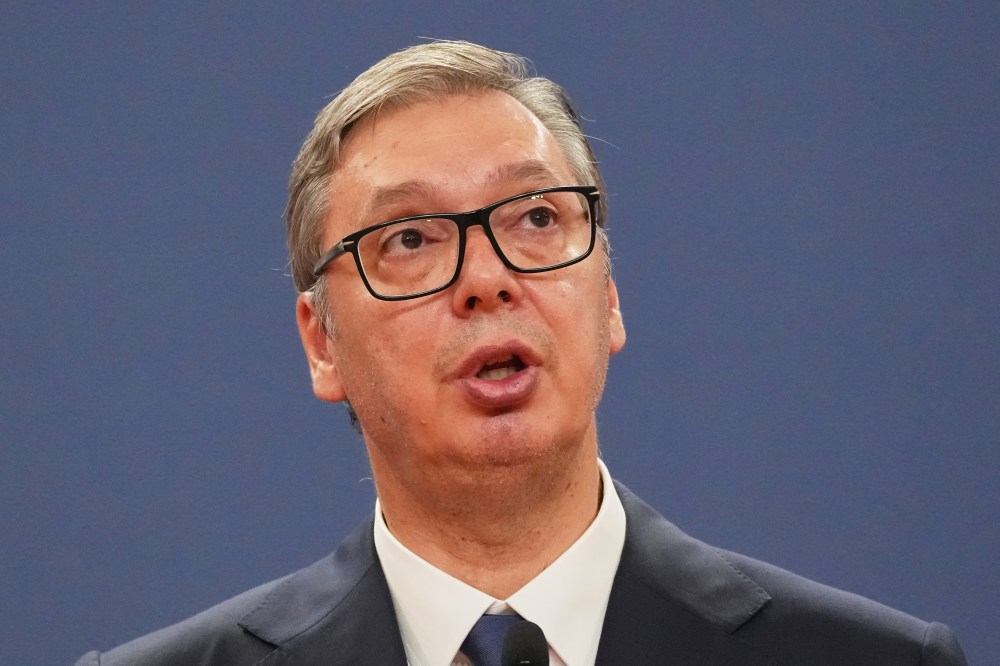
BELGRADE, Serbia (AP) — Serbia ’s governing party on Saturday formally proposed that President Aleksandar Vucic become prime minister if they win an upcoming early parliamentary election that is seen as a major test for the populists after more than a year of street protests.
Vucic is yet to formally dissolve Parliament and call the ballot that is expected to be held on Oct. 25.
Voting will be held nearly two years after a train station canopy collapse in northern Serbia killed 16 people, triggering youth-led demonstrations that blamed government corruption and incompetence for the tragedy. The election will take place in an atmosphere of heightened political tensions as the populists seek to retain power despite widespread popular discontent.
Scores of anti-government protesters on Saturday marched in the city of Nis while Vucic’s party held their meeting there. Police surrounded the National Theater building to prevent the protesters from reaching the meeting venue.
Vucic told party officials that he will call the vote in the coming days. He said he will then resign the presidency so he could officially join the campaign. The presidential election will be held later, he said.
More than a year of demonstrations, sometimes drawing hundreds of thousands of people, shook Vucic more than ever during his 14 years in power. The protesters demanded accountability for the Nov. 1, 2024, concrete canopy collapse in Novi Sad and an end to corruption they believed was the cause for bad renovation work.
Vucic has pushed hard against the protesters as the government faced international criticism over police violence and arbitrary detentions of demonstrators. He has repeatedly accused without evidence the Serbian university students and professors behind the protests of an intention to “destroy the state.”
The Serbian president reiterated such claims on Saturday, alleging that the protests have been orchestrated by unspecified foreign powers. “This evil,” Vucic said, “is not coming from the inside, it is coming from the outside.”
The SNS party will face a student-backed election list that is expected to include university professors and experts, though their names have not been made public. Also in the race will be both right-wing and center-left opposition parties, and several smaller groups.
A group of university students said earlier this week they were among at least 14 people targeted with spyware earlier this year in what the Serbian Share Foundation group described as the biggest such incident so far. Vucic’s authorities have dismissed the reports.
Serbia is formally seeking European Union entry but the effort has been stalled under Vucic due to democratic backsliding, including election irregularities in previous votes. Vucic has refused to join EU sanctions against Russia over its invasion of Ukraine and has maintained close relations with China.