

AfD party’s landslide win in eastern Germany tests country’s ‘firewall’ against the far right
Advertisement
Read this article for free:
or
Already have an account? Log in here »
To continue reading, please subscribe:
Digital Subscription
One year of digital access for only $1.44 a week*
- Enjoy unlimited reading on winnipegfreepress.com
- Read the E-Edition, our digital replica newspaper
- Access News Break, our award-winning app
- Play interactive puzzles
*Billed as $5.77 plus GST every four weeks. After 52 weeks, price increases to the regular rate of $19.95 plus GST every four weeks. Offer available to new and qualified returning subscribers only. Cancel any time.
To continue reading, please subscribe:
Add Free Press access to your Brandon Sun subscription for only an additional
$1 for the first 4 weeks*
- Enjoy unlimited reading on winnipegfreepress.com
- Read the E-Edition, our digital replica newspaper
- Access News Break, our award-winning app
- Play interactive puzzles
*Your next Brandon Sun subscription payment will increase by $1.00 and you will be charged $17.95 plus GST for four weeks. After four weeks, your payment will increase to $24.95 plus GST every four weeks.
Read unlimited articles for free today:
or
Already have an account? Log in here »
BERLIN (AP) — Alternative for Germany, or AfD, has established itself as a significant political force in the 13 years since its founding, but it has never been part of any state or federal government. That’s a result of what is often called a “firewall” against cooperation with the anti-immigrant, far-right party.
That firewall faces its biggest test after AfD won a landslide victory in Sunday’s election in the eastern German state of Saxony-Anhalt.
Germany’s mainstream parties have long said they would not work with Alternative for Germany, which is classified by Germany’s domestic intelligence agency as an extremist group in some regions of the country — including the eastern state of Saxony-Anhalt. Any dealing by mainstream parties with AfD is particularly sensitive in view of Germany’s Nazi past.
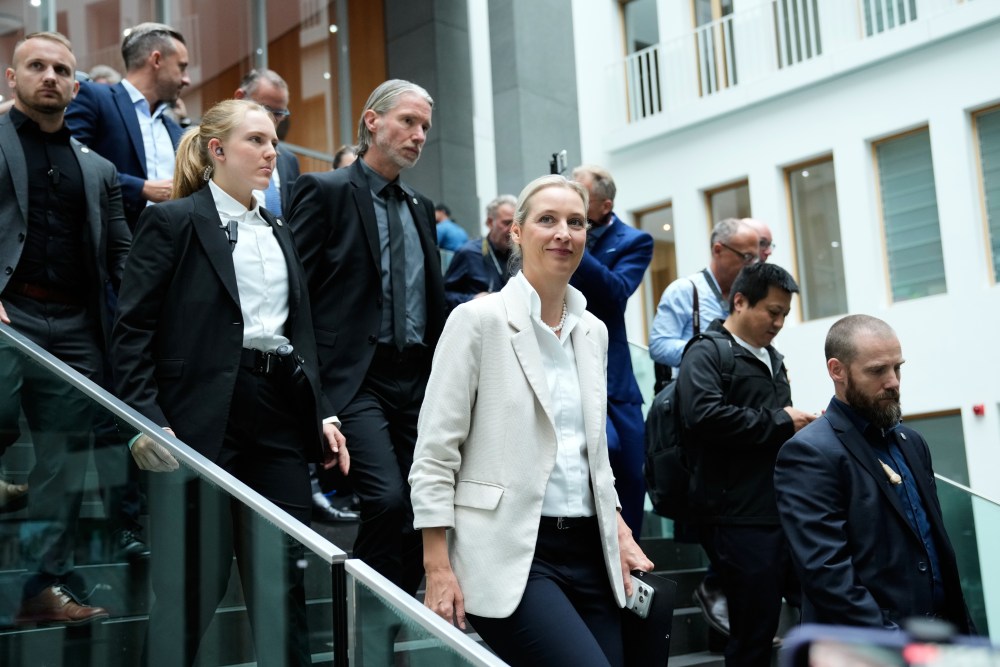
Many Germans had believed their country had developed an immunity to nationalism and assertions of racial superiority after confronting the horrors of its Nazi past through education and laws to outlaw persecution.
But as it turns out, that conviction was mistaken, and similar to voters across Europe and elsewhere, voters in Germany are increasingly empowering the extreme far-right party.
AfD has rejected any accusations of being undemocratic or even anti-constitutional and has repeatedly pushed back against the firewall.
The firewall taboo has sometimes forced other parties into unusual alliances to keep AfD out of power — for instance, a three-party coalition straddling ideological divisions that governs the eastern state of Thuringia since AfD emerged as the strongest party for the first time in a regional election there two years ago.
In Germany’s national election last year, AfD achieved the best showing by a far-right party since World War II and became the strongest political force in parts of the country. AfD became the biggest opposition party in parliament after Chancellor Friedrich Merz’s center-right Christian Democrats upheld the firewall and formed an unpopular coalition with the center-left Social Democrats.
The firewall could crack after AfD’s latest victory
AfD won 43.8% of the vote in Sunday’s election, more than double its showing five years ago in the state, while Merz’s party lost about half its support.
Merz has strictly rejected any kind of cooperation with AfD in the past and top officials reiterated that stance on Sunday. But other parties in the newly elected state parliament may be less likely to keep up the firewall.
The AfD candidate for governor, Ulrich Siegmund, aims to become the first far-right head of a state government and has already said he will reach out to all other parties and individual lawmakers to assemble a governing majority.
While Siegmund has rejected an AfD minority government, his party could possibly govern with the hard-left BSW party, which received 5.3% of the vote. The two parties share a Russia-friendly course and oppose immigration but do not agree on some other subjects.
BSW could help AfD run Germany’s first far-right state government since World War II
On Monday, BSW’s lead candidate in the election, Thomas Schulze, expressed his party’s willingness to help an AfD governor take office in the state parliament.
Forming a government that excludes the AfD would only be possible if all the other parties that were elected worked together — CDU, Social Democrats, the Greens, the Left Party, and the BSW. However, a coalition involving five partners would be extremely unusual, very complicated and prone to instability.
It’s also possible that newly elected lawmakers from other parties could defect to AfD — it would only need three people to get a majority to govern.
Political analyst Volker Resing said AfD may be able to overcome the firewall after its strong showing in Saxony-Anhalt, with BSW potentially serving as the kingmaker.
“This tiny party could now play a decisive role in determining the future of Saxony-Anhalt,” he told The Associated Press.
Resing said “it is still unclear” whether the parties will join forces based on their common view toward Russia to overcome the firewall and succeed in forming Germany’s first far-right state government since the end of the Nazi era.