

EU leaders condemn Serbia’s funeral honors for Ratko Mladic, raising doubts over membership bid
Advertisement
Read this article for free:
or
Already have an account? Log in here »
To continue reading, please subscribe:

Digital Subscription
One year of digital access for only $205*
- Enjoy unlimited reading on winnipegfreepress.com
- Read the E-Edition, our digital replica newspaper
- Access News Break, our award-winning app
- Play interactive puzzles
*First annual payment billed as $205.00 + GST for one year. This annual subscription will automatically renew at $233.00 + GST every 52 weeks (10% off the regular annual price of $259.35). Offer available to new and qualified returning subscribers only. Cancel any time.
To continue reading, please subscribe:
Add Free Press access to your Brandon Sun subscription for only an additional
$1 for the first 4 weeks*
- Enjoy unlimited reading on winnipegfreepress.com
- Read the E-Edition, our digital replica newspaper
- Access News Break, our award-winning app
- Play interactive puzzles
*Your next Brandon Sun subscription payment will increase by $1.00 and you will be charged $17.95 plus GST for four weeks. After four weeks, your payment will increase to $24.95 plus GST every four weeks.
Read unlimited articles for free today:
or
Already have an account? Log in here »
BRUSSELS (AP) — Top European Union officials on Tuesday expressed shock after Serbia gave a hero’s funeral to Ratko Mladic, a Bosnian Serb general who died while serving a life sentence for war crimes, and questioned Serbia’s fitness to join their bloc.
Mladic was buried in Belgrade on Monday with military honors. The head of the Serbian Orthodox Church, Patriarch Porfirije, led the funeral service and Serbian army soldiers carried Mladic’s flag-draped coffin at the cemetery.
Several Serbian government ministers attended the service for the man known as the “Butcher of Bosnia” and found guilty of committing the continent’s first genocide since World War II. Mladic is still considered a hero by many Serbs.
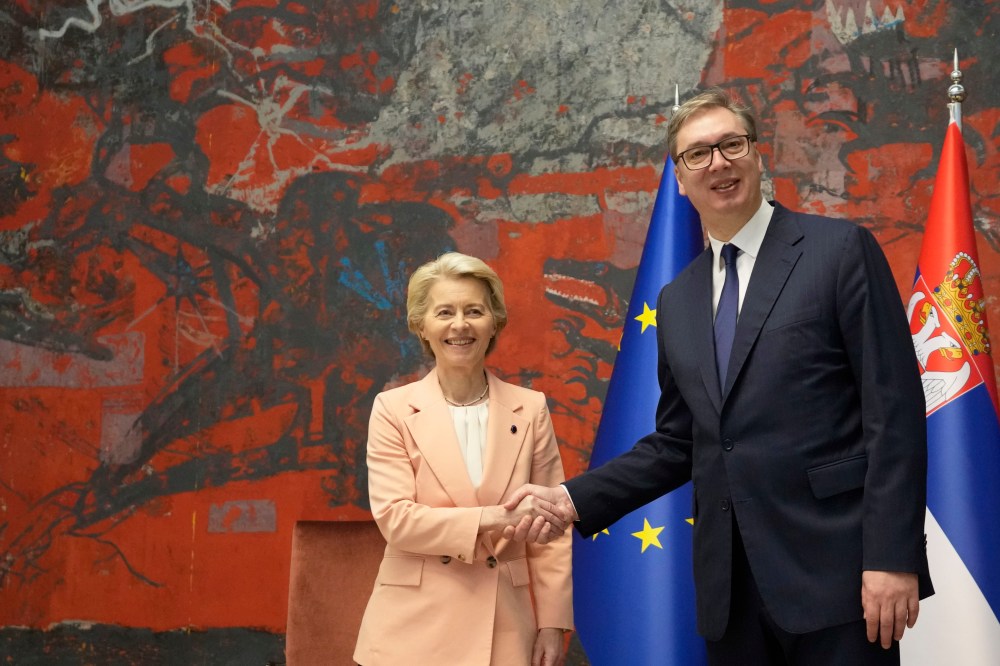
“The images from Ratko Mladic’s funeral yesterday in Belgrade were shocking,” European Commission President Ursula von der Leyen and European Council President Antonio Costa said in posts on social media.
“The elements of official support and the presence of some senior Serbian officials at the funeral are deeply regrettable,” von der Leyen and Costa said. “They demonstrate a failure to confront a dark chapter in Europe’s recent history and contradict the values underpinning Serbia’s path towards the European Union.”
Serbian officials play down the funeral’s significance
Populist President Aleksandar Vucic did not go to the funeral but his son, Danilo, did. Bosnian Serb nationalist leader Milorad Dodik and the Russian ambassador in Serbia, Alexander Botsan-Kharchenko, were among those present.
Vucic, a former extreme nationalist who supported Serbia’s expansionist policies during the wars that tore Yugoslavia apart in the 1990s, described the funeral as an “emotional outpouring.”
Serbia’s Justice Minister Nenad Vujic attended and stood with Mladic’s family. He said the authorities helped keep order at the funeral to make sure it passed in a “dignified” manner but that the family was in charge.
Vucic has been walking a political tightrope. He’s trying to rally supporters — many of them Mladic admirers — ahead of an early parliamentary election that could be held in late October without alienating the EU, which Serbia says it wants to join.
The funeral was a test for Serbia’s EU membership
Last week, EU Enlargement Commissioner Marta Kos warned that the funeral would be “a test” for Belgrade. She canceled an upcoming visit to Serbia, arguing that “the glorification” of Mladic’s death would be incompatible with EU values.
The EU traditionally hands down its annual enlargement report in late October or early November, laying out the progress that each of the candidate countries, including Serbia, is making toward membership and highlighting deficiencies.
Von der Leyen is scheduled to tour the Western Balkans region just before the report is published. She usually visits each country, but no dates have been set for the visit, nor has any agenda been made public.
Asked what the consequences might be for Serbia’s EU membership, von der Leyen’s spokesperson said only: “we are looking into it.”
Mladic’s funeral is unlikely to help Serbia’s cause. Its membership prospects were already damaged over democratic backsliding. In April, Kos warned Belgrade that it could lose access to around 1.5 billion euros ($1.8 billion) in EU funds as concern mounted about municipal election irregularities.
EU politics will also play a role
In Serbia’s favor, Vucic’s nationalist-populist SNS party has close ties to the EU’s biggest political grouping, the European People’s Party, which unites center-right political parties from across Europe. The EPP has been accused of protecting Vucic.
“It is high time for the EPP to stop acting as a safe haven for the SNS party, which openly celebrates convicted war criminals and rolls out the red carpet for the ‘Butcher of Bosnia’,” Slovenian Green member of the European Parliament Vladimir Prebilic said last week.
Von der Leyen is a senior member of the EPP, as are half of her team of policy commissioners and European Parliament President Roberta Metsola. Von der Leyen in particular has refrained from criticizing Vucic publicly.
For many years, the EPP staunchly supported former Hungarian Prime Minister Viktor Orbán’s stridently nationalist Fidesz party, hoping to keep him within Europe’s political mainstream. But the EPP eventually suspended Fidesz in 2019 over concerns about democracy and the rule of law in Hungary. Fidesz quit the group in 2021.
___
AP writer Jovana Gec in Belgrade, Serbia, contributed to this report.