

North Korea says its recent live-fire drill demonstrated ‘huge destructive power’
Advertisement
Read this article for free:
or
Already have an account? Log in here »
To continue reading, please subscribe:

Digital Subscription
One year of digital access for only $205*
- Enjoy unlimited reading on winnipegfreepress.com
- Read the E-Edition, our digital replica newspaper
- Access News Break, our award-winning app
- Play interactive puzzles
*First annual payment billed as $205.00 + GST for one year. This annual subscription will automatically renew at $233.00 + GST every 52 weeks (10% off the regular annual price of $259.35). Offer available to new and qualified returning subscribers only. Cancel any time.
To continue reading, please subscribe:
Add Free Press access to your Brandon Sun subscription for only an additional
$1 for the first 4 weeks*
- Enjoy unlimited reading on winnipegfreepress.com
- Read the E-Edition, our digital replica newspaper
- Access News Break, our award-winning app
- Play interactive puzzles
*Your next Brandon Sun subscription payment will increase by $1.00 and you will be charged $17.95 plus GST for four weeks. After four weeks, your payment will increase to $24.95 plus GST every four weeks.
Read unlimited articles for free today:
or
Already have an account? Log in here »
SEOUL, South Korea (AP) — North Korea said Monday it conducted a joint live-fire drill involving missiles, artillery and drones that it claimed demonstrated “huge destructive power.”
The test included firing different types of weapons simultaneously, likely aiming at developing the ability to overwhelm South Korean and U.S. air defenses.
Experts say North Korea is not slowing its testing activities even after U.S. President Donald Trump recently scaled back a military exercise with South Korea in an apparent effort to revive diplomacy with leader Kim Jong Un.
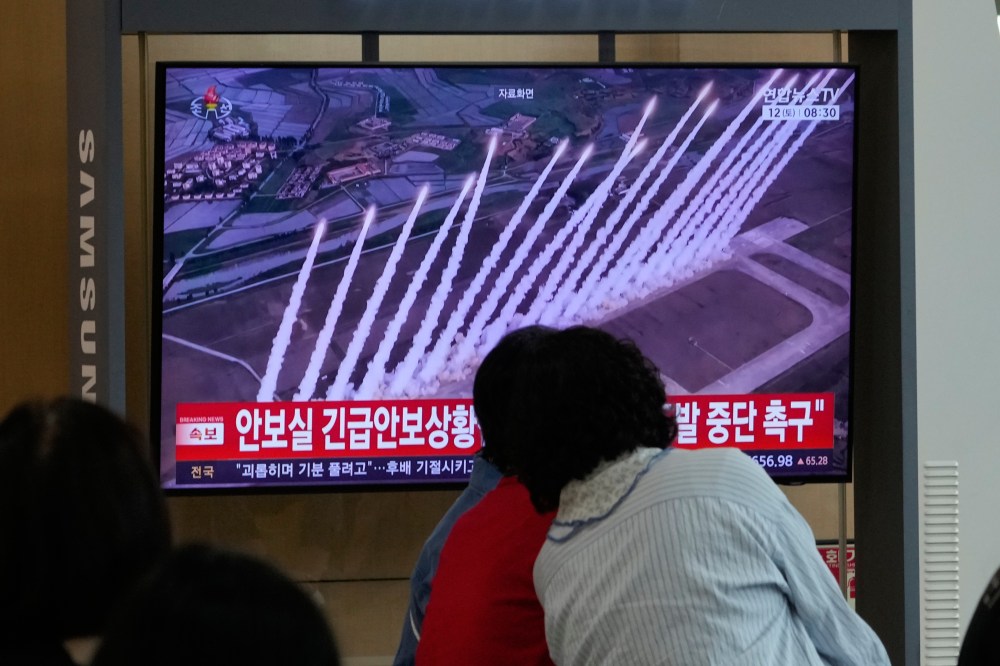
The North’s official Korean Central News Agency said Saturday’s drill was meant to practice the operations of an integrated weapons control system. South Korea’s military earlier said it detected short-range ballistic missile launches from North Korea’s eastern coastal Wonsan area on Saturday morning.
After observing the firing drill, North Korean Marshal Pak Jong Chon said the drill would “improve the level of specialization to bring down the enemy’s armed forces organizationally and structurally once an order is issued.” He added that the weapons systems mobilized demonstrated “the huge destructive power of concentrated fire,” according to KCNA.
It’s extremely difficult to independently verify North Korean claims on its weapons tests. South Korea’s Joint Chiefs of Staff said several missiles fired Saturday each flew about 250 kilometers (155 miles) toward North Korea’s eastern waters. The flight distances signal that the weapons are designed to strike targets in South Korea including U.S. military bases.
The firing drill, which included North Korea’s first public ballistic missile launches in about three weeks, came a day after the United States, South Korea and Japan wrapped up a trilateral military exercise that North Korea views as a provocation.
In August, Trump ordered the Pentagon to “substantially reduce” a major bilateral military exercise with South Korea, citing what he called a good relationship with Kim. But North Korea rebuffed Trump’s overture, saying that shortening the drill didn’t change its “provocative, aggressive nature.” The Ulchi Freedom Shield exercise eventually ended six days earlier than originally scheduled.
Buoyed by his advancing nuclear arsenal and deepened ties with Russia and China, experts say Kim likely thinks he has greater leverage in possible diplomacy with the U.S. than when he first met Trump in 2018-2019.
Kim said earlier this year that he could return to talks if the U.S. drops its “hostile policy” against his country and respects what he calls the North’s status as a nuclear state.