

Sweden may wait long for a new government as the opposition has a narrow lead in a tight election
Advertisement
Read this article for free:
or
Already have an account? Log in here »
To continue reading, please subscribe:

Digital Subscription
One year of digital access for only $205*
- Enjoy unlimited reading on winnipegfreepress.com
- Read the E-Edition, our digital replica newspaper
- Access News Break, our award-winning app
- Play interactive puzzles
*First annual payment billed as $205.00 + GST for one year. This annual subscription will automatically renew at $233.00 + GST every 52 weeks (10% off the regular annual price of $259.35). Offer available to new and qualified returning subscribers only. Cancel any time.
To continue reading, please subscribe:
Add Free Press access to your Brandon Sun subscription for only an additional
$1 for the first 4 weeks*
- Enjoy unlimited reading on winnipegfreepress.com
- Read the E-Edition, our digital replica newspaper
- Access News Break, our award-winning app
- Play interactive puzzles
*Your next Brandon Sun subscription payment will increase by $1.00 and you will be charged $17.95 plus GST for four weeks. After four weeks, your payment will increase to $24.95 plus GST every four weeks.
Read unlimited articles for free today:
or
Already have an account? Log in here »
STOCKHOLM (AP) — Sweden may face a long wait for a new government as preliminary election results on Monday showed a thin and still-uncertain lead for the left-leaning opposition, while a hard-right anti-immigration party saw its support slip.
With nearly 95% of districts counted, the Swedish Election Authority reported that the four opposition parties were heading for 176 seats in the 349-seat parliament in Stockholm, the Riksdag, with 173 seats going to the four parties that make up or support the outgoing conservative-led government.
But the outcome may not be clear until early votes, including overseas ballots, which didn’t make it to polling stations by Election Day, are counted on Wednesday.
It could be much longer until it’s clear who will run NATO’s newest member for the next four years. Sweden, a country of about 10.6 million inhabitants, is also a member of the European Union.
Negotiators will have to overcome red lines
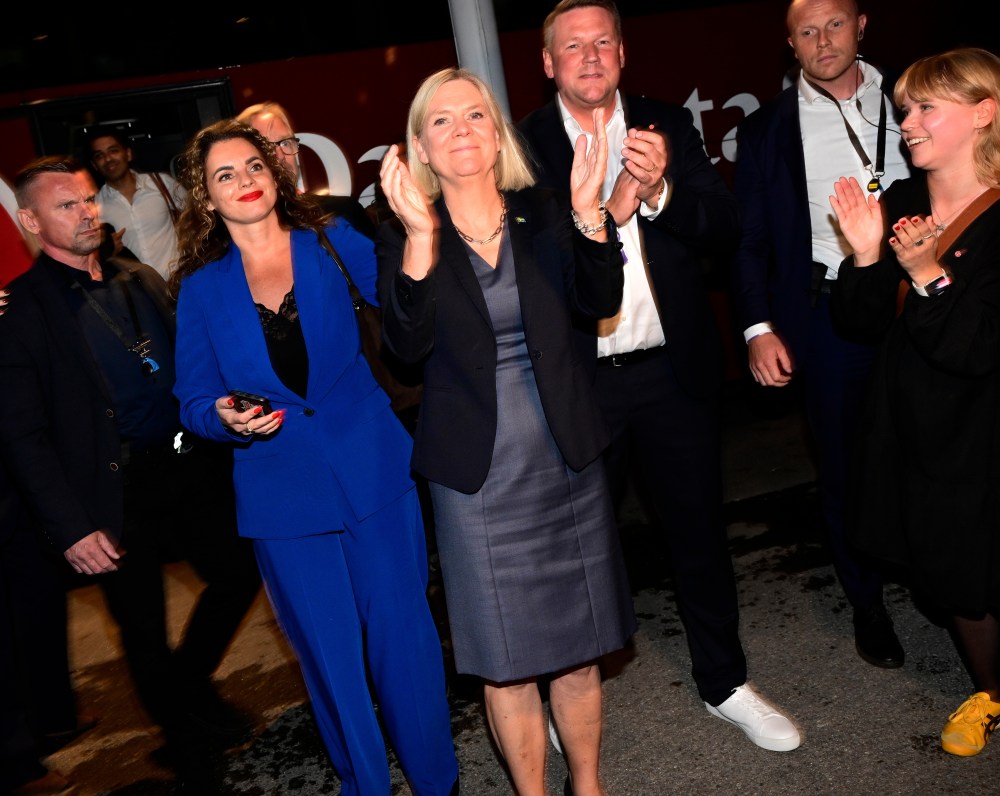
Former Prime Minister Magdalena Andersson’s center-left Social Democrats were set to finish as the biggest single party, despite losing some support, and Andersson hopes to win back the job she lost in 2022. But if the left-leaning parties do emerge with a majority, she will face a complicated task to translate it into a government because of tensions within that bloc.
Current Prime Minister Ulf Kristersson remarked that “if all the red lines remain in place, then Sweden won’t have a government at all,” public broadcaster SVT reported. He added that he intends to “explore a number of possibilities that may exist.”
Mikael Damberg, a prominent Social Democrat, said that “all parties will have to do some giving and taking, and we will do that too,” Swedish news agency TT reported.
Kristersson has led Sweden since 2022 with a three-party center-right coalition. It relied on outside support from the Sweden Democrats, an anti-immigration party that has far-right roots but has moved toward the political mainstream, for a parliamentary majority.
Kristersson had held out the prospect of Cabinet seats for the Sweden Democrats this time — if the governing coalition won. Still, their performance was disappointing: preliminary results showed their support slipping to just under 18%, down about 3 percentage points from four years ago, and they fell behind Kristersson’s Moderates to land in third place.
“In Sweden, there has been a tradition of quite rapid government formations, but for the last 10 years they have turned more complicated, and this will be the case this year as well,” said Ann-Cathrine Jungar, a political science professor at Södertörn University.
Some of that has to do with the Center Party, which has aligned with the left because it doesn’t want to govern with the Sweden Democrats but also doesn’t want to go into government with the Left Party, at the other end of the spectrum.
That is a potential headache for Andersson, whose Social Democrats were on course for an unimpressive showing of about 28% of the vote. Any combinations across the traditional right-left division would also be complicated.
Hard-right party slips, but it has a solid base
With broad political consensus in Sweden on several major issues such as support for Ukraine and the decision to join NATO, much election discussion focused on the possibility of the hard right entering government. The Sweden Democrats’ role was in focus against a background of gains for the populist right in Europe.
The Sweden Democrats were founded in the 1980s by people who had been active in right-leaning extremist groups, including neo-Nazis. They toned down their rhetoric and expelled openly racist members under Jimmie Åkesson, who has led them since 2005 and overseen their growth from what was once a marginal party.
Jungar noted that, when right-wing populist parties enter or support governments, “they tend to lose votes … because voters get disappointed if they don’t get all their policies through.”
She added that they have a stable electoral base with support around the country, and “their electoral result will go up and down, and that’s part of the normalization of these populist radical right parties in Sweden as elsewhere.”
Sweden’s multiparty system is geared to compromise and governments typically cooperate with the opposition for continuity on major socio-economic issues, Jungar said.
One thing is clear, she added. Whoever ends up forming the government, there are unlikely to be “any major changes in terms of going back to more liberal migration policies,” after populist right-leaning parties helped influence more restrictive policies across the Nordic region over the past two decades.
___
Associated Press writers Geir Moulson in Berlin and David McHugh in Frankfurt, Germany, contributed to this report.