

South Korean court orders North Korea to pay $32.5 million for blowing up joint liaison office
Advertisement
Read this article for free:
or
Already have an account? Log in here »
To continue reading, please subscribe:

Digital Subscription
One year of digital access for only $205*
- Enjoy unlimited reading on winnipegfreepress.com
- Read the E-Edition, our digital replica newspaper
- Access News Break, our award-winning app
- Play interactive puzzles
*First annual payment billed as $205.00 + GST for one year. This annual subscription will automatically renew at $233.00 + GST every 52 weeks (10% off the regular annual price of $259.35). Offer available to new and qualified returning subscribers only. Cancel any time.
To continue reading, please subscribe:
Add Free Press access to your Brandon Sun subscription for only an additional
$1 for the first 4 weeks*
- Enjoy unlimited reading on winnipegfreepress.com
- Read the E-Edition, our digital replica newspaper
- Access News Break, our award-winning app
- Play interactive puzzles
*Your next Brandon Sun subscription payment will increase by $1.00 and you will be charged $17.95 plus GST for four weeks. After four weeks, your payment will increase to $24.95 plus GST every four weeks.
Read unlimited articles for free today:
or
Already have an account? Log in here »
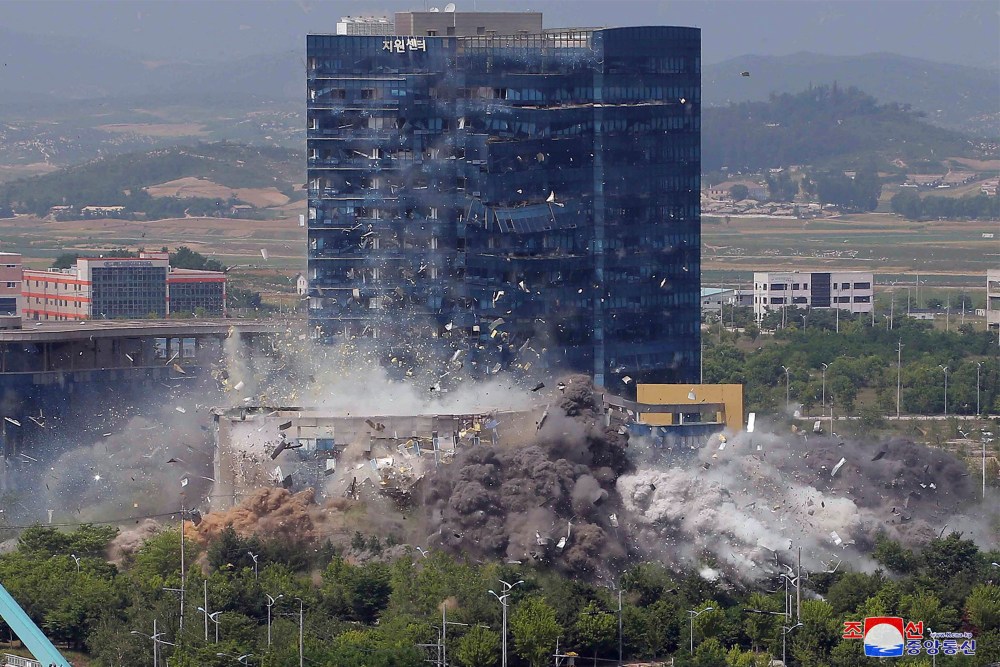
SEOUL, South Korea (AP) — A South Korean court ruled on Wednesday that North Korea should pay the South 44.6 billion won ($32.5 million) for blowing up a joint liaison office between the countries in 2020 as their relations deteriorated following the collapse of nuclear negotiations between Pyongyang and Washington.
The ruling by the Seoul Central District Court was symbolic as South Korea has no clear way to force the North to pay amid a diplomatic breakdown.
North Korean leader Kim Jong Un in recent years has suspended all meaningful diplomacy with the South and declared it his most hostile enemy while advancing his nuclear weapons program and pursuing closer ties with Moscow and Beijing as part of what he has described as a “new Cold War.”
While there have been cases of individuals suing the North Korean government over human rights abuses and other issues, the liaison office case was the first time the South Korean government sued Pyongyang.
South Korea’s Unification Ministry, which handles affairs related to North Korea, said it respects the court’s ruling and called for a resumption of inter-Korean diplomacy so that “all issues between the South and North can be resolved through dialogue and cooperation.” North Korean state media didn’t immediately comment on the ruling.
South Korea filed the suit in 2023, describing the North’s detonation of the building in the North Korean border town of Kaesong as an unlawful and violent act that breached previous agreements between the countries and severely damaged “mutual respect and trust.”
Seoul was then ruled by a conservative government that took a hard line on North Korea’s nuclear and missile development and its military support for Russia’s invasion of Ukraine, while strengthening security cooperation with the United States and Japan to counter the North Korean threat.
South Korea shifted to a softer tone under current liberal President Lee Jae Myung, who took office last year after his conservative predecessor Yoon Suk Yeol was ousted over his brief imposition of martial law in December 2024. But North Korea has so far ignored Lee’s calls to resume diplomacy.
In June 2020, North Korea used explosives to blow up the South Korean-built liaison office in Kaesong after criticizing Seoul’s failure to stop North Korean defectors from flying anti-Pyongyang propaganda leaflets across the border using balloons. North Korea shut down the office in January 2020 as it closed its borders over coronavirus concerns, and the building was empty at the time of the detonation.
The building’s destruction was then seen as a calculated display of anger to pressure Seoul over deadlocked nuclear negotiations with Washington. Former liberal South Korean President Moon Jae-in met Kim three times in 2018 while helping set up Kim’s first summit with U.S. President Donald Trump in June that year. However, the diplomacy derailed after the second Kim-Trump summit in 2019 at which the Americans rejected North Korea’s demand for major sanctions relief in exchange for a partial surrender of its nuclear capabilities.
Kim has accelerated the expansion of his nuclear weapons and missile arsenal in recent years while strengthening his ties with Russia, sending thousands of troops and large quantities of weapons to support Russian President Vladimir Putin’s war in Ukraine.
Trump has expressed interest in reviving diplomacy with Kim entering his second term and last month ordered the Pentagon to “substantially reduce” a major military exercise with South Korea, citing what he called a “good relationship” with Kim. But Kim’s government has so far dismissed Trump’s dialogue offers and called for Washington to discard its demands for the North’s denuclearization as a precondition for reviving talks.
The same day, the Seoul court sentenced three people to suspended prison terms for flying drones toward North Korea from border areas several times between September last year and January, ruling that they violated South Korea’s air safety laws.
The flights drew an angry response from North Korea, which warned of consequences for what it described as an “outrageous encroachment upon our sovereignty.”