

Protesters of Xi’s policies push for change in earshot of White House visit with Trump
Advertisement
Read this article for free:
or
Already have an account? Log in here »
To continue reading, please subscribe:

Digital Subscription
One year of digital access for only $205*
- Enjoy unlimited reading on winnipegfreepress.com
- Read the E-Edition, our digital replica newspaper
- Access News Break, our award-winning app
- Play interactive puzzles
*First annual payment billed as $205.00 + GST for one year. This annual subscription will automatically renew at $233.00 + GST every 52 weeks (10% off the regular annual price of $259.35). Offer available to new and qualified returning subscribers only. Cancel any time.
To continue reading, please subscribe:
Add Free Press access to your Brandon Sun subscription for only an additional
$1 for the first 4 weeks*
- Enjoy unlimited reading on winnipegfreepress.com
- Read the E-Edition, our digital replica newspaper
- Access News Break, our award-winning app
- Play interactive puzzles
*Your next Brandon Sun subscription payment will increase by $1.00 and you will be charged $17.95 plus GST for four weeks. After four weeks, your payment will increase to $24.95 plus GST every four weeks.
Read unlimited articles for free today:
or
Already have an account? Log in here »
WASHINGTON (AP) — President Donald Trump warmly welcomed Chinese leader Xi Jinping with a personal airport greeting, a tour of his new helipad and a candlelit dinner. But outside the White House, protests against Xi continued almost nonstop Thursday during his state visit.
The demonstrators represented a range of causes, from calls for religious autonomy and greater freedoms in Tibet, Hong Kong and the ethnic region of Xinjiang to demands to keep China out of self-governed Taiwan.
Protests against visiting Chinese leaders are nothing new — in 2006, a woman heckled Xi’s predecessor Hu Jintao at a White House welcome ceremony — but Xi has become the focus of attacks for his tough approach to tightening control over Xinjiang, Hong Kong and other regions and the Chinese military’s growing threats to Taiwan, which he says must come under Chinese rule.
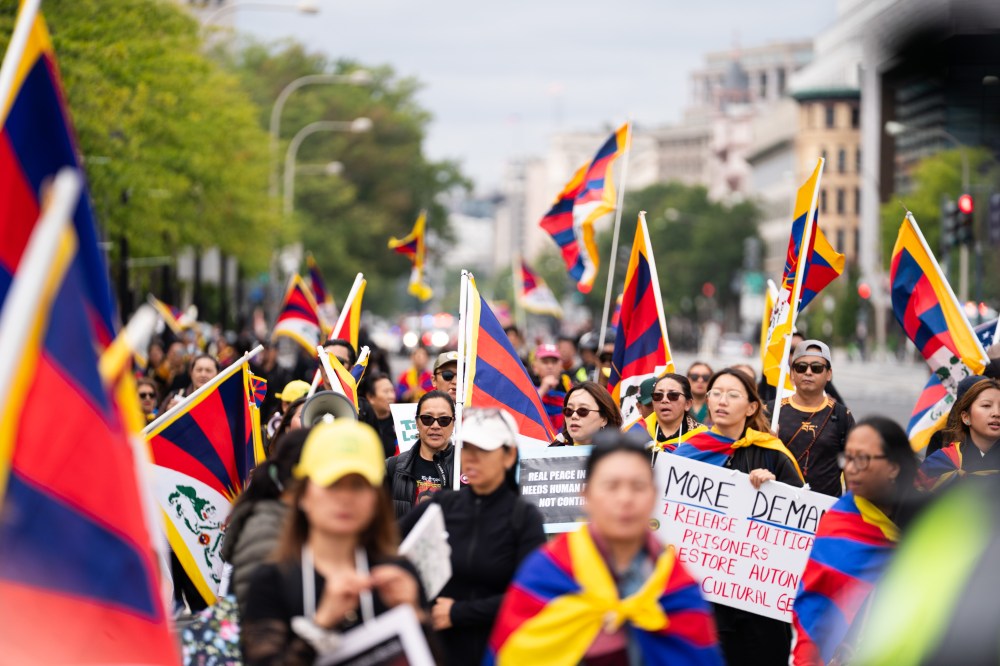
Crowds gathered behind a fence along Lafayette Park, waving flags and holding signs. Loudspeakers carried their voices across the park to the White House’s North Portico, where an honor guard and a red carpet awaited guests attending the state dinner.
The crowd chanted, “Xi Jinping has got to go” and “Shame! Shame on Xi Jinping!” The chants grew louder throughout the ceremony.
Pro-China demonstrators also turned out in Washington. Around 200 supporters of Xi gathered outside the hotel where he was staying, waving Chinese and American flags and chanting, “Welcome, welcome, a warm welcome.” They had banners reading, “A warm welcome to Chairman Xi on his visit to the U.S.” and “Hello, Uncle Xi.”
Meanwhile, protesters of the Xi’s government gathered outside the Chinese Embassy in the morning before marching through the city. By late afternoon, a few hundred people gathered at a park near the White House to “unwelcome” Xi.
Many waved Tibetan flags and called for a “Free Tibet.” Others carried flags bearing the Chinese words for “freedom” and “democracy,” along with signs reading, “Keep Taiwan Free” and “Liberate Hong Kong, revolution of our times,” a slogan associated with Hong Kong’s mass protests in 2019.
Anjali Tenzin Sonn, 17, joined a mostly Tibetan group calling for a free Tibet outside the U.S. Capitol. She said she felt compelled to participate after growing up hearing stories about her mother fleeing Tibet on foot and her grandfather suffering as a political prisoner. She described the protest as “inspirational.”
“I hope Emperor Xi won’t remain in power. I hope he can give Chinese people real freedom — freedom of speech and religion,” said Zhang Na, a 31-year-old warehouse worker in Los Angeles who traveled to the same protest.
Zhang said she became weary of China’s prolonged COVID-19 lockdowns and flew to Ecuador three years ago before walking to the United States through the southern border.
Yang Fan, a 39-year-old Christian, attended with his wife and daughter and held a handwritten sign calling for “freedom of religion” and an “end to dictatorship.” He said he wanted to stand up for Christians in China and hoped Xi would release those imprisoned for their religious beliefs.
“I would like to see the liberation of Hong Kong and the complete restoration of its freedoms,” said Melody Calkins, 30, who spent much of her childhood in Hong Kong.