

What will the next leader of the UN need to get the job done in an increasingly complex world?
Advertisement
Read this article for free:
or
Already have an account? Log in here »
To continue reading, please subscribe:

Digital Subscription
One year of digital access for only $205*
- Enjoy unlimited reading on winnipegfreepress.com
- Read the E-Edition, our digital replica newspaper
- Access News Break, our award-winning app
- Play interactive puzzles
*First annual payment billed as $205.00 + GST for one year. This annual subscription will automatically renew at $233.00 + GST every 52 weeks (10% off the regular annual price of $259.35). Offer available to new and qualified returning subscribers only. Cancel any time.
To continue reading, please subscribe:
Add Free Press access to your Brandon Sun subscription for only an additional
$1 for the first 4 weeks*
- Enjoy unlimited reading on winnipegfreepress.com
- Read the E-Edition, our digital replica newspaper
- Access News Break, our award-winning app
- Play interactive puzzles
*Your next Brandon Sun subscription payment will increase by $1.00 and you will be charged $17.95 plus GST for four weeks. After four weeks, your payment will increase to $24.95 plus GST every four weeks.
Read unlimited articles for free today:
or
Already have an account? Log in here »
UNITED NATIONS (AP) — On Jan. 1, the next United Nations secretary-general will take over an aging organization still controlled by World War II powers. What will the world need from that person?
Once a major player in solving conflicts and crises around the world, the 81-year-old institution has been sidelined from the top table in trying to end the wars in Iran, Ukraine and Gaza. And its precarious financial situation — caused mainly by the billions of dollars the United States owes — has forced major cuts to its humanitarian and development programs where it has remained a key player.
The annual global gathering of world leaders at the United Nations that ended last week shed some light on what the next U.N. chief needs to focus on and pursue.
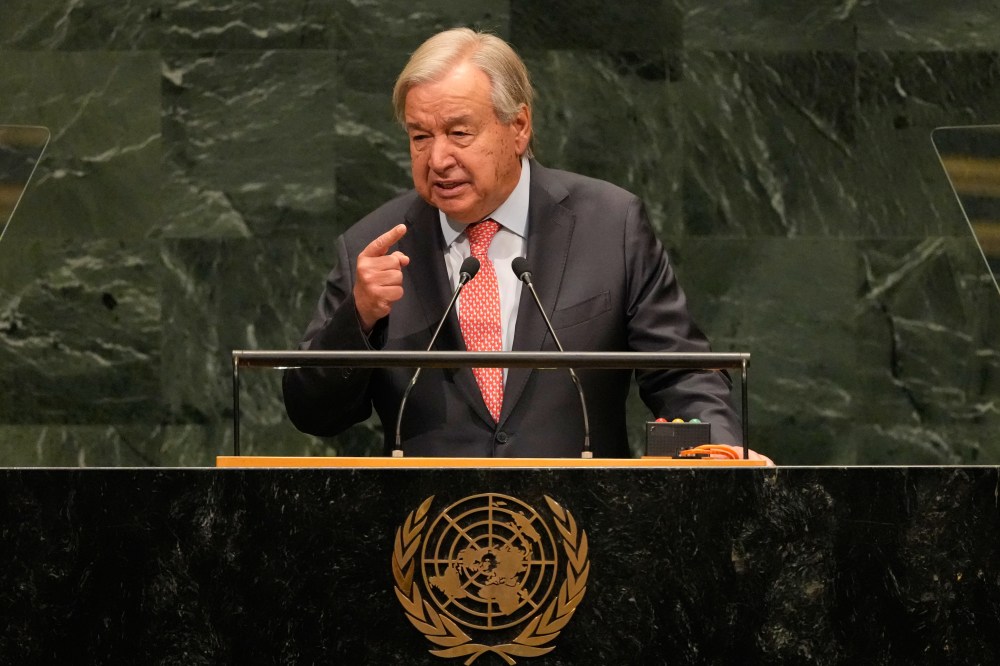
In his farewell address to the General Assembly, outgoing Secretary-General Antonio Guterres told global leaders, “The world does not need a weaker United Nations.”
“It needs a U.N. strong enough to face the world as it is,” he said, “and determined enough to build the world as it should.”
But is that even possible?
Much talk of a shared future with the UN at the center
After 10 years at the helm of the United Nations, Guterres said he is strongly convinced that its greatest power is to build a tomorrow that works for everyone. As he put it, “Our shared future will be forged by whether humanity can govern power wisely.”
Guterres then issued challenges to the United Nations that will be led by his successor, the 193 countries in the General Assembly “and humanity itself.”
Will you “uphold the law before impunity becomes normalized?” Will you “end wars before they consume generations?” Will you tackle inequality “before societies fracture?” Will you accelerate climate action “before tipping points are crossed?” Will you govern artificial intelligence “before it governs us?” Guterres asked.
For the next secretary-general — the selection process is ongoing — the top priority will be reconfiguring the United Nations to reflect the 21st century rather than the post-World War II era when it was established.
The new U.N. chief “will have the most monumental task that the U.N. has faced in decades because you have a U.N. that’s going through this critical reform process that it has not gone through for a long time,” said Kizito Byenkya, the Open Society Institute’s advocacy director.
The U.N.’s financial crisis has led to budget cuts and efforts to consolidate programs and agencies, and eliminate hundreds of mandates ordering the U.N. Secretariat to take a wide variety of actions and deliver reports, many that never get read. That’s just to name a few.
At the same time, Byenkya told The Associated Press, “You have huge pressure on all sides for the new secretary-general to act like a general and really play a central role in mediation for world conflicts.” He cited the late secretary-general Kofi Annan, who became directly involved in some conflicts and was a skilled mediator and negotiator.
“If you look at the conflicts we’ve been facing in the last few years, let’s say from Gaza to Sudan to Ukraine and more, you often have to ask yourself: Where has the role of the United Nations been with all of these?,” he said. “In the time of Kofi Annan, he was center to all.”
Reform sounds good but is a lot harder than one might think
During high-level week, leader after leader spoke of the need for reform. But when it comes to taking action, serious and sometimes impossible differences emerge, especially when it comes to reforming the Security Council, the U.N.’s most powerful body and still controlled by the World War II victors.
All U.N. member nations want to see the council reflect the 21st century world, but there are huge national differences on how it should be expanded. That has stymied progress for decades.
The five permanent members — the U.S., Russia, China, Britain and France — hold veto power, which gives them ultimate control. Africa, home to 1.5 billion people, has no permanent seat. Neither does Latin America. Neither do the collection of island nations whose existence is threatened by climate change.
“Security Council reform is not a favor to Africa,” Ghana’s President John Mahama told world leaders last week. “It is an imperative for the legitimacy, credibility, and survival of the United Nations.”
Mahama also raised perhaps the most difficult problem that will confront the next U.N. chief: the world’s “intense fragmentation, deepening inequality and eroded trust in our multilateral system.”
“We must address the alarming breakdown of global order today,” he said, pointing to “the dangerous drift toward unilateralism.”
Mahama lauded the U.N. Charter, whose opening words say the organization was founded to prevent a repetition of the 20th century’s two world wars. That, he said, “must reign supreme over the cynical doctrine that `might makes right.’”
___
Edith M. Lederer has covered international affairs for The Associated Press for more than a half century.