

Nationalists gain ground in Bosnia election, raising fears of deeper instability
Advertisement
Read this article for free:
or
Already have an account? Log in here »
To continue reading, please subscribe:

Digital Subscription
One year of digital access for only $205*
- Enjoy unlimited reading on winnipegfreepress.com
- Read the E-Edition, our digital replica newspaper
- Access News Break, our award-winning app
- Play interactive puzzles
*First annual payment billed as $205.00 + GST for one year. This annual subscription will automatically renew at $233.00 + GST every 52 weeks (10% off the regular annual price of $259.35). Offer available to new and qualified returning subscribers only. Cancel any time.
To continue reading, please subscribe:
Add Free Press access to your Brandon Sun subscription for only an additional
$1 for the first 4 weeks*
- Enjoy unlimited reading on winnipegfreepress.com
- Read the E-Edition, our digital replica newspaper
- Access News Break, our award-winning app
- Play interactive puzzles
*Your next Brandon Sun subscription payment will increase by $1.00 and you will be charged $17.95 plus GST for four weeks. After four weeks, your payment will increase to $24.95 plus GST every four weeks.
Read unlimited articles for free today:
or
Already have an account? Log in here »
SARAJEVO, Bosnia and Herzegovina (AP) — An election in Bosnia on Sunday saw nationalist parties gain strength and the elevation of a separatist, pro-Russia leader in the Balkan country where ethnic tensions have led to political deadlock and stalled progress in moving closer to the European Union.
Bosnian Serb nationalist politician Milorad Dodik, who is banned from holding office and did not appear on the ballot, in a victory speech on Sunday credited U.S. President Donald Trump’s return to power and Russian President Vladimir Putin’s support for his Alliance of Independent Social Democrats’ decisive win.
Dodik’s ally, Zeljka Cvijanovic, took more than 55% of votes to be elected to her second term on Bosnia’s tripartite presidency, representing the country’s Serb-majority entity of Republika Srpska. Dodik’s party’s candidate for the entity’s own president, Savo Minic, also won decisively.
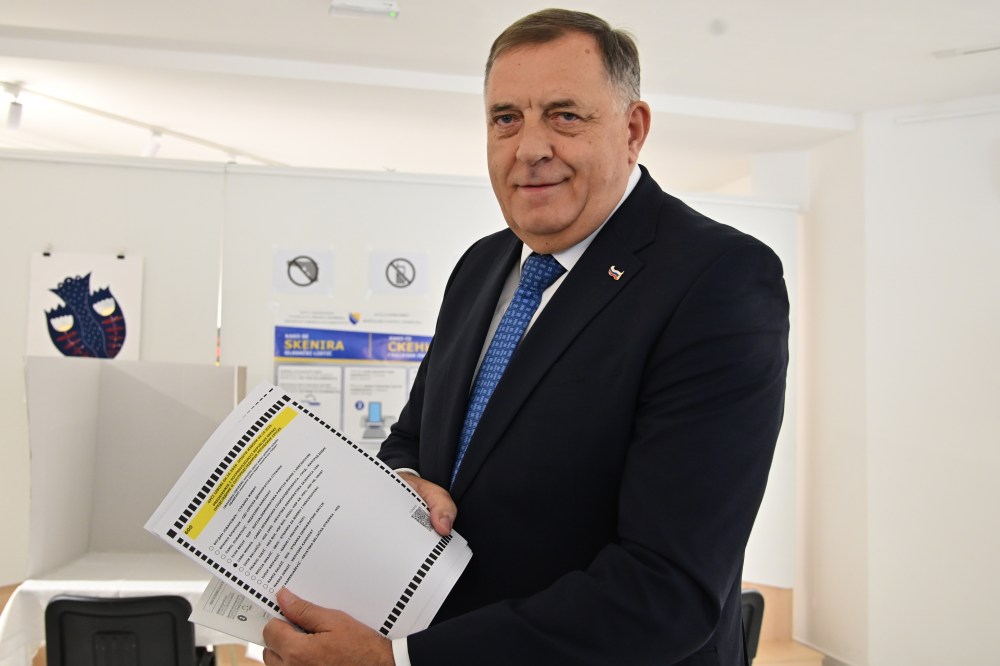
In Bosnia’s other entity, the Bosniak-Croat Federation, Darijana Filipovic of the nationalist Croatian Democratic Union appeared set to take the Croat seat on the presidency. The center-left incumbent Denis Becirovic of the Social Democratic party was ahead in the race for the Bosniak seat.
Kurt Bassuener, an analyst and co-founder of the Democratization Policy Council, a Berlin-based think-tank, said Bosnia’s nationalist parties “all gained ground” in the election, which he believes could lead to further instability that has plagued and divided Bosnia since its brutal 1992-95 war.
Political complexity slows progress toward EU
Around 3.4 million voters on Sunday were eligible to choose the three members of the country’s multi-ethnic tripartite presidency, lawmakers for the national parliament, and heads of institutions for the country’s two entities: the Bosniak-majority Federation of Bosnia-Herzegovina, and Republika Srpska, which is dominated by ethnic Serbs.
Bosnia has a complex web of governing institutions that were created by a U.S.-brokered peace agreement in 1995 in an effort to manage the ethnic divisions between Muslim Bosniaks, Orthodox Serbs and Catholic Croats that gave rise to the war, which killed over 100,000 people and displaced millions.
That political complexity, and the ethnic tensions which have been inflamed by some of Bosnia’s politicians, has blocked Bosnia’s progress toward joining the EU despite the bloc’s efforts to encourage the country’s divided leaders to work together for reform.
Meanwhile, Putin has relied on the pro-Russian Dodik, who has advocated for Republika Srpska to separate and join Serbia, to maintain Moscow’s influence in the Western Balkans.
Bassuener, the analyst, said that Sunday’s success of nationalist candidates along ethnic lines creates “more threats of instability,” which is “a real challenge to Europe, because they have been the dominant actor and remain such now, but they have effectively a moribund policy.”
He noted the United States’ quest for influence in Bosnia as well, pointing out that in Dodik’s victory speech on Sunday, he “said triumphantly … that if it weren’t for Donald Trump, we’d be politically dead.”
Trump’s administration lifted sanctions on Dodik and his family members last year that had been imposed by Joe Biden’s administration in 2022 over accusations that Dodik had engaged in corruption and threatened to destabilize the region with his separatist efforts.
Bassuener said that the EU using enlargement as its means for exercising influence in Bosnia has “given running room to the nationalists to use fear as a political tool.”
“I wouldn’t take yesterday’s electoral results as a reading of what people necessarily want. I think it’s what they’re afraid of,” he said.
Many voters want to leave ethnic divisions behind
As Bosnia faces economic decline, a youth exodus and stalled progress toward the EU, many voters have expressed a desire for an end to divisive politics and more cooperation among leaders of all ethnicities.
Radomir Erceg, a resident of Republika Srpska’s administrative capital Banja Luka, said Bosnia “should not be going back into the past.”
“We should have compromise between each other. I was watching Bosniak leaders last night on TV, and I think they have to start talking with Dodik. There should not be any conditions from their side, but also no conditions from our side toward them,” he said.
Ilma Rakic, a resident of Bosnia’s capital Sarajevo, bemoaned the lack of youth engagement in Bosnia’s public life. Hundreds of thousands of people under 40 have emigrated in recent years.
“Ï don’t think there is enough of them (young people) in politics. They should activate themselves. What we have today is very weak,” Rakic said.
___
Spike reported from Budapest, Hungary.