

In first Maine Senate debate, Collins seeks to distance herself from Trump
Advertisement
Read this article for free:
or
Already have an account? Log in here »
To continue reading, please subscribe:

Digital Subscription
One year of digital access for only $205*
- Enjoy unlimited reading on winnipegfreepress.com
- Read the E-Edition, our digital replica newspaper
- Access News Break, our award-winning app
- Play interactive puzzles
*First annual payment billed as $205.00 + GST for one year. This annual subscription will automatically renew at $233.00 + GST every 52 weeks (10% off the regular annual price of $259.35). Offer available to new and qualified returning subscribers only. Cancel any time.
To continue reading, please subscribe:
Add Free Press access to your Brandon Sun subscription for only an additional
$1 for the first 4 weeks*
- Enjoy unlimited reading on winnipegfreepress.com
- Read the E-Edition, our digital replica newspaper
- Access News Break, our award-winning app
- Play interactive puzzles
*Your next Brandon Sun subscription payment will increase by $1.00 and you will be charged $17.95 plus GST for four weeks. After four weeks, your payment will increase to $24.95 plus GST every four weeks.
Read unlimited articles for free today:
or
Already have an account? Log in here »
Republican U.S. Sen. Susan Collins distanced herself from President Donald Trump during her first Maine Senate debate with Democrat Troy Jackson, arguing she has maintained her political independence by repeatedly voting against Trump’s agenda and saying that she’s “not exactly his favorite senator.”
Democrats are trying to flip the Maine Senate seat as they work to win control of the Senate. Trump lost the state in 2024, giving Democrats hope of defeating the five-term moderate Republican, who has been targeted by Democrats in previous elections and survived.
During the hourlong debate, Jackson focused largely on attempting to connect Collins to Trump. He kicked off the night by pointing out she cast a critical vote to confirm Supreme Court Justice Brett Kavanaugh, a Trump nominee who eventually helped overturn the constitutional right to abortion. Collins supports abortion rights and said Kavanaugh assured her it was settled law, but she has said recently that she does not regret her vote to confirm him.
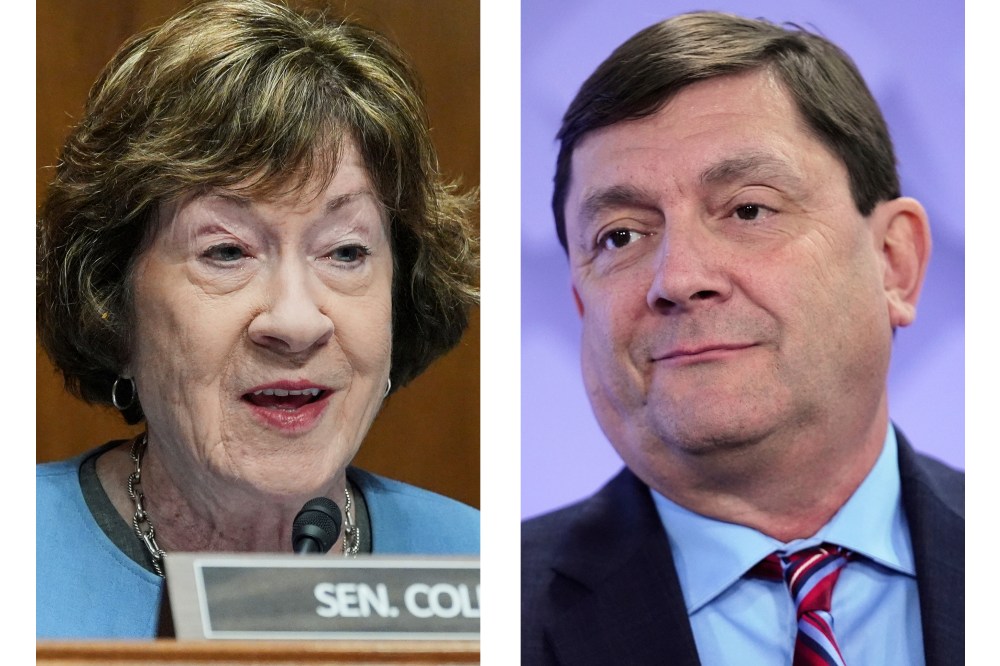
“Would you trust her to pick the next Supreme Court justice?” asked Jackson, a former state lawmaker and logger.
He also repeatedly brought up her procedural vote to advance the president’s 2025 tax and spending bill — though Collins ultimately broke with her party to vote against it.
Collins countered that she has voted against Trump more than she did Joe Biden when the Democrat was president, and has pushed back against Trump on tariffs, immigration enforcement and the war in Iran.
“I voted against my party more than another other senator on either side of the aisle,” Collins said.
The attention on Trump comes as only 31% of U.S. adults approved of how the Republican is handling the presidency, according to a September AP-NORC poll. That’s well below where his approval stood when he took office last year.
The president has started holding rallies around the country in an effort to help GOP candidates win in November, telling voters to pretend he is on the ballot. At Tuesday’s debate, a moderator noted Trump has floated the idea of campaigning in Maine, and asked Collins if she would stand beside him if he does.
“I’m not exactly his favorite senator,” she said, adding “I would say that he’s not coming to Maine.”
Collins, who has said she didn’t vote for Trump in 2016, voted to convict the president after his 2021 impeachment over his role in the Jan. 6 Capitol riot. In January, Collins joined a handful of Republican colleagues in backing a failed effort to limit the president’s ability to unilaterally use force in Venezuela. The move prompted Trump to say on social media that they “should never be elected to office again.”
Collins argued that her seniority and experience in the Senate have resulted in money and resources for Maine, saying: “Leadership matters in Washington.”
She also spent Tuesday evening attempting to turn the focus of Maine’s high cost of energy and housing on Jackson, arguing that he had a larger role in making a difference when he was the state Senate president and criticizing “Augusta’s failed policies” as a way to connect Jackson’s to the state’s struggle to address affordability.
Other moments showed how the two candidates were approaching their appeal to working class Maine voters. For example, as Collins touted her ability to remove certain items from Trump’s trade war with Canada, including pulp, concrete and road salt. Jackson pushed back by quipping “we can’t eat road salt.”
Jackson and Collins are scheduled to participate in three more debates later this month.