

Kosovo lawmakers elect a new president in a late-night vote to avert snap election
Advertisement
Read this article for free:
or
Already have an account? Log in here »
To continue reading, please subscribe:

Digital Subscription
One year of digital access for only $205*
- Enjoy unlimited reading on winnipegfreepress.com
- Read the E-Edition, our digital replica newspaper
- Access News Break, our award-winning app
- Play interactive puzzles
*First annual payment billed as $205.00 + GST for one year. This annual subscription will automatically renew at $233.00 + GST every 52 weeks (10% off the regular annual price of $259.35). Offer available to new and qualified returning subscribers only. Cancel any time.
To continue reading, please subscribe:
Add Free Press access to your Brandon Sun subscription for only an additional
$1 for the first 4 weeks*
- Enjoy unlimited reading on winnipegfreepress.com
- Read the E-Edition, our digital replica newspaper
- Access News Break, our award-winning app
- Play interactive puzzles
*Your next Brandon Sun subscription payment will increase by $1.00 and you will be charged $17.95 plus GST for four weeks. After four weeks, your payment will increase to $24.95 plus GST every four weeks.
Read unlimited articles for free today:
or
Already have an account? Log in here »
PRISTINA, Kosovo (AP) — Lawmakers in Kosovo elected economist and academic Justina Shiroka Pula as the country’s new president in a marathon late-night session, moments before a constitutional deadline that would have forced a snap election.
The election late Tuesday was a significant moment in a political crisis in the small Balkan nation that has caused legislative deadlock for over 19 months and two early parliamentary elections.
Just before Shiroka Pula was elected, lawmakers also approved a law limiting the powers of a special court in The Hague, Netherlands, which was set up to investigate and prosecute war crimes committed by the Kosovo Liberation Army (KLA) during the country’s 1998-99 war for independence from Serbia.
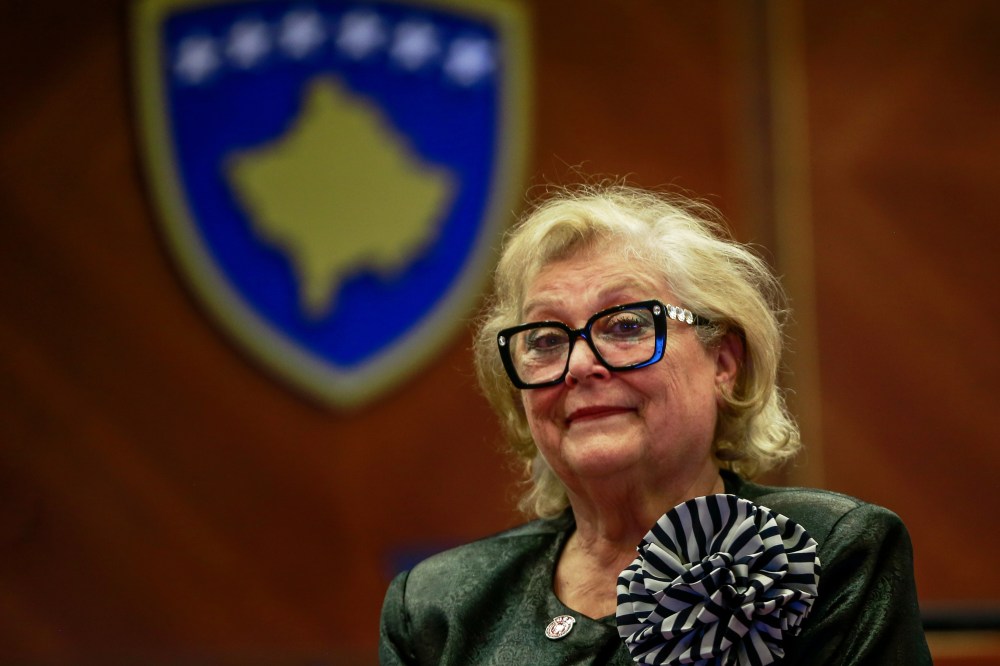
During the extraordinary session in Parliament, Shiroka Pula secured 81 votes in the 120-seat parliament. Outside, thousands of protesters had gathered demanding that the legislature pass the law limiting the powers of the war crimes court, known as the Specialist Chambers.
Shiroka Pula recently served as president of the Academy of Sciences and Arts of Kosovo. She will become Kosovo’s third female president since the country’s post-war independence. She was a last-minute consensus candidate backed by the ruling Self-Determination movement and the largest opposition party, the Democratic Party of Kosovo.
The role of president in Kosovo is largely ceremonial, though office holders do play an important role in foreign policy and serve as commander-in-chief of the armed forces. She will have to endorse the law limiting the power of the Hague court for it to become binding.
In her speech after taking the oath late Tuesday, Shiroka Pula said: “Today, I accept with great honor and full responsibility the duty of President of the Republic of Kosovo.”
“This mandate does not belong to one person alone, it belongs to our citizens, our institutions, and the state for which many generations have sacrificed,” she said.
Shiroka Pula’s election came after over two weeks of protests following a verdict by The Hague-based court convicting four of Kosovo’s wartime rebel leaders of war crimes, including the country’s former president Hashim Thaci. They were sentenced to between 13 and 25 years in prison.
Kosovo has criticized the verdicts as unjust, maintaining that the KLA, which Thaci had led before entering politics, had fought against Serbian oppression. Both residents and politicians feared the court ruling would tarnish Kosovo’s independence struggle.
More than 13,000 people, mostly ethnic Albanians, were killed during the conflict in Kosovo, while about 1 million ethnic Albanian Kosovars were driven from their homes during the fighting.