

Another court declares Ohio school choice voucher program unconstitutional
Advertisement
Read this article for free:
or
Already have an account? Log in here »
To continue reading, please subscribe:

Digital Subscription
One year of digital access for only $205*
- Enjoy unlimited reading on winnipegfreepress.com
- Read the E-Edition, our digital replica newspaper
- Access News Break, our award-winning app
- Play interactive puzzles
*First annual payment billed as $205.00 + GST for one year. This annual subscription will automatically renew at $233.00 + GST every 52 weeks (10% off the regular annual price of $259.35). Offer available to new and qualified returning subscribers only. Cancel any time.
To continue reading, please subscribe:
Add Free Press access to your Brandon Sun subscription for only an additional
$1 for the first 4 weeks*
- Enjoy unlimited reading on winnipegfreepress.com
- Read the E-Edition, our digital replica newspaper
- Access News Break, our award-winning app
- Play interactive puzzles
*Your next Brandon Sun subscription payment will increase by $1.00 and you will be charged $17.95 plus GST for four weeks. After four weeks, your payment will increase to $24.95 plus GST every four weeks.
Read unlimited articles for free today:
or
Already have an account? Log in here »
COLUMBUS, Ohio (AP) — Another court declared Ohio’s private school voucher program unconstitutional on Thursday, finding it provides a choice to the private schools that must honor the taxpayer-funded vouchers rather than to Ohio families.
The ruling by a three-judge panel of the 10th District Court of Appeals affirmed a lower court’s June 2025 ruling that found the EdChoice program violates an Ohio constitutional requirement for “a thorough and efficient system of common schools.” The ruling will not immediately affect the EdChoice program, which was allowed to remain operational in anticipation of an appeal.
“EdChoice, as presently structured and funded, secures with taxpayer funds a competing system of uncommon schools that is not subject to the same obligations imposed on Ohio’s system of common schools,” Judge David Leland wrote in a unanimous opinion.
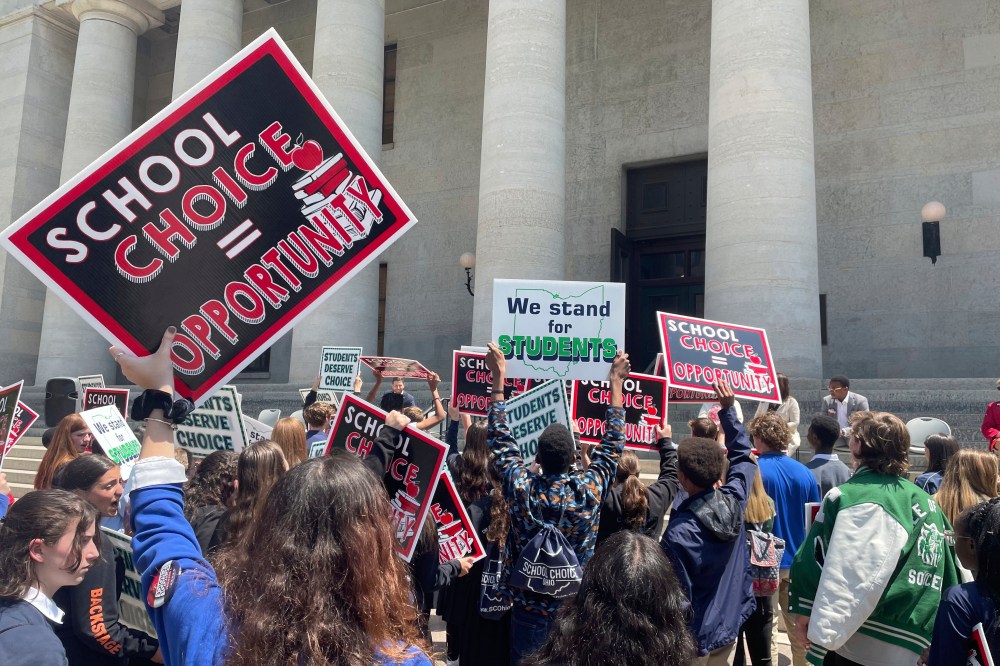
Judges took particular issue with the fact that a private school that participates in EdChoice has “broad discretion” over which students it admits, including denying or discontinuing any student “based on its perception that its stated admissions criteria are not met, whatever those criteria may be.”
“Thus, under the program, it is the participating school, not the student or their family, that chooses whether to admit the student and, consequently, whether the student may utilize taxpayer vouchers at that school,” the court said.
The court further found that EdChoice harms public schools in three ways: by allowing private schools to cherry-pick students, concentrating participating schools in urban areas and giving voters less reason to approve local school levies.
“Each one of these effects reinforce one another,” according to the court, “creating a downward spiral of reduced enrollment, reduced revenue, and increased fiscal pressure on schools.”
The decision comes in a 2022 lawsuit joined by hundreds of public school districts, known collectively as Vouchers Hurt Ohio, as well as some parents, students and the Ohio Coalition for Equity & Adequacy of School Funding.
The plaintiffs argued that Ohio’s nearly 30-year-old school voucher plan, known as EdChoice, has over time created an unconstitutional system of separately funded private schools and led to resegregation of some districts because mostly nonminority students take advantage of the program. In her lower court ruling, Franklin County Common Pleas Judge Jaiza Page rejected plaintiffs’ argument that EdChoice violates the equal protection clause.
Ohio expanded to a universal voucher program in 2023 that is one of the largest and most expansive in the U.S.
Republican Ohio House Speaker Matt Huffman, who championed that effort, said Thursday that the appellate court’s ruling is out of step with legal precedent.
“The constitutionality of various school choice programs has been affirmed by the United States Supreme Court, the Ohio Supreme Court, and a variety of other tribunals over the past several decades,” Huffman said in a statement. “The decision of one of 12 courts of appeal in Ohio will not affect that.”
In Thursday’s opinion, Leland wrote that the appeals court was not suggesting “that school vouchers in all forms violate the Ohio Constitution” — only that EdChoice does “as presently structured, funded, and challenged in this case.”