

Rubio urges restraint over Ethiopia-Eritrea tensions as rights group reports civilians killed
Advertisement
Read this article for free:
or
Already have an account? Log in here »
To continue reading, please subscribe:

Digital Subscription
One year of digital access for only $205*
- Enjoy unlimited reading on winnipegfreepress.com
- Read the E-Edition, our digital replica newspaper
- Access News Break, our award-winning app
- Play interactive puzzles
*First annual payment billed as $205.00 + GST for one year. This annual subscription will automatically renew at $233.00 + GST every 52 weeks (10% off the regular annual price of $259.35). Offer available to new and qualified returning subscribers only. Cancel any time.
To continue reading, please subscribe:
Add Free Press access to your Brandon Sun subscription for only an additional
$1 for the first 4 weeks*
- Enjoy unlimited reading on winnipegfreepress.com
- Read the E-Edition, our digital replica newspaper
- Access News Break, our award-winning app
- Play interactive puzzles
*Your next Brandon Sun subscription payment will increase by $1.00 and you will be charged $17.95 plus GST for four weeks. After four weeks, your payment will increase to $24.95 plus GST every four weeks.
Read unlimited articles for free today:
or
Already have an account? Log in here »
NAIROBI, Kenya (AP) — U.S. Secretary of State Marco Rubio has called for de-escalation in the Horn of Africa amid fighting in northern Ethiopia and heightened tensions with neighboring Eritrea.
Rubio spoke by phone with Ethiopian Prime Minister Abiy Ahmed on Wednesday, urging dialogue under a peace deal agreed between Ethiopia and Eritrea in 2018. He said the region could not tolerate more conflict, according to a statement from the State Department.
Renewed fighting in northern Ethiopia’s Tigray region in recent weeks has effectively shattered a 2022 peace agreement that ended a devastating two-year war. Ethiopia has accused Eritrean troops of occupying parts of its territory, while Eritrea condemned Ethiopia for what it called a declaration of war.
Human Rights Watch has received reports of civilians killed and injured by shelling in southern Tigray, Laetitia Bader, the group’s deputy Africa director, told The Associated Press in an interview Tuesday.
She said shelling also forced some health facilities to close and called for independent monitoring, restored communications and safe humanitarian access. Her account did not identify who carried out the shelling.
Near the border, a resident reported that Eritrean soldiers withdrew Monday from Fatsi, about 20 kilometers (12 miles) from the Ethiopian border town of Zalambessa.
“The last time I saw Eritrean soldiers was when they left late this morning,” Hayelom Gebretsadkan, a three-wheeled taxi driver from Zalambessa, told the AP on Monday. He said the soldiers headed toward the border and there was no active fighting in Fatsi. Later that day, he said Ethiopian federal forces had moved into the town.
In a letter to the U.N. Security Council on Friday, Ethiopian Foreign Minister Gedion Timothewos accused Eritrea of deploying troops across the border and said Ethiopia was taking measures in self defense. He did not specify those measures, identify the occupied areas or provide evidence supporting the allegations. The AP could not independently verify the claims.
Eritrean Foreign Minister Osman Saleh urged the council to condemn what he called a “deplorable declaration of war” by Ethiopia. His response did not confirm or deny the alleged troop crossings.
Rubio told Abiy in their call that “all countries in the Horn of Africa must respect the sovereignty and territorial integrity of their neighbors and avoid cross-border incursions.”
The dispute also reflects tensions over Abiy’s pursuit of access to the Red Sea. Ethiopia became landlocked when Eritrea gained independence in 1993.
The countries’ armies fought together against the Tigray People’s Liberation Front during the 2020-2022 war, which caused about 500,000 civilian deaths from violence, famine and the collapse of health services, according to researchers at Ghent University in Belgium.
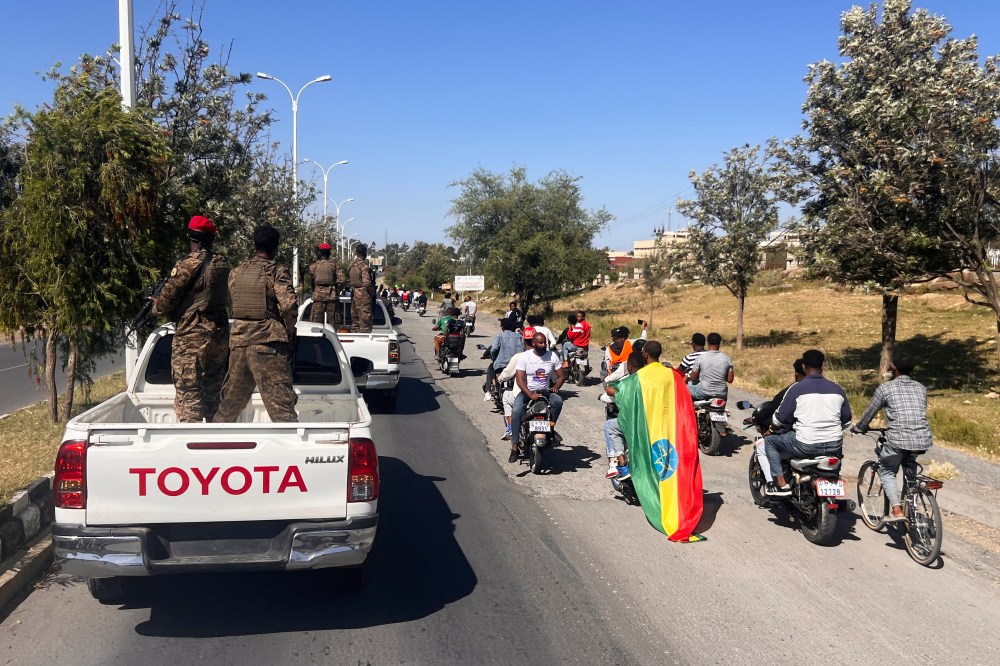
Last week government-allied fighters entered Mekelle, the capital of Tigray, after the rebel Tigray People’s Liberation Front announced its withdrawal. Ethiopian Airlines resumed flights to Mekelle on Sunday after suspending all flights there for days.
______
Kiyaro reported from Hamburg, Germany. Filmon Equar Hailu reported from Mekelle, Ethiopia. Associated Press journalists Matthew Lee in Washington and Moses Ndungu in Nairobi contributed to this report.