

Colombia judge orders protection of historical artifacts after museum purge sparks protests
Advertisement
Read this article for free:
or
Already have an account? Log in here »
To continue reading, please subscribe:
Digital Subscription
One year of digital access for only $1.44 a week*
- Enjoy unlimited reading on winnipegfreepress.com
- Read the E-Edition, our digital replica newspaper
- Access News Break, our award-winning app
- Play interactive puzzles
*Billed as $5.77 plus GST every four weeks. After 52 weeks, price increases to the regular rate of $19.95 plus GST every four weeks. Offer available to new and qualified returning subscribers only. Cancel any time.
To continue reading, please subscribe:
Add Free Press access to your Brandon Sun subscription for only an additional
$1 for the first 4 weeks*
- Enjoy unlimited reading on winnipegfreepress.com
- Read the E-Edition, our digital replica newspaper
- Access News Break, our award-winning app
- Play interactive puzzles
*Your next Brandon Sun subscription payment will increase by $1.00 and you will be charged $17.95 plus GST for four weeks. After four weeks, your payment will increase to $24.95 plus GST every four weeks.
Read unlimited articles for free today:
or
Already have an account? Log in here »
BOGOTA, Colombia (AP) — A Colombian judge on Monday ordered the nation’s government to protect more than 30 historical artifacts that officials removed from exhibits in Bogota’s National Museum last week, as part of an effort by Colombia’s conservative government to change how the nation’s history is told in museums and schools.
The artifacts were related to the country’s social movements and guerrilla fighters, which have led critics to describe the initiative as an attack on leftist movements and sexual minorities.
In a ruling Monday, Bogota judge Cesar Enrique Osorio said that the objects, which include a copy of the first magazine published by Colombia’s LGBTQ+ community and a poster depicting a former guerrilla leader who later became a presidential candidate, should be preserved in a safe place while a ruling is made on whether they should once again be shown to the public.
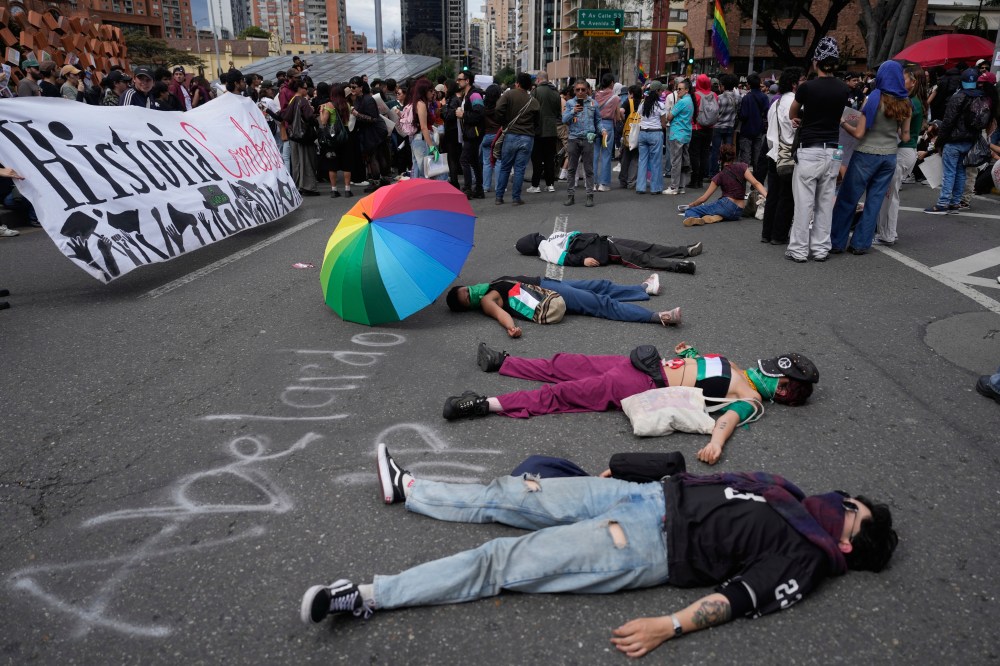
The judge also ordered officials to refrain from removing any more objects from the museum’s exhibits, alleging that the rights of Colombians to free expression and historical memory could be jeopardized.
The removal of dozens of objects from the national museum’s exhibit halls last Thursday sparked protests outside the historical building over the weekend that lasted several hours and were eventually broken up by riot police.
Feminist groups, left wing activists and members of Bogota’s LGBTQ+ community have accused the government of conservative president Abelardo de la Espriella of trying to erase their constituencies from the nation’s historical record.
On Thursday, de la Espriella gave a speech in the country’s Ministry of Culture, where he urged officials to protect the nation’s heritage and embark on what he described as a cultural battle against “wokeism” and “moral relativism.”
“The extreme left has permeated all facets of society for decades, particularly the cultural and academic spheres,” de la Espriella said. “We have the duty to confront it, exalting the principles that Colombians value.”
The president also argued that the state’s cultural institutions “belong to all Colombians” and could not be used to promote a political doctrine or an “ideological” interpretation of history.
Some of the items removed from the museum’s halls include a pen used to sign the 2016 peace deal between Colombia’s government and the FARC rebels, an agreement that has long been criticized by Colombia’s conservatives for being too lenient with the rebels — and for not stopping new waves of violence in rural areas.
Another item removed was a campaign poster of Carlos Pizarro, a former leader of the M-19, a guerrilla movement that signed a peace agreement with the government in March 1989, in which its leaders were pardoned for kidnappings and other war crimes. Pizarro was assassinated a month later while he was running for Colombia’s presidency.
De la Espriella said last week that Colombia’s cultural entities should not “promote terrorism” or treat members of guerrilla groups “as if they were national heroes.”
Pizarro’s daughter, former Sen. María José Pizarro, said the exhibits at the museum were modified suddenly, without any technical criteria.
“My father is a symbol of rebellion against tyranny,” Pizarro said in a video published on her social media accounts. “We will not allow sexual minorities to be censored in Colombia, and for the memory, the life, of the leaders of the left to be persecuted.”
___
Follow AP’s Latin America coverage at https://apnews.com/hub/latin-america