

India launches spacecraft to explore water deposits on moon
Advertisement
Read this article for free:
or
Already have an account? Log in here »
To continue reading, please subscribe:
Monthly Digital Subscription
$1 per week for 24 weeks*
- Enjoy unlimited reading on winnipegfreepress.com
- Read the E-Edition, our digital replica newspaper
- Access News Break, our award-winning app
- Play interactive puzzles
*Billed as $4.00 plus GST every four weeks. After 24 weeks, price increases to the regular rate of $19.95 plus GST every four weeks. Offer available to new and qualified returning subscribers only. Cancel any time.
Monthly Digital Subscription
$4.99/week*
- Enjoy unlimited reading on winnipegfreepress.com
- Read the E-Edition, our digital replica newspaper
- Access News Break, our award-winning app
- Play interactive puzzles
*Billed as $19.95 plus GST every four weeks. Cancel any time.
To continue reading, please subscribe:
Add Free Press access to your Brandon Sun subscription for only an additional
$1 for the first 4 weeks*
*Your next subscription payment will increase by $1.00 and you will be charged $16.99 plus GST for four weeks. After four weeks, your payment will increase to $23.99 plus GST every four weeks.
Read unlimited articles for free today:
or
Already have an account? Log in here »
Hey there, time traveller!
This article was published 22/07/2019 (2424 days ago), so information in it may no longer be current.
NEW DELHI – India sent a spacecraft to explore water deposits on the far side of the moon in a successful launch Monday after a technical problem caused a week’s delay.
Scientists at the mission control centre burst into applause as the rocket lifted off in clear weather as scheduled at 2:43 p.m. from Sriharikota in southern India. K. Sivan, head of India’s space agency, said the rocket successfully injected the spacecraft into orbit.
The Chandrayaan, the Sanskrit word for “moon craft,” is scheduled to land on the lunar south pole in September and send a rover to explore water deposits confirmed by an earlier, orbiting mission. India would become only the fourth nation to land on the moon, following the U.S., Russia and China.
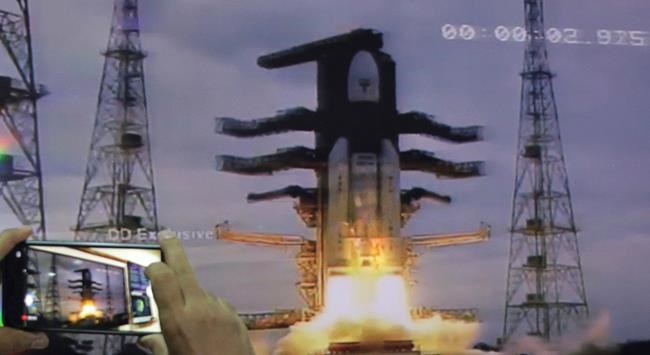
India’s first moon mission in 2008 helped confirm the presence of water. The country plans to send its first manned spaceflight by 2022.
India’s launch coincided with the 50th anniversary of the Apollo 11 mission this month. It came at a time when the world’s biggest space agencies are returning their gaze to the moon, seen as an ideal testing ground for technologies required for deep space exploration, and with the confirmed discovery of water, as a possible pit stop along the way. The U.S. is working to send a manned spacecraft to the moon’s south pole by 2024.
Indian Prime Minister Narendra Modi said the country’s lunar program will get a substantial boost, writing on Twitter that the country’s existing knowledge of the moon “will be significantly enhanced.”
Sivan said at a news conference that the successful launch of the spacecraft was the “beginning of India’s historic journey” to the moon.
The launch of the $141 million moon mission last week was called off less than an hour before liftoff because of a “technical snag.” Media reports scientists from the Indian Space Research Organization identified a leak while filling helium in the rocket’s cryogenic engine. The space agency neither confirmed nor denied the reports, saying instead that the problem had been identified and corrected.
The spacecraft that launched Monday is carrying an orbiter, lander and rover that will move around on the lunar surface for 14 Earth days. It will travel about 47 days before landing on the moon.
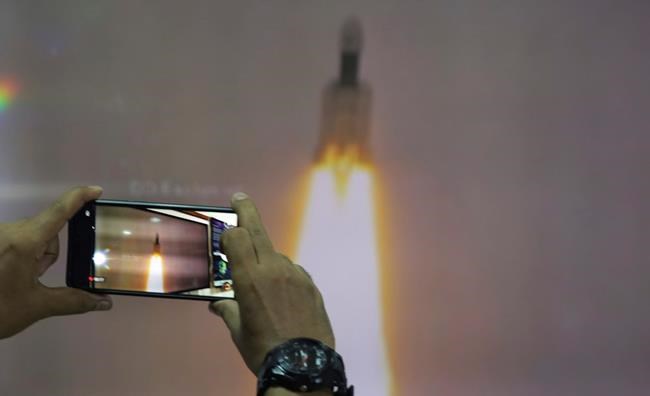
India put a satellite into orbit around Mars in the nation’s first interplanetary mission in 2013 and 2014.
With India poised to become the world’s fifth-largest economy, Modi’s ardently nationalist government is eager to show off the country’s prowess in security and technology.
India successfully test-fired an anti-satellite weapon in March, which Modi said demonstrated the country’s capacity as a space power alongside the United States, Russia and China.