Legal pot helps cops solve bigger crimes, study says
Researchers study 'clearance rates' in Colorado, Washington
Advertisement
Read this article for free:
or
Already have an account? Log in here »
To continue reading, please subscribe:
Digital Subscription
One year of digital access for only $1.44 a week*
- Enjoy unlimited reading on winnipegfreepress.com
- Read the E-Edition, our digital replica newspaper
- Access News Break, our award-winning app
- Play interactive puzzles
*Billed as $5.77 plus GST every four weeks. After 52 weeks, price increases to the regular rate of $19.95 plus GST every four weeks. Offer available to new and qualified returning subscribers only. Cancel any time.
To continue reading, please subscribe:
Add Free Press access to your Brandon Sun subscription for only an additional
$1 for the first 4 weeks*
- Enjoy unlimited reading on winnipegfreepress.com
- Read the E-Edition, our digital replica newspaper
- Access News Break, our award-winning app
- Play interactive puzzles
*Your next Brandon Sun subscription payment will increase by $1.00 and you will be charged $17.95 plus GST for four weeks. After four weeks, your payment will increase to $24.95 plus GST every four weeks.
Read unlimited articles for free today:
or
Already have an account? Log in here »
Hey there, time traveller!
This article was published 28/07/2018 (3012 days ago), so information in it may no longer be current.
Marijuana legalization in Colorado and Washington state has “produced some demonstrable and persistent benefit” to police departments’ ability to solve other types of crime, according to researchers at Washington State University.
“Our models show no negative effects of legalization and, instead, indicate that crime clearance rates for at least some types of crime are increasing faster in states that legalized than in those that did not,” the authors write in a study published in the journal Police Quarterly.
A crime is typically considered “cleared” if authorities have identified and arrested a suspect and referred him to the judicial system for prosecution. The Washington State study examined clearance rates for crimes in Colorado and Washington from 2010 through 2015, using monthly FBI data.
To isolate the effects of legalization, the researchers looked at how the trends in clearance changed after the implementation of marijuana legalization in November 2012 in Colorado and December 2012 for Washington. While recreational markets in these states didn’t open until 2014, provisions allowing for personal possession and use took effect shortly after the votes were certified.
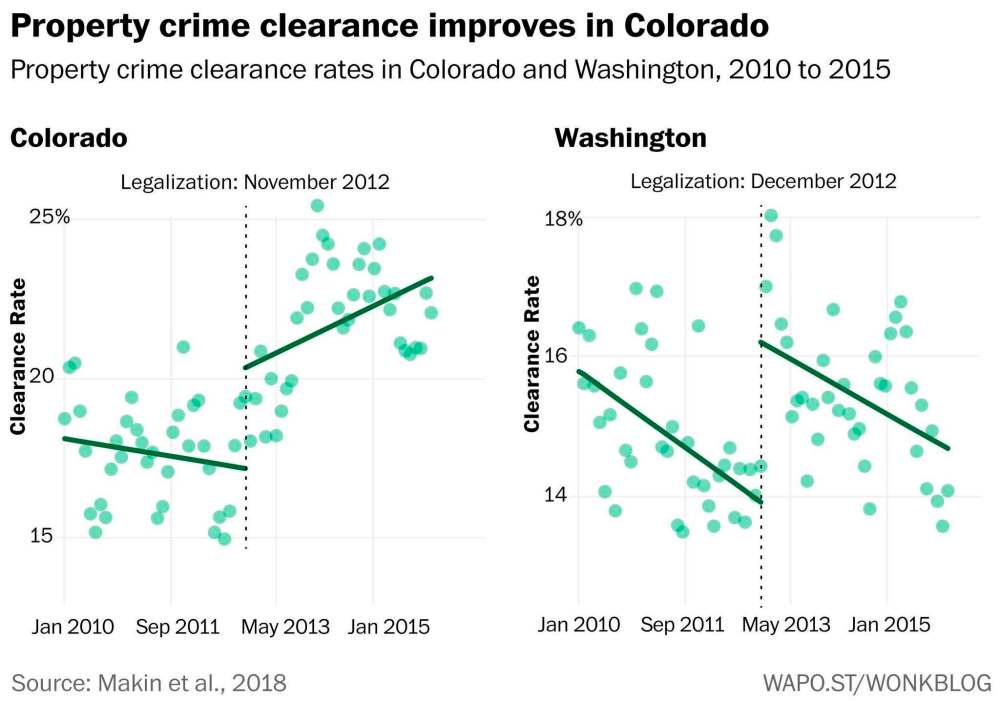
Clearance rates were falling in both states before legalization. Afterward, the decline stabilized in Colorado and began to reverse itself in Washington. The authors note that no similar shift happened in the country as a whole.
The researchers stress, however, that the data can’t prove conclusively that legalization directly caused the changes in clearance rates. There could have been other changes to policing in those states during that time period, such as increased use of overtime hours, the implementation of new policing strategies or a more aggressive focus on certain types of crime.
They note, however, that no other major changes to public policy happened in those states that would affect clearance rates in the way they observed. “We think the argument that legalization did in fact produce a measurable impact on clearance rates is plausible,” they conclude.
Property crime clearance rates show a dramatic reversal in Colorado, with a brief boost in Washington followed by a continuation of the prior trend.
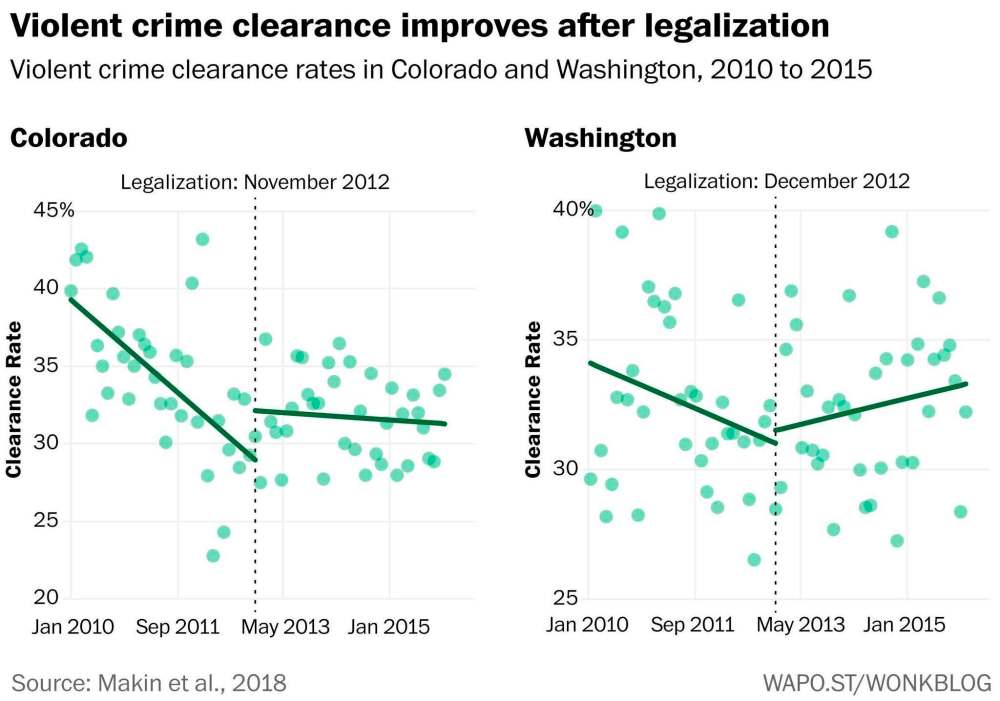
The authors also looked at trends for some specific types of crime, most notably burglary and motor vehicle theft. “The clearance rate for these two offences increased dramatically post-legalization,” the authors found. “In contrast, national trends remained essentially flat.”
Going beyond simple visual comparisons, the authors ran a number of statistical tests that largely confirm the findings hinted at in the charts: “While there were both immediate and longer-term differences between states which legalized and the rest of the country in terms of crime clearance rates, the long-term differences are much more pronounced, especially in Colorado.”
Advocates for legalization have frequently argued that freeing police from the burden of low-level marijuana enforcement would allow them to devote resources to more serious crimes. The Washington State researchers say their findings support this idea: “Our results suggest that, just as marijuana legalization proponents argued, the legalization of marijuana influenced police outcomes, which in the context of this article is modelled as improvements in clearance rates.”
They note, furthermore, that “there were no crime types in either state for which legalization appeared to have a negative impact on clearance rates.”
— Washington Post