

Colonies, towns scramble
Areas seldom hit by floods decry short notice, whip up dikes


Advertisement
Read this article for free:
or
Already have an account? Log in here »
To continue reading, please subscribe:

Digital Subscription
One year of digital access for only $205*
- Enjoy unlimited reading on winnipegfreepress.com
- Read the E-Edition, our digital replica newspaper
- Access News Break, our award-winning app
- Play interactive puzzles
*First annual payment billed as $205.00 + GST for one year. This annual subscription will automatically renew at $233.00 + GST every 52 weeks (10% off the regular annual price of $259.35). Offer available to new and qualified returning subscribers only. Cancel any time.
To continue reading, please subscribe:
Add Free Press access to your Brandon Sun subscription for only an additional
$1 for the first 4 weeks*
- Enjoy unlimited reading on winnipegfreepress.com
- Read the E-Edition, our digital replica newspaper
- Access News Break, our award-winning app
- Play interactive puzzles
*Your next Brandon Sun subscription payment will increase by $1.00 and you will be charged $17.95 plus GST for four weeks. After four weeks, your payment will increase to $24.95 plus GST every four weeks.
Read unlimited articles for free today:
or
Already have an account? Log in here »
Hey there, time traveller!
This article was published 12/05/2011 (5605 days ago), so information in it may no longer be current.
JAMES VALLEY HUTTERITE COLONY — This is one of the first colonies established in the province and it has been high and dry for almost 100 years since its creation in 1918.
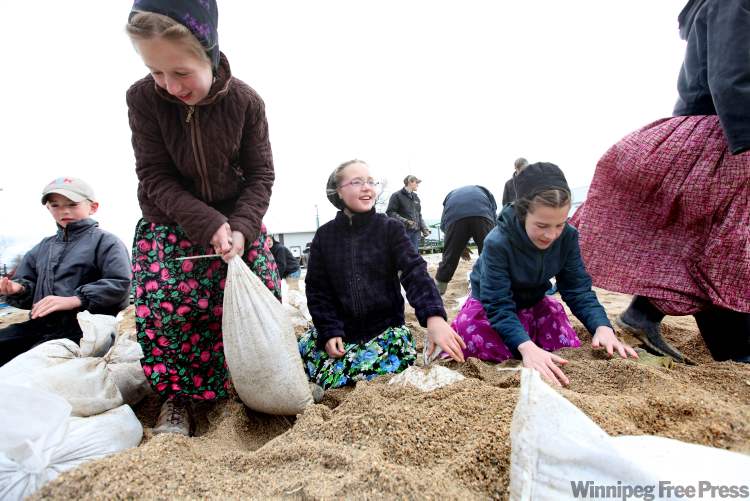
The more than 150 colony members here don’t want 2011 to be the year the community went under water so on Wednesday they — along with dozens of members from more than a half-dozen other colonies — worked feverishly tossing sandbags onto dikes, moving super sandbags into place and pushing tons of earth into ring dikes.
“The highest dike we have to build is a six-foot dike,” said Johnny Hofer, as he piled sandbags onto pallets along with other men, women and children before the sandbags were whisked away by forklifts to the people using them for dikes. The colony is located about 40 kilometres west of Winnipeg and seven kilometres south of Elie.
“The La Salle River is two miles north, but the water will flow through and come to the creek right beside us. We never expected this. Through the years we were always safe.
“But if you have a manmade catastrophe, that doesn’t follow the rules.”
If a vote were held in the rural municipalities of Cartier and Macdonald, those on colonies, farms, businesses or in homes would reject the province’s plan to pierce the dike holding back the Assiniboine River to allow part of the flow to go through this area.
Norman Swenson, owner of Swen’s Small Engines a few kilometres east of the colony, summed up the feelings of many: “Let nature take its course.
“Let them give it the best shot and if something happens I’ll accept it. But not when someone starts digging… When you start cutting a dike it’s like poking a balloon — it all goes boom. They can put boulders into it and it will fly them around like pebbles.”
Up and down the gravel roads around here, the vehicles of choice are dump trucks — lots of them. Whether the homeowner was home or not, they had several piles of sandbags dumped on their driveways.
Kayla Matyas burst into tears after the first dump truck arrived with its load within metres of her rented mobile home. A few minutes later, nine more truckloads filled with hundreds of sandbags joined the first one because the property she lives on backs onto a creek.
“Two hours ago I thought I just needed to help others — now I’m the one needing to find help,” Matyas said. “I’m only 5-2 or 5-3 — these piles are higher than me.”
Nearby, Ed and Mary-Jo Thiessen were joined by about a dozen members of their church in Winnipeg to build a dike around their home.
“We thought we were free and clear — the water came up and then the water went down a couple of weeks ago,” Mary-Jo said.
“But we get it — they’re going with the greater numbers of who to protect. I’m just really thankful for friends.
“But the people who owned this property, their family homesteaded it. They said it got close before but it never ever flooded.”
Mitch Carels, of Barnes and Duncan Land Surveyors, was busy taking his crews around to the properties to show owners how high their dikes had to be built to keep their possessions safe.
“Seven hundred ninety-two is what they need for protection and most of the ones in this area are 788,” he said.
Nathan Hofer, of the Starlite Colony, said his is one of seven other colonies that will soon be fighting to hold back the water. He’s not sure whether all of them will be able to hold back the flood that is only days away once the province cuts through the Assiniboine River dike.
“We are expecting the worst,” he said.
Hofer, who said the water will reach his colony in three to seven days, said the colony is busy building a ring dike made mostly of earth, but in other places with super sandbags.
“The La Salle River is just 300 metres from our homes. It is our backyard.
“We are very concerned about a flood. We have 150,000 turkeys, 5,000 hogs and 13,000 chickens. We are taking a precaution measure — an urgent precaution measure.”
Workers at the colony’s cement plant are instead filling giant sandbags. The colony’s bobcat has a forklift on it to lift the giant sandbags into a dike being constructed near the homes built in 1990, when the colony was first organized on the banks of the La Salle River.
Meanwhile, the reeve of Macdonald, which includes the communities of Starbuck, Sanford and La Salle, was upset that they were scrambling to find flood-fighting equipment because the province waited so long to tell the municipality it was set to be a sacrificial lamb in a controlled flood.
“It astonishes me,” Rodney Burns said. “A one-in-300-year flood and we didn’t know about it? That really blows my mind,” he said.
Burns said Starbuck, which has older dikes, is “fairly vulnerable” because the dikes were built on sand and are prone to seepage.
A few kilometres north, in the RM of Cartier, which includes the town of Elie, Reeve Roland Rasmussen said they’re panicked but purposeful.
“It’s very upsetting for everyone,” Rasmussen said. “It is short notice.
“We’re trying to concentrate on Elie,” he said. “Right now, most of our effort is to at least save their houses,” he said. Up to 30 homes are vulnerable, he said.

Rasmussen said he figured out how vulnerable his community was before the province issued its warning.
“On Sunday night we got the email about how many cubic feet per second to expect.
“I did the math and realized this is a big problem. Our whole municipality could be flooded,” he said.
“On Monday, we had (sandbag) trucks hired.”
kevin.rollason@freepress.mb.ca carol.sanders@freepress.mb.ca
Kevin Rollason
Reporter
Whether it is covering city hall, the law courts, or general reporting, Kevin could be counted on to not only answer the 5 Ws — Who, What, When, Where and Why — but to do it in an interesting and accessible way for readers. Kevin retired in 2026.
Carol Sanders
Legislature reporter
In 1997, Carol started at the Free Press working nights as a copy editor. In 2000, she jumped at a chance to return to reporting. In early 2020 — before a global pandemic was declared — she agreed to pitch in, temporarily, at the Free Press legislature bureau. She’s been there ever since.
Our newsroom depends on a growing audience of readers to power our journalism. If you are not a paid reader, please consider becoming a subscriber.
Our newsroom depends on its audience of readers to power our journalism. Thank you for your support.
Kevin Rollason
Reporter
Whether it is covering city hall, the law courts, or general reporting, Kevin could be counted on to not only answer the 5 Ws — Who, What, When, Where and Why — but to do it in an interesting and accessible way for readers. Kevin retired in 2026.
Carol Sanders
Legislature reporter
In 1997, Carol started at the Free Press working nights as a copy editor. In 2000, she jumped at a chance to return to reporting. In early 2020 — before a global pandemic was declared — she agreed to pitch in, temporarily, at the Free Press legislature bureau. She’s been there ever since.
Our newsroom depends on a growing audience of readers to power our journalism. If you are not a paid reader, please consider becoming a subscriber.
Our newsroom depends on its audience of readers to power our journalism. Thank you for your support.
Related Articles
Deliberate dike breach delayed until Saturday
Advertisement Advertise With Us
Advertisement Advertise With Us