Dramatic account of Madoff’s fall highlight of tale
Advertisement
Read this article for free:
or
Already have an account? Log in here »
To continue reading, please subscribe:

Digital Subscription
One year of digital access for only $205*
- Enjoy unlimited reading on winnipegfreepress.com
- Read the E-Edition, our digital replica newspaper
- Access News Break, our award-winning app
- Play interactive puzzles
*First annual payment billed as $205.00 + GST for one year. This annual subscription will automatically renew at $233.00 + GST every 52 weeks (10% off the regular annual price of $259.35). Offer available to new and qualified returning subscribers only. Cancel any time.
To continue reading, please subscribe:
Add Free Press access to your Brandon Sun subscription for only an additional
$1 for the first 4 weeks*
- Enjoy unlimited reading on winnipegfreepress.com
- Read the E-Edition, our digital replica newspaper
- Access News Break, our award-winning app
- Play interactive puzzles
*Your next Brandon Sun subscription payment will increase by $1.00 and you will be charged $17.95 plus GST for four weeks. After four weeks, your payment will increase to $24.95 plus GST every four weeks.
Read unlimited articles for free today:
or
Already have an account? Log in here »
Hey there, time traveller!
This article was published 14/05/2011 (5617 days ago), so information in it may no longer be current.
The Wizard of Lies
Bernie Madoff and the Death of Trust
By Diana B. Henriques
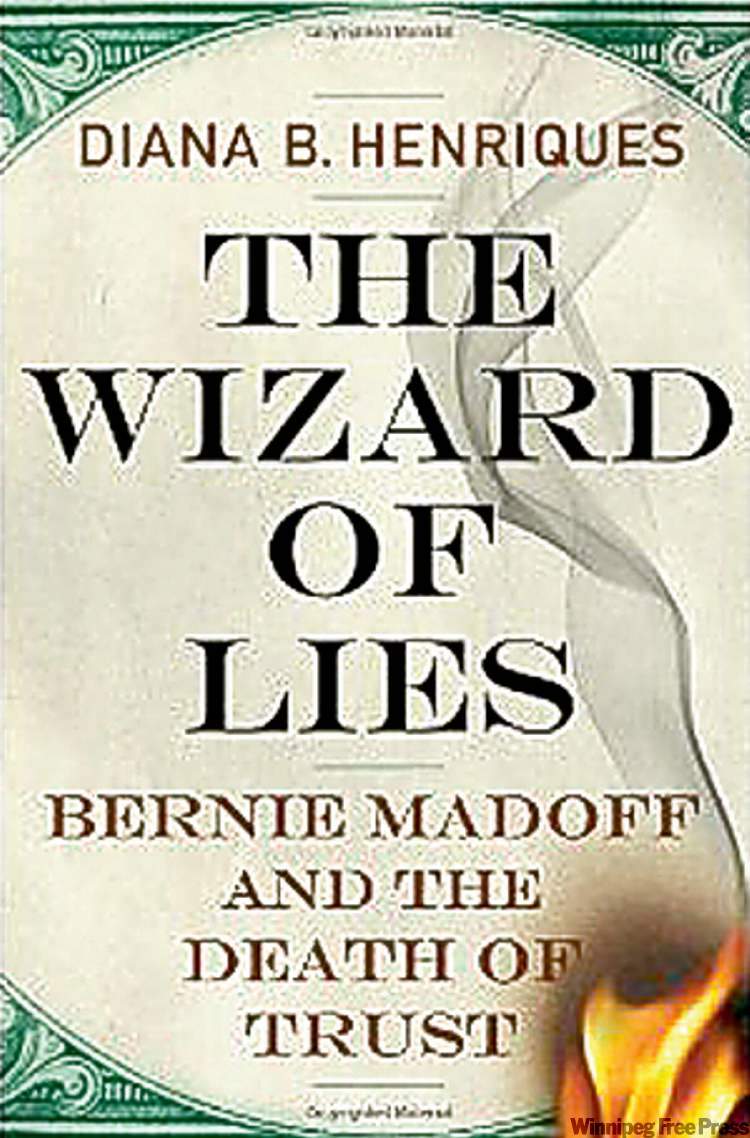
Times Books, 419 pages, $34.50
BEFORE beginning to tell the story of the largest Ponzi scheme ever, U.S. business journalist Diana Henriques furnishes her readers with a list of key “characters” — 89 in all.
That is thoughtful of her, since it can be difficult to keep track of all the players in The Wizard of Lies, despite how well Henriques relates the tale.
The intriguing story of how Bernie Madoff fooled thousands of people into believing he was a wizard of Wall Street trading, and not just using new money to pay old investors, begins nearly 50 years ago in 1962.
That’s when Madoff first used someone else’s money to deceive investors, reports Henriques, a financial writer at the New York Times who has penned three previous books and been a Pulitzer Prize finalist.
The cover-up money came from father-in-law Saul Alpern, who was an accountant. Madoff had lost $30,000 on risky stocks but borrowed that amount from Alpern and put it into clients’ accounts so that they wouldn’t know about the loss.
The sleight-of-hand wasn’t a Ponzi scheme, but it wasn’t honest, either.
Madoff did it to, in Henriques’s words, “burnish his reputation as a trading star.”
He concealed information clients of his then two-year-old firm deserved to know — that he had lost their money on a gamble he should not have taken.
Despite first-hand knowledge of his son-in-law’s deceitfulness, Alpern referred and recruited many people to him for investment services.
After Alpern retired, his accounting firm’s remaining partners continued its association with Madoff and eventually made investor recruitment for Madoff its sole focus.
Madoff’s business grew tremendously through the 1970s and ’80s, as more and more people became convinced he was an investment genius.
By the early ’90s, Madoff’s firm was a major force in the NASDAQ stock exchange that he had helped create and once chaired.
Somewhere along the way, his “investment advisory” service became a Ponzi scheme. Precisely when is unclear and may never be known.
Madoff says it happened during a money crunch in 1992, but Henriques suspects the transformation occurred shortly after the Black Monday market crash in October 1987.
She suggests in the epilogue that the transformation might not have been so abrupt as Madoff going crooked on a particular day.
Rather, she says, the Ponzi scheme may have been the climax of a gradual process that began in 1962 when Madoff learned he could get away with deceiving investors.
His criminal behaviour may have been, as she puts it, “a destination he reached after a decades-long journey along the edges of right and wrong.”
At any rate, the stress of constantly having to reel in new money to cover redemptions became too much for him and he confessed his crimes to his sons, who were both employees at his firm, on Dec. 8, 2008.
His sons turned him in, he was arrested Dec. 11, and Bernard L. Madoff Investment Securities was shut down.
Henriques’s account of those dramatic days, meticulously reconstructed through interviews with virtually everyone involved, is one of the book’s highlights.

She also does an excellent job explaining the process and controversies involved in trying to get compensation for Madoff’s thousands of victims, who were out more than $20 billion in cash losses and still more in paper losses.
Madoff, 73, is serving a 150-year sentence at a medium-security prison in North Carolina.
He told Henriques this past Feb. 15, in the second of their two interviews at the prison, that he never really believed he was stealing.
What a character.
Mike Stimpson is a Winnipeg writer.
Related Articles
Bad behaviour worth the read
Advertisement Advertise With Us
Advertisement Advertise With Us