

Praying for a real election
Advertisement
Read this article for free:
or
Already have an account? Log in here »
To continue reading, please subscribe:

Digital Subscription
One year of digital access for only $205*
- Enjoy unlimited reading on winnipegfreepress.com
- Read the E-Edition, our digital replica newspaper
- Access News Break, our award-winning app
- Play interactive puzzles
*First annual payment billed as $205.00 + GST for one year. This annual subscription will automatically renew at $233.00 + GST every 52 weeks (10% off the regular annual price of $259.35). Offer available to new and qualified returning subscribers only. Cancel any time.
To continue reading, please subscribe:
Add Free Press access to your Brandon Sun subscription for only an additional
$1 for the first 4 weeks*
- Enjoy unlimited reading on winnipegfreepress.com
- Read the E-Edition, our digital replica newspaper
- Access News Break, our award-winning app
- Play interactive puzzles
*Your next Brandon Sun subscription payment will increase by $1.00 and you will be charged $17.95 plus GST for four weeks. After four weeks, your payment will increase to $24.95 plus GST every four weeks.
Read unlimited articles for free today:
or
Already have an account? Log in here »
Hey there, time traveller!
This article was published 03/09/2011 (5447 days ago), so information in it may no longer be current.
Here we go again. Another provincial election and one we knew was coming for a long time, since it is the first under Manitoba’s new fixed-date rules.
Once more a chance to have at them. A chance to thank the government for its kindness and re-elect them. Or a chance to kick the bastards out. Or maybe a chance to try something completely different. We haven’t had a Liberal government for more than 50 years!
For the NDP, the election comes at the end of a phenomenal, unprecedented period of electoral success. Under Gary Doer, they had three successive majority governments. Doer left us two years ago to go to Washington to become Canada’s ambassador to the U.S. and to sell to the Americans the idea of importing more and more of our dirty oil from Alberta.
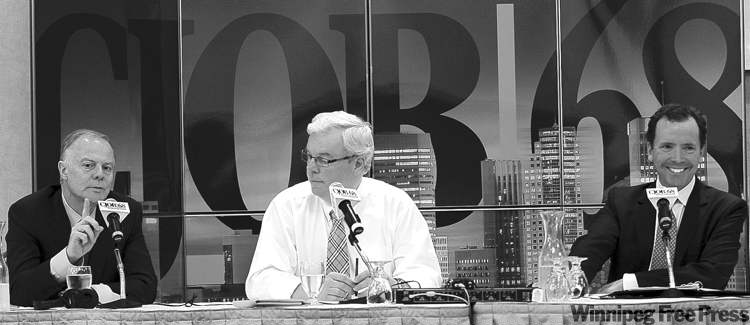
Greg Selinger took over. The trusty and phlegmatic minister of finance is a politician of such dependence on talking points that, if he did not have them, he would be near speechless.
With three majorities behind them, this is an election for the NDP to lose. It seems tempting fate for them to expect to win again. Is it not time for a change? Yet they have a 50-50 chance of doing it.
Doer ground the party into an efficient, disciplined, pragmatic machine. Actually, he did what Stephen Harper is accused of doing to the Conservative caucus in Ottawa: stay on message, keep repeating the talking points and stay away from any independent thought.
This, combined with a generally passive media, an almost non-sitting legislature and overall buoyant revenues, has served the NDP well. The party has had 12 years in power and some things have worked well: inner-city development, a steady economy and fairly acceptable investments in education and health care.
Unusually for the NDP, which we thought was a party of reform, the message is “steady as she goes.”
Elections in Manitoba are really about the contests in roughly 12 seats. The two solitudes of an NDP north and north Winnipeg, and a Conservative rural south and a suburban south Winnipeg will remain unchanged. The battleground will be in seats in the no-man’s land between them, seats the NDP won last time around. There will be hand-to-hand combat in Assiniboia, Jim Rondeau’s riding, and in Fort Richmond, Seine River and Southdale, where Kerri Irvin-Ross, Theresa Oswald and Erin Selby are the NDP incumbents.
How the floods will affect the outcome is not clear but likely not much. By an accident of nature, most of the affected areas are Tory seats, though Tom Nevakshonoff might be in trouble in Interlake, if only because of his absurdly insensitive remarks about the predicament of some of his inundated constituents.
So the Conservatives have a chance to win, but they have to win the campaign. Even if they knock off all of the above NDP incumbents, they are still shy of a majority.
Hugh McFadyen might have been tempted to let the NDP defeat itself, but I think that will not work.
What has he to offer? He might have been tempted to play the fiscal conservative card of tight, balanced budgets and cutbacks but he has decided instead to become a newly born Keynesian. In one of the few substantial promises of the nascent campaign, he has said he will not balance the provincial books until 2018.
Goodness, the NDP will keep running deficits only until 2014. But at least McFadyen can claim to not quite be the Dracula of provincial finances that the NDP want to make him into.
Indeed, unless one sees the PCs and their leader through the prism of the NDP’s manufactured messages of the bloodsucking McFadyen who takes bread from the mouths of children, both major parties seem about to promise roughly similar things.
Remember, it is steady as she goes. The only differences will be on law and order and the question of the route of the new Hydro line down the east or west side of Lake Winnipeg.
As for the Liberals, they are a party of honest endeavour and fine convictions but their leader, Jon Gerrard, has failed to ignite a following. Their promise to establish an independent Lake Winnipeg Authority is laudable, but to fund it at $260,000 is barely to pay for the rent of the office of its first director.
So an election of image-mongering and furious name-calling with little substantive policy discussion is in the works. Manitoba is not exempt from the overall dumbing-down and sloganeering that take place in such other stellar jurisdictions as the U.S. and Ottawa. It will be an election roughly about little.
Yet behind the catcalling, precious issues go unaddressed. Where is the concern about the absence of a properly operating legislature in the province? How about the NDP’s patronage policy? How about its politicization of the Council on Post-Secondary Education? Has it not been far too late in its policies to save Lake Winnipeg? The level of gang-related crime in Winnipeg can hardly be to the NDP’s credit.
Recently, the Manitoba Employers Association came out with a report on Manitoba’s performance on a number of economic and financial indicators in the last 10 years, comparing us with Ontario, B.C., Alberta and Saskatchewan.
It is dismal reading.
Of the five provinces, we are the highest taxed in personal income tax; we have the lowest weekly earnings, lowest growth rate of the labour force and the lowest increases of provincial GDP per capita. Most worrisome is how poorly we have fared compared not just with high-flying Alberta but with Saskatchewan.
And perhaps most disturbing, Manitoba has the highest percentage of the labour force with less than a high school education and the second-lowest percentage of the labour force with a university degree.
In every one of the last 10 years, Manitoba has had a net loss of interprovincial migration. Almost the only indicator we have done better at is the percentage of workers who have taken job-related training.
So there are issues that might be engaged by our politicians. I remain an unrepentant reformer who sees public service as a chance to advance new and progressive changes in our public life. I am holding my breath and praying to Buddha for some intelligent discussion of possible reforms.
I have noticed that Buddha responds to my prayers nine times out of 10 when I call on him to deliver a goal for Manchester United. Nevertheless, I suspect that our provincial politicians would test not just the patience of Job but the power of Buddha, too.
Allen Mills is a political science professor at the University of Winnipeg and a former Liberal candidate.
Related Articles
Meet your candidate: We invited would-be MLAs to introduce themselves to you




Advertisement Advertise With Us
Advertisement Advertise With Us