Technology visionary Doug Engelbart, inventor of computer mouse, dies at age of 88
Advertisement
Read this article for free:
or
Already have an account? Log in here »
To continue reading, please subscribe:

Digital Subscription
One year of digital access for only $205*
- Enjoy unlimited reading on winnipegfreepress.com
- Read the E-Edition, our digital replica newspaper
- Access News Break, our award-winning app
- Play interactive puzzles
*First annual payment billed as $205.00 + GST for one year. This annual subscription will automatically renew at $233.00 + GST every 52 weeks (10% off the regular annual price of $259.35). Offer available to new and qualified returning subscribers only. Cancel any time.
To continue reading, please subscribe:
Add Free Press access to your Brandon Sun subscription for only an additional
$1 for the first 4 weeks*
- Enjoy unlimited reading on winnipegfreepress.com
- Read the E-Edition, our digital replica newspaper
- Access News Break, our award-winning app
- Play interactive puzzles
*Your next Brandon Sun subscription payment will increase by $1.00 and you will be charged $17.95 plus GST for four weeks. After four weeks, your payment will increase to $24.95 plus GST every four weeks.
Read unlimited articles for free today:
or
Already have an account? Log in here »
Hey there, time traveller!
This article was published 03/07/2013 (4790 days ago), so information in it may no longer be current.
SAN FRANCISCO – Doug Engelbart, a visionary who invented the computer mouse and developed other technology that has transformed the way people work, play and communicate, died late Tuesday. He was 88.
His death of acute kidney failure occurred at his home in Atherton, Calif., after a long battle with Alzheimer’s disease, according to one of his daughters, Diana Engelbart Mangan.
Back in the 1950s and ’60s, when mainframes took up entire rooms and were fed data on punch cards, Engelbart already was envisioning a day when computers would empower people to share ideas and solve problems in ways that seemed unfathomable at the time.
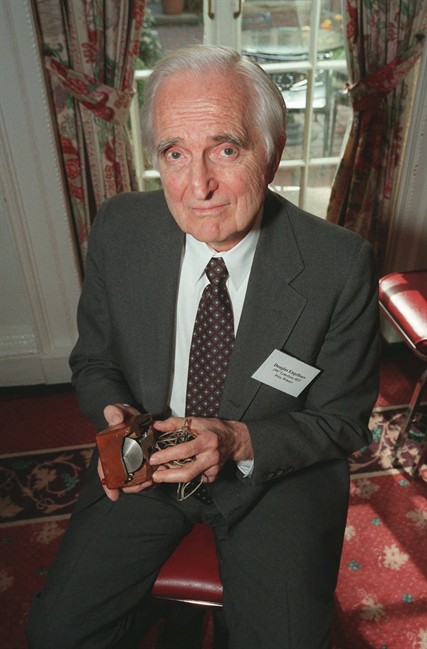
Engelbart considered his work to be all about “augmenting human intellect” — a mission that boiled down to making computers more intuitive to use. One of the biggest advances was the mouse, which he developed in the 1960s and patented in 1970. At the time, it was a wooden shell covering two metal wheels: an “X-Y position indicator for a display system.”
Engelbart “brought tremendous value to society,” said Curtis R. Carlson, the CEO of SRI International, where Engelbart worked when it was still known as the Stanford Research Institute. “We will miss his genius, warmth and charm. Doug’s legacy is immense. Anyone in the world who uses a mouse or enjoys the productive benefits of a personal computer is indebted to him.”
The notion of operating the inside of a computer with a tool on the outside was way ahead of its time when Engelbart began working on it. The mouse didn’t become commercially available until 1984, with the released of Apple’s then-revolutionary Macintosh, a prelude to future breakthroughs such as the iPhone and iPad.
All of those devices were conceived by Apple co-founder Steve Jobs, who died in October 2011. Although Jobs’ contributions to personal technology are far better known, Engelbart left an indelible mark, too.
“There are only a handful of people who were as influential,” said Marc Weber, founder and curator of the Internet history program at the Computer History Museum, where Engelbart had been a fellow since 2005. “He had a complete vision of what computers could become at a very early stage. He was thinking about these things when computers were used just for calculations and number crunching. They weren’t interactive at all, so it was pretty radical at the time.”
Engelbart conceived the computer mouse so early in the evolution of computers that he and his colleagues didn’t profit much from it. The mouse patent had a 17-year life span, allowing the technology to pass into the public domain in 1987. That prevented Engelbart from collecting royalties on the mouse when it was in its widest use. At least 1 billion have been sold since the mid-1980s.
Although computer mice remain prevalent, their usage is waning as people increasingly control smartphones and tablets in an even simpler way: by merely swiping their finger across a display screen. But the leap to touch-screen controls might not have been made if the mouse hadn’t simplified computing in the first place.
Among Engelbart’s other key developments in computing, along with his colleagues at the Stanford Research Institute and his own lab, the Augmentation Research Center, was the use of multiple windows. Engelbart’s lab also helped develop ARPANet, the government research network that led to the Internet.
In a precursor to the dramatic presentations that Apple’s Jobs became famous for, Engelbart dazzled the industry at a San Francisco computer conference in 1968. Working from his house with a homemade modem, he used his lab’s elaborate new online system to illustrate his ideas to the audience, while his staff linked in from the lab. It was the first public demonstration of the mouse and video teleconferencing, and it prompted a standing ovation.
“Doug pioneered network computing technologies when it was not popular to do so,” Sun Microsystems’ then-CEO, Scott McNealy, said in 1997.
Even so, the mild-mannered Engelbart gave deference to his colleagues and played down the importance of his inventions, stressing instead his bigger vision of using collaboration over computers to solve the world’s problems.
“Many of those firsts came right out of the staff’s innovations — even had to be explained to me before I could understand them,” he said in a biography written by his daughter Christina. “They deserve more recognition.”
In 1997, Engelbart won the most lucrative award for American inventors, the $500,000 Lemelson-MIT Prize. Three years later, President Bill Clinton bestowed Engelbart with the National Medal of Technology “for creating the foundations of personal computing.”
Douglas Carl Engelbart was born Jan. 30, 1925, and grew up on a small farm near Portland, Ore. He studied electrical engineering at Oregon State University, taking two years off during World War II to serve as a Navy electronics and radar technician in the Philippines.
It was there that he read Vannevar Bush’s “As We May Think” in a Red Cross library and was inspired by Bush’s idea of a machine that would aid human cognition.
After the war, Engelbart worked as an electrical engineer for what is now NASA’s Ames Research Center in Silicon Valley. Restless, and dreaming of computers that could change the world, Engelbart left Ames to pursue his Ph.D. at University of California, Berkeley.
He earned his degree in 1955. But after joining the faculty, Engelbart was warned by a colleague that if he kept talking about his “wild ideas” he’d be an acting assistant professor forever. So he left for the research position at SRI.

In 1990, Engelbart started the Bootstrap Institute, which researches ways to advance collaboration on complex problems.
Engelbart is survived by his wife, Karen O’Leary Engelbart; his four children, Diana, Christina, Norman and Greda; and nine grandchildren.
___
Online:
Video of his 1968 demonstration: http://sloan.stanford.edu/mousesite/1968Demo.html