Technology visionary Doug Engelbart, inventor of computer mouse, dies at age of 88

Advertisement

Advertise with us

SAN FRANCISCO - Doug Engelbart, a visionary who invented the computer mouse and developed other technology that has transformed the way people work, play and communicate, died late Tuesday. He was 88.

Read this article for free:


or

Already have an account? Log in here »

To continue reading, please subscribe:

Subscribe and receive a limited-edition Free Press branded hat or tote.

Digital Subscription

One year of digital access for only $205*

  • Enjoy unlimited reading on winnipegfreepress.com
  • Read the E-Edition, our digital replica newspaper
  • Access News Break, our award-winning app
  • Play interactive puzzles

*First annual payment billed as $205.00 + GST for one year. This annual subscription will automatically renew at $233.00 + GST every 52 weeks (10% off the regular annual price of $259.35). Offer available to new and qualified returning subscribers only. Cancel any time.

To continue reading, please subscribe:

Add Free Press access to your Brandon Sun subscription for only an additional

$1 for the first 4 weeks*

  • Enjoy unlimited reading on winnipegfreepress.com
  • Read the E-Edition, our digital replica newspaper
  • Access News Break, our award-winning app
  • Play interactive puzzles
Start now

*Your next Brandon Sun subscription payment will increase by $1.00 and you will be charged $17.95 plus GST for four weeks. After four weeks, your payment will increase to $24.95 plus GST every four weeks.

Hey there, time traveller!
This article was published 03/07/2013 (4790 days ago), so information in it may no longer be current.

SAN FRANCISCO – Doug Engelbart, a visionary who invented the computer mouse and developed other technology that has transformed the way people work, play and communicate, died late Tuesday. He was 88.

His death of acute kidney failure occurred at his home in Atherton, Calif., after a long battle with Alzheimer’s disease, according to one of his daughters, Diana Engelbart Mangan.

Back in the 1950s and ’60s, when mainframes took up entire rooms and were fed data on punch cards, Engelbart already was envisioning a day when computers would empower people to share ideas and solve problems in ways that seemed unfathomable at the time.
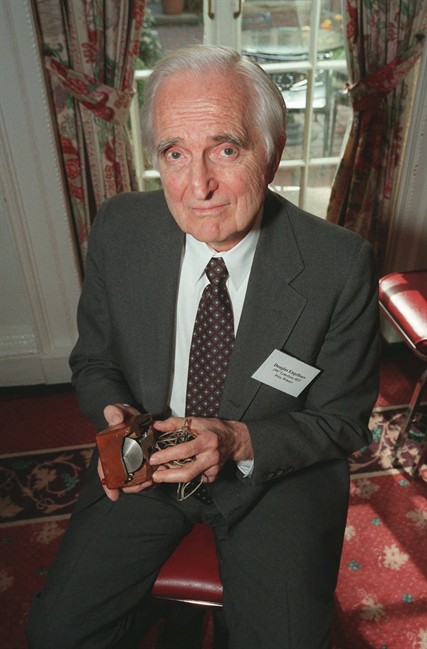
FILE - In this April 9, 1997 file photo, Doug Engelbart, inventor of the computer mouse and winner of the half-million dollar 1997 Lemelson-MIT prize, poses with the computer mouse he designed, in New York. Engelbart has died at the age of 88. The cause of death wasn't immediately known. (AP Photo/Michael Schmelling, File)

Engelbart considered his work to be all about “augmenting human intellect” — a mission that boiled down to making computers more intuitive to use. One of the biggest advances was the mouse, which he developed in the 1960s and patented in 1970. At the time, it was a wooden shell covering two metal wheels: an “X-Y position indicator for a display system.”

Engelbart “brought tremendous value to society,” said Curtis R. Carlson, the CEO of SRI International, where Engelbart worked when it was still known as the Stanford Research Institute. “We will miss his genius, warmth and charm. Doug’s legacy is immense. Anyone in the world who uses a mouse or enjoys the productive benefits of a personal computer is indebted to him.”

The notion of operating the inside of a computer with a tool on the outside was way ahead of its time when Engelbart began working on it. The mouse didn’t become commercially available until 1984, with the released of Apple’s then-revolutionary Macintosh, a prelude to future breakthroughs such as the iPhone and iPad.

All of those devices were conceived by Apple co-founder Steve Jobs, who died in October 2011. Although Jobs’ contributions to personal technology are far better known, Engelbart left an indelible mark, too.

“There are only a handful of people who were as influential,” said Marc Weber, founder and curator of the Internet history program at the Computer History Museum, where Engelbart had been a fellow since 2005. “He had a complete vision of what computers could become at a very early stage. He was thinking about these things when computers were used just for calculations and number crunching. They weren’t interactive at all, so it was pretty radical at the time.”

Engelbart conceived the computer mouse so early in the evolution of computers that he and his colleagues didn’t profit much from it. The mouse patent had a 17-year life span, allowing the technology to pass into the public domain in 1987. That prevented Engelbart from collecting royalties on the mouse when it was in its widest use. At least 1 billion have been sold since the mid-1980s.

Although computer mice remain prevalent, their usage is waning as people increasingly control smartphones and tablets in an even simpler way: by merely swiping their finger across a display screen. But the leap to touch-screen controls might not have been made if the mouse hadn’t simplified computing in the first place.

Among Engelbart’s other key developments in computing, along with his colleagues at the Stanford Research Institute and his own lab, the Augmentation Research Center, was the use of multiple windows. Engelbart’s lab also helped develop ARPANet, the government research network that led to the Internet.

In a precursor to the dramatic presentations that Apple’s Jobs became famous for, Engelbart dazzled the industry at a San Francisco computer conference in 1968. Working from his house with a homemade modem, he used his lab’s elaborate new online system to illustrate his ideas to the audience, while his staff linked in from the lab. It was the first public demonstration of the mouse and video teleconferencing, and it prompted a standing ovation.

“Doug pioneered network computing technologies when it was not popular to do so,” Sun Microsystems’ then-CEO, Scott McNealy, said in 1997.

Even so, the mild-mannered Engelbart gave deference to his colleagues and played down the importance of his inventions, stressing instead his bigger vision of using collaboration over computers to solve the world’s problems.

“Many of those firsts came right out of the staff’s innovations — even had to be explained to me before I could understand them,” he said in a biography written by his daughter Christina. “They deserve more recognition.”

In 1997, Engelbart won the most lucrative award for American inventors, the $500,000 Lemelson-MIT Prize. Three years later, President Bill Clinton bestowed Engelbart with the National Medal of Technology “for creating the foundations of personal computing.”

Douglas Carl Engelbart was born Jan. 30, 1925, and grew up on a small farm near Portland, Ore. He studied electrical engineering at Oregon State University, taking two years off during World War II to serve as a Navy electronics and radar technician in the Philippines.

It was there that he read Vannevar Bush’s “As We May Think” in a Red Cross library and was inspired by Bush’s idea of a machine that would aid human cognition.

After the war, Engelbart worked as an electrical engineer for what is now NASA’s Ames Research Center in Silicon Valley. Restless, and dreaming of computers that could change the world, Engelbart left Ames to pursue his Ph.D. at University of California, Berkeley.

He earned his degree in 1955. But after joining the faculty, Engelbart was warned by a colleague that if he kept talking about his “wild ideas” he’d be an acting assistant professor forever. So he left for the research position at SRI.

In 1990, Engelbart started the Bootstrap Institute, which researches ways to advance collaboration on complex problems.

Engelbart is survived by his wife, Karen O’Leary Engelbart; his four children, Diana, Christina, Norman and Greda; and nine grandchildren.

___

Online:

Video of his 1968 demonstration: http://sloan.stanford.edu/mousesite/1968Demo.html

Report Error Submit a Tip

More Stories

Signs the Carney approach is working

Editorial 4 minute read Preview

Signs the Carney approach is working

Editorial 4 minute read Wednesday, Aug. 12, 2026

It was, if nothing else, a glowing review in trying times.

Matt Winkler, the editor in chief emeritus of Bloomberg News, spoke last week on Bloomberg Business News Daily about a recent Bloomberg analysis of the performance of the Canadian economy, and this country as a target for investment

“This is one of the greatest periods for overseas investment in Canada that we’ve seen in the century, and it may be unprecedented, because we have to wait for the rest of the year. … Money is pouring into Canada like we have not seen from everywhere. Stocks and bonds are the obvious beneficiaries,” Winkler said. He argued that Canada is both liked and seen as reasonable.

“The point is… Canada since Mark Carney became prime minister in 2025, has outperformed everyone in America and also the Eurozone and anywhere in the world. The 10 largest stock markets in the world, Canada appreciated the most, more than 40 per cent. … Its bond market is also doing great, partially because the inflation rate in Canada, unlike the Eurozone or America, is actually trending lower, and is outperforming both the Eurozone and the U.S.”

Read
Wednesday, Aug. 12, 2026

Opaskwayak restorative justice court to give offenders opportunity to ‘heal’

Erik Pindera 5 minute read Preview

Opaskwayak restorative justice court to give offenders opportunity to ‘heal’

Erik Pindera 5 minute read Yesterday at 6:00 AM CDT

The Manitoba government, provincial court and Opaskwayak Cree Nation are signing a memorandum of understanding today to establish a community-led court focused on Indigenous restorative justice principles.

Justice Minister Matt Wiebe is in the northern First Nation, which neighbours The Pas, to attend this week’s Opaskwayak Indigenous Days summer festival, ahead of the signing of the nation-to-nation agreement after a pipe ceremony today.

“This is really a pivotal marker on the path to reconciliation for our justice system and an incredible opportunity to begin the process of reconciling the two systems of justice, that being the traditional Indigenous justice system with our colonial system,” Wiebe told the Free Press on Wednesday.

“I’m just excited to be here to have the opportunity to formally mark the collaboration, but really to listen and to hear from community about the best ways, the best path forward.”

Read
Yesterday at 6:00 AM CDT

‘Disrespectful’: residents frustrated after Wyatt arrives hour late to committee meeting

Joyanne Pursaga 3 minute read Preview

‘Disrespectful’: residents frustrated after Wyatt arrives hour late to committee meeting

Joyanne Pursaga 3 minute read Yesterday at 4:37 PM CDT

Several Winnipeggers attending a city development hearing on Thursday expressed frustration that one councillor arrived about an hour late, delaying the matter from being heard.

Coun. Russ Wyatt, who continues to attend city hall while facing criminal charges, began participating in the 9:30 a.m. East Kildonan-Transcona community committee meeting at 10:35 a.m.

A resident who hoped to speak at the meeting about a development plan in south Transcona noted the tardiness led the committee to bump the topic down on its agenda, while dozens waited to speak on it.

Christina Pyra eventually opted to leave city hall instead of waiting for her turn to make a presentation, to avoid missing a work commitment.

Read
Yesterday at 4:37 PM CDT

Dazed and confused stoner comedy hard to get right

Alison Gillmor 4 minute read Preview

Dazed and confused stoner comedy hard to get right

Alison Gillmor 4 minute read 2:01 AM CDT

Stoner comedy has always been kind of a dude thing. Think of the Fabulous Furry Freak Brothers, Cheech & Chong, Ice Cube’s Friday franchise, Harold & Kumar, basically any movie with the young Seth Rogen.

Screenwriter Dylan Meyer (Moxie) provides a much-needed gender swap in her directorial debut, giving us Kristen Stewart and Alia Shawkat as ride-or-die roommates Frankie and Molly. Dipping in and out of the gig economy and perpetually broke, they share their Los Angeles bungalow with two cats, a life-size cardboard cutout of Celine Dion and an enormously complicated “bong-a-tron” that takes up most of the living room.

Finally, finally, it’s women who get to be messy, aimless and really high.

Unfortunately, stoner movies — no matter the gender — are surprisingly hard to get right. The Wrong Girls is sweet and shaggy and intermittently funny, but Meyer ends up struggling with the genre’s common buzzkills.

Read
2:01 AM CDT

PCs say Hutterite colonies singled out by Bill 21

Alex Lambert 4 minute read Preview

PCs say Hutterite colonies singled out by Bill 21

Alex Lambert 4 minute read 2:01 AM CDT

SOURIS — Members of Hutterite colonies in the province took aim at the NDP government’s proposed changes to drinking water legislation during a public meeting Thursday in Souris.

The meeting was hosted by Progressive Conservative MLA Colleen Robbins (Spruce Woods) to hear from rural residents about their concerns over Bill 21, which the government says will improve oversight on wells and other water systems in the province.

“There’s not enough clarity, but I feel that the overreach that this bill will bring is not clearly defined, and it could have a lot of negative consequences,” attendee Gilbert Hofer, a member of Green Acres colony near Wawanesa, said after the meeting, which drew about 20 people.

The legislation would allow public health officers to designate the type of water source based on its intended use, water quality and use duration rather than solely the number of connections it has.

Read
2:01 AM CDT

A message to Mark: Don’t. Back. Down.

Judy Waytiuk 5 minute read Preview

A message to Mark: Don’t. Back. Down.

Judy Waytiuk 5 minute read 2:00 AM CDT

When is a leak really a trial balloon? While Mark Carney currently enjoys huge favourability in Canada, there are nine federal byelections pending. If he stumbles on his pledge of “Elbows up’ against the U.S., votes could go against the Liberals; millions of Canadians have utterly lost patience with Trump’s madness — and with Carney appearing to pander to it.

Now we lift the booze bans? Meddle with our supply management dairy system? So say “sources” in the Carney camp. But journalists can be manipulated — a galling truth. Set up a leak from a couple of sources. Two is standard; what’s often forgotten is that those sources, especially if the story’s a hot one, should be verifiably unconnected.

If a story is really hot, more sources must be scraped up, but the temptation to run with it regardless of that is enormous. Many a drool-worthy story I ran across in my early days at the Free Press and later at CBC TV news was spiked because those standards could not be met. These days, it’s almost impossible to meet that bar. Everybody’s connected.

Well, appeasement doesn’t work; we all know it. We dropped the digital services tax. That achieved nothing. American trade envoy Jameson Greer noted we don’t get credit for lifting something Trump resented from the get-go. The digital giants who imposed news-sharing bans on Canada in retaliation for the tax did not lift those bans. We still can’t share news links on Meta platforms in Canada, and we have not a penny in digital tax to show for it.

Read
2:00 AM CDT