Running for his life

Local Amazing Race Canada contestant faces a bigger challenge every day than the ones he tackled on reality show

Advertisement

Advertise with us

Yes, it was amazing. And challenging. And inspiring, at times frightening, consistently exhausting and, in the end, quite rewarding.

Read this article for free:


or

Already have an account? Log in here »

To continue reading, please subscribe:

Subscribe and receive a limited-edition Free Press branded hat or tote.

Digital Subscription

One year of digital access for only $205*

  • Enjoy unlimited reading on winnipegfreepress.com
  • Read the E-Edition, our digital replica newspaper
  • Access News Break, our award-winning app
  • Play interactive puzzles

*First annual payment billed as $205.00 + GST for one year. This annual subscription will automatically renew at $233.00 + GST every 52 weeks (10% off the regular annual price of $259.35). Offer available to new and qualified returning subscribers only. Cancel any time.

To continue reading, please subscribe:

Add Free Press access to your Brandon Sun subscription for only an additional

$1 for the first 4 weeks*

  • Enjoy unlimited reading on winnipegfreepress.com
  • Read the E-Edition, our digital replica newspaper
  • Access News Break, our award-winning app
  • Play interactive puzzles
Start now

*Your next Brandon Sun subscription payment will increase by $1.00 and you will be charged $17.95 plus GST for four weeks. After four weeks, your payment will increase to $24.95 plus GST every four weeks.

Opinion

Hey there, time traveller!
This article was published 13/07/2013 (4816 days ago), so information in it may no longer be current.

Yes, it was amazing. And challenging. And inspiring, at times frightening, consistently exhausting and, in the end, quite rewarding.

But for Winnipegger Tim Hague, 48, who competed in The Amazing Race Canada alongside 23-year-old son Tim Jr., the reality-TV competition was nothing compared to the real race he’s in.

Hague, who was diagnosed with early-onset Parkinson’s disease three years ago, is inclined to treat every day like a full-on sprint in order to make sure no opportunity is missed and no regrets are accumulated.
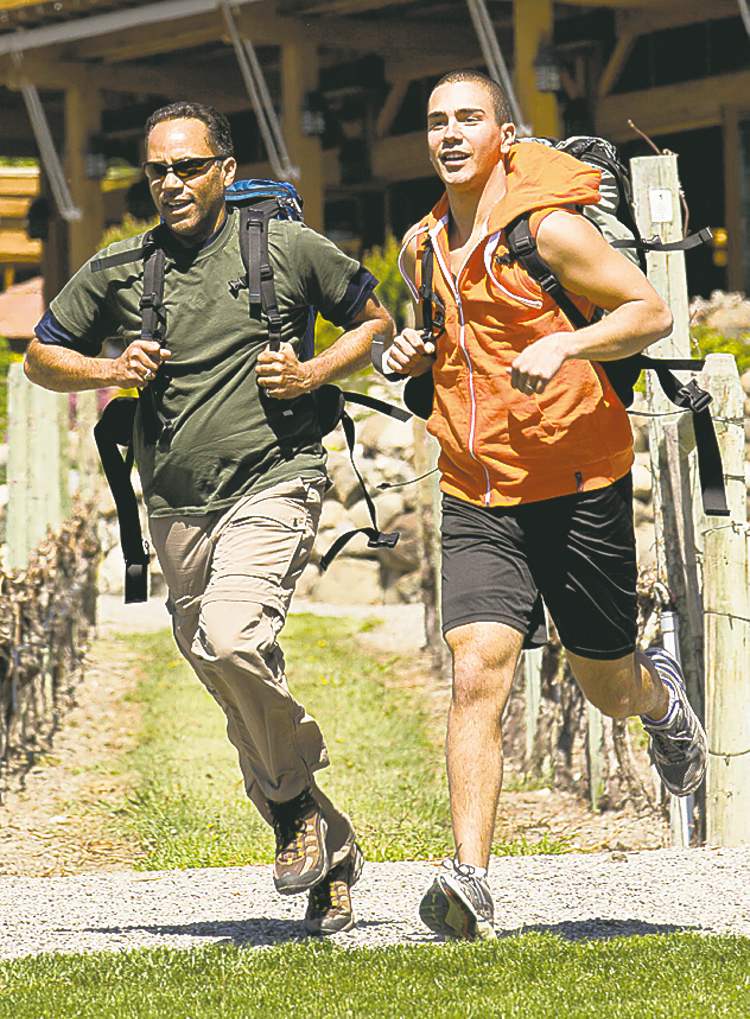
Tim Hague (left) and Tim Jr. battled hard and survived The Amazing Race Canada.

“Parkinson’s is generally seen as an old man’s disease, right?” says Hague, a native of Robstown, Texas, who moved to Winnipeg nearly 25 years ago after meeting his wife, Sheryl, at a Bible college in Kansas. “It’s grandpa or the old guy who gets it; it’s rarely a 30-something or a 40-something you think of when you think of Parkinson’s.

“I know a couple of things: without a cure, this disease will win the war. It will. And I can deal with that. It’s the day-to-day that you have to wrap your head around, and that factors well into The Amazing Race, because it’s all about persistence and perseverance. You’ve got to stand up and face this thing every day and do what you’ve got to do… In the Race, as in life, you get up every morning, face the damned thing, and kick its ass.

“You have to. Because if you don’t, not only will it win the war, it will also beat you down every day.”

While his indomitable can-do spirit made him a perfect candidate for the Canadian version of The Amazing Race, it was actually wife Sheryl’s faithful fan interest in the long-running CBS series that led to both Tims taking part in the show.

“She was a large part of the motivation,” explains Hague, a registered nurse who works at St. Boniface General Hospital. “Quite frankly, I probably wouldn’t have applied on my own… But she has watched every season of the show, and was very interested in her and I doing it together. But when we looked at the requirements — they wanted a commitment of five weeks of your life, and the idea of leaving both of our jobs when we’ve got 15-year-old twins at home just wasn’t practical — she came back and said, ‘You and Timothy are applying.’


“So we spent about a day-and-a-half putting the (audition) video together; I typed up an email and sent it and then forgot about it. I didn’t hold out a whole lot of hope that we’d get called, but lo and behold, we did get a call, and the rest is history.”

The Hagues are one of nine two-person teams competing in The Amazing Race Canada, which takes place fully within this country’s borders and offers its winners a $250,000 cash prize, a pair of 2014 Corvette Stingrays and an opportunity to travel free for a year, first class, to anywhere Air Canada flies.

Hague says the fact he has made fitness a major part of his life during the past couple of decades played a big part in his being able to race despite his Parkinson’s diagnosis.

“I’m very fortunate,” Hague explains. “About 20 years ago, I started running and cycling. I’ve done one short triathlon, a full marathon and a bunch of half-marathons. And that has preserved my well-being; my neurologist tells me that every time I see him. Not only am in better shape than most people with Parkinson’s, I’m in better shape than most people, period. And that is the reason I’m doing as well as I am.

“I’m not on any meds; I can do pretty much whatever I want. I can’t run as fast as I used to, but that may have more to do with being closer to 50 than 20. I’m in great shape compared to most people, and it has been pointed out to me over and over that that is a result of 20 years of hard exercise.”

That said, Hague admits that the disease was a consideration for him and Tim Jr. throughout their Amazing Race experience.

The Amazing Race Canada host Jon Montgomery

“It was a factor in the race, absolutely,” he says. “I get tired; I get brutally tired — that’s the No. 1 thing I deal with. And when I get tired, it throws my emotions off and I can experience these huge emotional swings when I’m exhausted.

“So I knew going in that I had to stay rested, because it really wears me down. The fatigue gets worse, the stiffness gets worse, and I just can’t function right. So we worked hard at making sure I got down time — when we were down, we did nothing except rest and eat — and we survived it.”

Hague says he hopes his involvement in The Amazing Race Canada will raise awareness and funds for the fight against Parkinson’s — in addition to the weekly CTV series, their Race exploits will be highlighted on Facebook, Twitter (@timtimeARC) and YouTube.

“I’m also doing the Parkinson SuperWalk on Sept. 7, which is to raise money for research towards a cure,” he adds, “so people can visit the website and support me.”

Hague says Canadians should be proud, rather than concerned or skeptical, about CTV’s decision to restrict the Canuck version of The Amazing Race to domestic destinations only.

“I grew up in the States; I’ve lived here for 24 years,” he says. “Canadians need to get their heads around the fact that this is a phenomenal country. I guarantee you Canadians are going to be impressed by what they see; to think that we will spend upwards of 10 episodes showcasing this country is absolutely amazing in and of itself.

“We should be fundamentally proud that anybody would take the time to show off Canada like this. I don’t care if their original reasons were budget or otherwise; this is a tribute to Canada that every Canadian should fully appreciate.”

brad.oswald@freepress.mb.ca Twitter: @BradOswald
Report Error Submit a Tip

More Stories

Manitoba abandoning spring, fall clock changes

Carol Sanders 8 minute read Preview

Manitoba abandoning spring, fall clock changes

Carol Sanders 8 minute read Updated: Yesterday at 8:48 AM CDT

Time’s up for the time change in Manitoba.

Manitobans won’t be setting their clocks back an hour in November. The province has decided to permanently stay on daylight time after surveying residents on the twice annual clock adjustment.

“We heard from Manitobans loud and clear — no more changing the clocks in Manitoba,” Premier Wab Kinew said in a news release Thursday.

Most of the 72,000 votes submitted in an online EngageMB survey — 92 per cent — said they would like to see the practice end. The survey asked if they preferred earlier sunrises in winter with standard time or the later sunsets in summer with daylight time. More than half of survey participants (58 per cent) indicated a preference to stay on permanent daylight time; 34 per cent voted to eliminate the time change but stay on standard time.

Read
Updated: Yesterday at 8:48 AM CDT

Desperate Poilievre wants Canadians to believe the sky is falling when it’s just cloudy outside

Tom Brodbeck 5 minute read Preview

Desperate Poilievre wants Canadians to believe the sky is falling when it’s just cloudy outside

Tom Brodbeck 5 minute read Yesterday at 12:47 PM CDT

Pierre Poilievre has a problem.

Canadians just don’t seem to be paying much attention to him anymore.

So, naturally, the Conservative Opposition leader has decided to turn up the volume.

At a recent party caucus retreat in Penticton, B.C., Poilievre delivered the familiar message: Canada is in trouble, Canadians are hurting and the Liberal government is making everything worse.

Read
Yesterday at 12:47 PM CDT

United Way, other charities fight for dollars as donor base shrinks

Scott Billeck 8 minute read Preview

United Way, other charities fight for dollars as donor base shrinks

Scott Billeck 8 minute read Yesterday at 2:00 AM CDT

Winnipeg’s charitable sector is being squeezed from both sides: demand for help is growing while the pool of donors to meet that need is shrinking.

The imbalance is increasingly being carried by a relatively small group of deep-pocketed donors. Last year, 600 people — about three per cent of United Way Winnipeg’s individual donors — accounted for roughly $8 million, or 55 per cent of individual donations.

The fundraising pitch isn’t getting any easier.

Homelessness and public drug use have become increasingly visible, household budgets remain strained and the problems charities are trying to address can seem so entrenched that donors may reasonably wonder what difference another contribution can make.

Read
Yesterday at 2:00 AM CDT

Cabernet Sauvignon star of wine festival

Ben Sigurdson 5 minute read Preview

Cabernet Sauvignon star of wine festival

Ben Sigurdson 5 minute read 3:00 AM CDT

The Winnipeg Wine Festival will celebrate the king of red wine grapes next weekend — the theme of this year’s festival, which takes place Sept. 25 and 26 at the RBC Convention Centre, is Cabernet Sauvignon.

Cab Sauv, as it’s also known, is the world’s most widely planted wine grape of any colour, first coming to prominence in the 1800s in France’s Bordeaux region, where the grape is still popular. Rather than single-variety wines, Bordeaux reds tend to be blends, with those coming from the left bank of the Gironde estuary being Cabernet-dominant, while right-bank wines are Merlot-dominant, with Cabernet Sauvignon playing a supporting role. Cabernet and Merlot work well together and many other countries have followed suit in blending the two.

A team at University of California Davis put Cabernet Sauvignon through a DNA test in 1996 and discovered its parent grapes are Cabernet Franc and Sauvignon Blanc — it’s likely that at some point the two varieties, planted next to each other in some vineyard, crossed and mutated and became the grape we know today. (Someone growing grapes in the 19th century must have had an inkling of what was up, as the grape has been called Cabernet Sauvignon since long before the DNA test.)

Flavour-wise, most Cabernet Sauvignon wines are big and bold, with a core of deep dark berry flavours, some graphite and spice notes and relatively bright acidity. It’s a grape that is well-suited to barrel aging, with most examples seeing at least some time in wood.

Read
3:00 AM CDT

Siloam Mission, WFPS discussing on-site paramedic to reduce staggering number of emergency calls

Scott Billeck 4 minute read Preview

Siloam Mission, WFPS discussing on-site paramedic to reduce staggering number of emergency calls

Scott Billeck 4 minute read Yesterday at 2:00 AM CDT

Winnipeg’s fire-paramedic service and its largest homeless-serving organization are discussing what it would look like to station at least one paramedic at Siloam Mission, as emergency calls to the downtown facility surge.

The ongoing discussions come as Winnipeg Fire Paramedic Service crews were dispatched 1,771 times during the first eight months of the year to the two adjacent Siloam properties at 303 Stanley St. and 300 Princess St.

WFPS said most of the calls were related to overdoses or other consequences of substance use, with the total nearly double the 854 calls recorded over the same period last year. By comparison, there were 831 calls during the same span in 2024, and 591 in 2023.

“The number of emergency calls isn’t sustainable for us as a service, but it’s certainly not sustainable for them as an agency trying to provide services,” WFPS chief Ryan Sneath told the Free Press. “And they recognize that they’re impacting emergency services, not them specifically, but the site in a significant way.”

Read
Yesterday at 2:00 AM CDT

Near-future U.S. the setting for surreal dual-world storyline

Reviewed by Morley Walker 4 minute read Preview

Near-future U.S. the setting for surreal dual-world storyline

Reviewed by Morley Walker 4 minute read 2:01 AM CDT

It’s not every day you encounter a seriously intended literary novel that attempts to dramatize a mind-bending physics theory like quantum entanglement.

But then the B.C.-born-and-raised Emily St. John Mandel is not your everyday Canadian literary writer.

In her late 40s, she has lived in the U.S. for her entire writing career. She is best known for her 2014 dystopian novel Station Eleven, about a Shakespearean acting troupe navigating a pandemic-ravaged America.

Her new outing, her seventh, Exit Party, shares DNA with detective and sci-fi genres more than with conventional literary fiction.

Read
2:01 AM CDT