‘God particle’ book a brain-buster

Advertisement

Advertise with us

Straddling the border between France and Switzerland is an enormous particle accelerator 27 kilometres in circumference, about 100 metres below the surface of the Earth. This is the Large Hadron Collider (LHC) at the Organisation européenne pour la recherche nucléaire -- better known as CERN -- where the Internet as we know it today was first created.

Read this article for free:


or

Already have an account? Log in here »

To continue reading, please subscribe:

Subscribe and receive a limited-edition Free Press branded hat or tote.

Digital Subscription

One year of digital access for only $205*

  • Enjoy unlimited reading on winnipegfreepress.com
  • Read the E-Edition, our digital replica newspaper
  • Access News Break, our award-winning app
  • Play interactive puzzles

*First annual payment billed as $205.00 + GST for one year. This annual subscription will automatically renew at $233.00 + GST every 52 weeks (10% off the regular annual price of $259.35). Offer available to new and qualified returning subscribers only. Cancel any time.

To continue reading, please subscribe:

Add Free Press access to your Brandon Sun subscription for only an additional

$1 for the first 4 weeks*

  • Enjoy unlimited reading on winnipegfreepress.com
  • Read the E-Edition, our digital replica newspaper
  • Access News Break, our award-winning app
  • Play interactive puzzles
Start now

*Your next Brandon Sun subscription payment will increase by $1.00 and you will be charged $17.95 plus GST for four weeks. After four weeks, your payment will increase to $24.95 plus GST every four weeks.

Hey there, time traveller!
This article was published 15/02/2014 (4572 days ago), so information in it may no longer be current.

Straddling the border between France and Switzerland is an enormous particle accelerator 27 kilometres in circumference, about 100 metres below the surface of the Earth. This is the Large Hadron Collider (LHC) at the Organisation européenne pour la recherche nucléaire — better known as CERN — where the Internet as we know it today was first created.

Inside this monstrosity of a machine is a concrete tunnel in which beams of particles travel in a set of two pipes at enormous speeds, zipping around the track 11,000 times each second and colliding, generating energy.

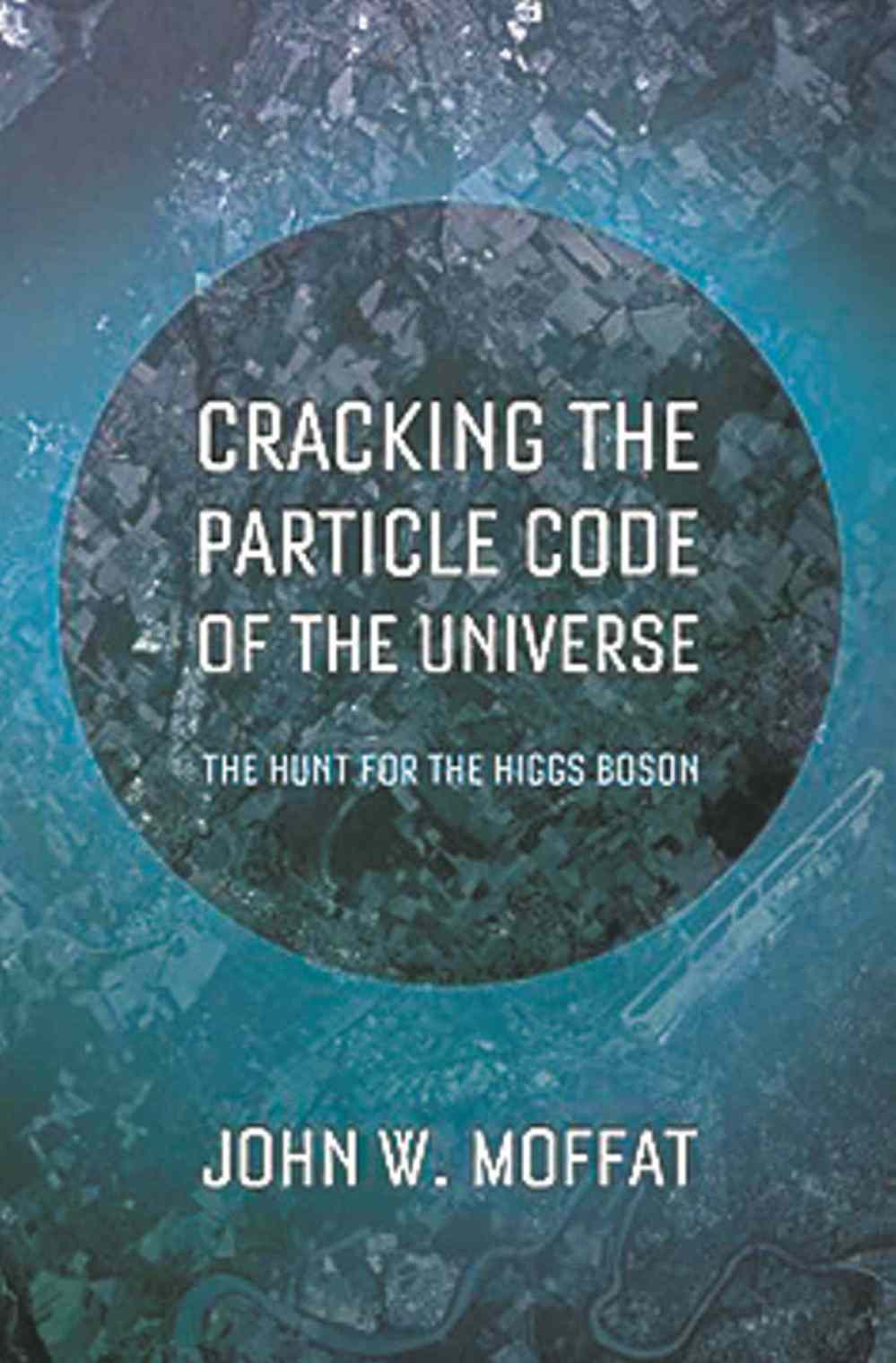
This is the playground for particle physicists such as John Moffat, professor emeritus of physics at the University of Toronto and a senior researcher at the Perimeter Institute for Theoretical Physics in Waterloo. In Cracking the Particle Code of the Universe, Moffat questions the holy grail of physics: the so-called “God particle.”
This is the elusive “Higgs boson” that is theorized to give everything in the universe its mass, and would effectively unify the four main forces in nature: electromagnetism, gravity and the “strong” and “weak” forces inside atoms.

In 2012, European physicists announced they may have found the Higgs boson, but Moffat doubts it exists.

To explain his reservations about the claimed success by CERN physicists, Moffat takes the reader on a grand tour de force, giving essentially a complete graduate seminar in particle physics. Along the way, we learn about the basic constituents of matter and the myriad subatomic particles that make up you and me.

There are quarks of different colours and flavours (although these attributes only describe different kinds of particles, not the way they actually taste), some with spins and some with charges — and then there are the antiparticles of each of them.

Cracking the Particle Code of the Universe attempts to make the visualizations of the particle interactions and collisions more understandable through the use of graphs and drawings, including vectors and Feynman diagrams, but the text is really designed for academics with some previous knowledge of physics, although some advanced casual science readers will be able to follow his discussion.

The more accessible portions of Moffat’s book give insight into his personal views, such as his caution that physicists come to their field with a certain amount of bias that reveals their human sides.

Moffat also notes that the search for the Higgs boson is an economic issue, since the quest involves funding for not only physicists at CERN but also researchers around the world whose work is dependent on the elusive particle.

He explains in detail how the search for a new particle is so dependent on the interpretation of data streaming from a multitude of sensitive detectors buried within the LHC device, and of physicists’ advocacy for one interpretation of a faint signal over another.

Moffat’s own theory of particle unity includes a particle he calls “quarkonium,” which solves some of the charge-and-spin issues that have been hampering the search for the Higgs. Yet he also acknowledges that the non-discovery of the Higgs boson may not be the end of particle physics if a unification particle cannot be found, as he notes a revolution in physics might be a good thing, after all. There are other problems in physics to solve that may keep CERN funded and running for years to come.

In 2013, Peter Higgs was awarded the Nobel Prize in physics for the discovery of the Higgs boson. But Moffat finds it “disturbing” that the calculated energies and parameters of the newly discovered particle don’t match well with physicists’ predictions.

CERN is undergoing maintenance for the next year or so. Perhaps in 2015, Moffat may be vindicated.


Chris Rutkowski is a science writer in Winnipeg.

History

Updated on Saturday, February 15, 2014 8:16 AM CST: Tweaks formatting.

Report Error Submit a Tip

More Stories

Rural residents ‘outraged’ property owner charged after shots fired during confrontation with alleged thieves: MLA

Zoe Pierce 5 minute read Preview

Rural residents ‘outraged’ property owner charged after shots fired during confrontation with alleged thieves: MLA

Zoe Pierce 5 minute read Thursday, Aug. 20, 2026

A rural Manitoba MLA says he has heard from constituents who are “shocked and outraged” that a 66-year-old man is facing charges after he fired shots at a group of people accused of stealing from his property.

Read
Thursday, Aug. 20, 2026

Wooed by wood, Cedarella founder takes pride in handcrafted designs

David Sanderson 8 minute read Preview

Wooed by wood, Cedarella founder takes pride in handcrafted designs

David Sanderson 8 minute read 6:00 AM CDT

Marina Bulan is the founder of Cedarella, a two-year-old venture that turns out eye-catching wood products such as jewelry, kitchen decor, children’s toys and, most recently, metre-high outdoor planters that double as home street-number indicators.

Ahead of immigrating to Winnipeg a decade ago from their native Russia, Bulan and her partner thought it would be prudent to conduct some research on their soon-to-be new home, a city they knew next to nothing about.

Imagine their surprise as they were viewing the 2007 surrealist film My Winnipeg, which comically blends historical facts about our burg with what Winnipeg-born writer/director Guy Maddin has termed “mystical hypothesizing.”

(For instance, there is no proof that, as reported in the award-winning flick, Winnipeg is the sleepwalking capital of the world, and that residents keep keys to their former abodes on their person in the event they turn up there during a bout of somnambulism.)

Read
6:00 AM CDT

Swede leads Manitoba Open, Winnipegger sits 33rd

Mike McIntyre 6 minute read Preview

Swede leads Manitoba Open, Winnipegger sits 33rd

Mike McIntyre 6 minute read 6:53 PM CDT

From Lars-Erik Sjoberg to Thomas Steen to Viggo Bjorck, there’s no shortage of Swedish athletes who have quickly become fan favourites here in Winnipeg.

Daniel Svard is hoping to add his name to the growing list.

Although he wields a golf club and not a hockey stick, the 23-year-old from Stockholm is opening plenty of eyes this week at Elmhurst. He carries a two-shot lead into Sunday’s final round of the Manitoba Open, looking to close out his first professional victory in his just his fourth career tournament.

Svard fired a six-under 66 on Saturday to move to 14-under through 54 holes of the PGA Tour Americas event.

Read
6:53 PM CDT

ER wait times have hit all-time highs in Winnipeg and are impacting nearly all aspects of hospital operations

Tom Brodbeck 16 minute read Preview

ER wait times have hit all-time highs in Winnipeg and are impacting nearly all aspects of hospital operations

Tom Brodbeck 16 minute read Yesterday at 6:00 AM CDT

On most days at Health Sciences Centre’s adult emergency department, all 58 treatment beds are filled with sick patients. Another dozen or so brought in by ambulance line the hallways on stretchers, with only one nurse to look after them.

Out in the waiting room, about 30 or 40 people — sometimes more — are slouched in chairs in pain or discomfort, waiting hours to see a doctor. Most have been assessed by a triage nurse, but many will have to wait 10 to 20 hours to be examined by a physician because there’s no room for them in the treatment area.

Some patients leave because they can no longer tolerate the excruciating wait, only to return days later, sicker than they were before.

Welcome to the emergency department at Manitoba’s largest hospital, where some of the highest-acuity patients seek medical care but now face delays that were unimaginable a few years ago.

Read
Yesterday at 6:00 AM CDT

‘We got attacked’: Carney says retaliatory tariffs on U.S. to take effect next month

Catherine Morrison and David Baxter, The Canadian Press 7 minute read Preview

‘We got attacked’: Carney says retaliatory tariffs on U.S. to take effect next month

Catherine Morrison and David Baxter, The Canadian Press 7 minute read Updated: 3:46 PM CDT

OTTAWA - Prime Minister Mark Carney says retaliatory tariffs will hit the U.S. starting next month after Canada walked away from what he called a "bad deal."

The U.S. introduced new 50 per cent tariffs on billions of dollars in Canadian exports on Saturday after trade talks failed.

"We got attacked," Carney told reporters on Parliament Hill Saturday when asked about the escalating trade war.

Carney suspended talks with the United States late Friday and summoned his negotiators back to Ottawa.

Read
Updated: 3:46 PM CDT

Plenty of alternatives to U.S. wines on the shelves

Ben Sigurdson 5 minute read Preview

Plenty of alternatives to U.S. wines on the shelves

Ben Sigurdson 5 minute read 6:00 AM CDT

In February 2025, Manitoba (and most other provinces) pulled American liquor from store shelves as part of the ongoing trade dispute with the United States.

Then in December, the province followed a similar course to others and put American booze that was already on hand back on shelves, selling off inventory that had been wasting away in warehouses for months, and directing proceeds from those sales to charities.

Lineups sprung up at numerous stores as consumers snapped up bestselling American products — think Maker’s Mark, Jack Daniel’s, Apothic Red and the like. After that initial rush, what was left has been languishing on shelves ever since, with many products eventually being drastically discounted for a quick sale, lest they become too long in the tooth.

I decided early on not to write about/review U.S. products in this space until things were well and truly sorted. But a few months back, I found myself in the mood for a big, oaky red wine and — in a moment of weakness, or nostalgia, or maybe just curiosity — I picked up a $30-ish California Cabernet Sauvignon.

Read
6:00 AM CDT