

The message school dress codes deliver

Advertisement
Read this article for free:
or
Already have an account? Log in here »
To continue reading, please subscribe:

Digital Subscription
One year of digital access for only $205*
- Enjoy unlimited reading on winnipegfreepress.com
- Read the E-Edition, our digital replica newspaper
- Access News Break, our award-winning app
- Play interactive puzzles
*First annual payment billed as $205.00 + GST for one year. This annual subscription will automatically renew at $233.00 + GST every 52 weeks (10% off the regular annual price of $259.35). Offer available to new and qualified returning subscribers only. Cancel any time.
To continue reading, please subscribe:
Add Free Press access to your Brandon Sun subscription for only an additional
$1 for the first 4 weeks*
- Enjoy unlimited reading on winnipegfreepress.com
- Read the E-Edition, our digital replica newspaper
- Access News Break, our award-winning app
- Play interactive puzzles
*Your next Brandon Sun subscription payment will increase by $1.00 and you will be charged $17.95 plus GST for four weeks. After four weeks, your payment will increase to $24.95 plus GST every four weeks.
Read unlimited articles for free today:
or
Already have an account? Log in here »
Hey there, time traveller!
This article was published 25/05/2015 (4091 days ago), so information in it may no longer be current.
It’s the same every year. With the warm, lilac-scented breeze of spring comes renewed debate on what constitutes appropriate dress for school.
A couple of weeks ago, Lauren Wiggins, a 17-year-old high school student from Moncton, N.B., was given detention for wearing a floor-length halter-top dress. She was told the dress was “inappropriate” and “a sexual distraction,” despite the fact that the only skin showing was that of her upper back and shoulders. Wiggins then was given a one-day suspension for writing a letter of complaint to her vice-principal which read, in part, “If you are truly so concerned that a boy in this school will get distracted by my upper back and shoulders, then he needs to be sent home and practise self-control.”
Also this month, a principal at a Guelph, Ont., high school advised students to keep it “scholarly, not skanky” when it comes to dressing for school — a comment that led to protests from students. And in March, Grade 6 girls at a school in Quebec were told not to wear leggings with short tops to school because their “cute little bums” might “encourage boys to touch them.”
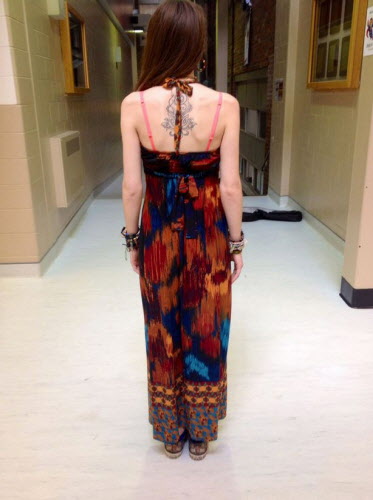
Those are just three recent stories, but there are plenty more, past and present. And, overwhelmingly, they are about female students who have been told their attire is “inappropriate” and “distracting.”
Dress codes aren’t new, and they exist, ostensibly, to maintain a safe and comfortable learning environment. Discouraging flip flops in auto shop, for example, is probably a good rule to have. But when schools outlaw halter dresses — or spaghetti-strap tank tops, or yoga pants, or whatever article of clothing we’re currently clutching our pearls about — via sexist dress codes, they’re not teaching them about professionalism. They’re teaching girls that their bodies are inherently sexual. They plant the seed, early on, that girls are responsible for any unwanted attention they receive.
The message being sent to boys is just as troubling: they are animals who can’t control themselves.
Sending a girl home to change — or suspending her for a day, effectively shaming her in front of her classmates — is far more detrimental to a learning environment than a halter dress or a pair of leggings.
This isn’t just a concern at the high school level. Last week, I received a tip from a reader about a Fort Rouge elementary school. The tipster said the school was “chiding” girls for wearing tank tops or dresses with spaghetti straps and that shorts had to be a certain length. It also said students were made to wear hoodies on a warm day.
Winnipeg School Division public relations officer Radean Carter couldn’t comment specifically on the school but says it’s possible the administration was being proactive in anticipation of questions from parents about what is and is not appropriate warm-weather clothing.
That’s because the division doesn’t actually have a formal dress code. Rather, it operates on a code of conduct that is handed out to students attending all of its schools at the beginning of the school year. The code of conduct simply mandates that students “dress appropriately for classes and school activities.” If that sounds vague, it’s because it is.
Because the word “appropriate” is open to interpretation, some guidelines might be given to parents by individual schools — such as straps must be two fingers wide and shorts must be two to three inches above the knee. Those guidelines apply to both boys and girls, Carter says. There’s only one very specific rule, and it relates to obscenities or discriminatory language on T-shirts.

“Ultimately, it’s up to parents to make sure students are dressed appropriately,” Carter says. “If they are comfortable and dressed in such a way that they’re safe, it’s fine.”
A tank top on a 10-year-old on might sound appropriate and safe to a parent, provided said student won’t be operating heavy machinery or frying something in hot oil that day. But a teacher or administrator might disagree. And that’s where it gets complicated.
We live in a culture that sexualizes girls. Outmoded, shame-based school dress codes don’t help dismantle that culture, but neither do well-meaning but vaguely worded codes of conduct that are open to interpretation — or misinterpretation as the case may be. Until we come up with a solution that doesn’t shame or sexualize female students, we can look forward to having this debate again next spring.
Oh, and those uniforms many of you are so fond of? Yeah, like those have never been sexualized via pornography or Sexy Schoolgirl Halloween costumes.
jen.zoratti@freepress.mb.ca
Jen Zoratti is a columnist and feature writer working in the Arts & Life department, as well as the author of the weekly newsletter NEXT. A National Newspaper Award finalist for arts and entertainment writing, Jen is a graduate of the Creative Communications program at RRC Polytech and was a music writer before joining the Free Press in 2013. Read more about Jen.
Every piece of reporting Jen produces is reviewed by an editing team before it is posted online or published in print – part of the Free Press‘s tradition, since 1872, of producing reliable independent journalism. Read more about Free Press’s history and mandate, and learn how our newsroom operates.
Our newsroom depends on a growing audience of readers to power our journalism. If you are not a paid reader, please consider becoming a subscriber.
Our newsroom depends on its audience of readers to power our journalism. Thank you for your support.
Jen Zoratti is a columnist and feature writer working in the Arts & Life department, as well as the author of the weekly newsletter NEXT. A National Newspaper Award finalist for arts and entertainment writing, Jen is a graduate of the Creative Communications program at RRC Polytech and was a music writer before joining the Free Press in 2013. Read more about Jen.
Every piece of reporting Jen produces is reviewed by an editing team before it is posted online or published in print – part of the Free Press‘s tradition, since 1872, of producing reliable independent journalism. Read more about Free Press’s history and mandate, and learn how our newsroom operates.
Our newsroom depends on a growing audience of readers to power our journalism. If you are not a paid reader, please consider becoming a subscriber.
Our newsroom depends on its audience of readers to power our journalism. Thank you for your support.
Related Articles
The real problem: a fixation with the female body
Advertisement Advertise With Us
Advertisement Advertise With Us