

While parties spar over recession, voters still left with difficult choice

Advertisement
Read this article for free:
or
Already have an account? Log in here »
To continue reading, please subscribe:

Digital Subscription
One year of digital access for only $205*
- Enjoy unlimited reading on winnipegfreepress.com
- Read the E-Edition, our digital replica newspaper
- Access News Break, our award-winning app
- Play interactive puzzles
*First annual payment billed as $205.00 + GST for one year. This annual subscription will automatically renew at $233.00 + GST every 52 weeks (10% off the regular annual price of $259.35). Offer available to new and qualified returning subscribers only. Cancel any time.
To continue reading, please subscribe:
Add Free Press access to your Brandon Sun subscription for only an additional
$1 for the first 4 weeks*
- Enjoy unlimited reading on winnipegfreepress.com
- Read the E-Edition, our digital replica newspaper
- Access News Break, our award-winning app
- Play interactive puzzles
*Your next Brandon Sun subscription payment will increase by $1.00 and you will be charged $17.95 plus GST for four weeks. After four weeks, your payment will increase to $24.95 plus GST every four weeks.
Read unlimited articles for free today:
or
Already have an account? Log in here »
Hey there, time traveller!
This article was published 01/09/2015 (4028 days ago), so information in it may no longer be current.
As we continue to navigate through an interminably long federal election campaign, one thing has become perfectly clear.
We will not suffer a shortage of hyperbole.
Economic data released Tuesday – which confirmed that Canada’s economy continues to struggle – injected a new measure of embellishment and exaggeration into a campaign that has already been pretty melodramatic.
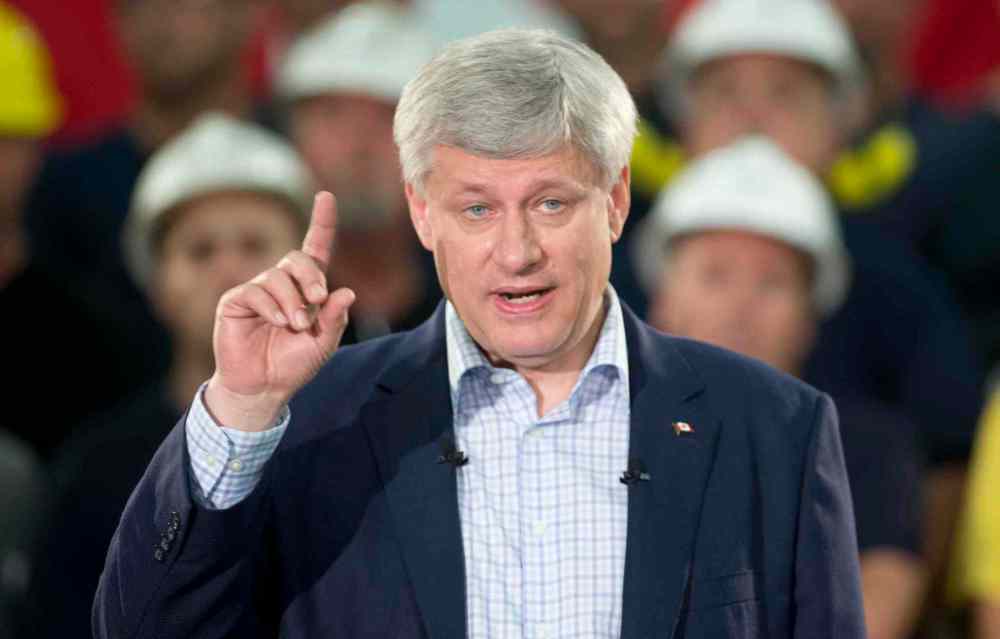
For several weeks, Liberal Leader Justin Trudeau and NDP Leader Tom Mulcair have been hammering the Conservative government and its leader, Stephen Harper, for driving Canada into an economic ditch. Tuesday’s release of GDP data – the principal measurement of the overall health of an economy – only served to ratchet up those allegations.
GDP numbers for the second quarter of 2015 (April-June) showed a contraction. That means Canada’s economy has shrunk in two consecutive quarters thanks to continued low prices for resource commodities and anemic growth in other sectors.
The Conservatives are desperate to draw a new line between “technical” recession and “real recession.” In a display of semantic gymnastics worthy of an Olympic medal, the prime minister has said the hard GDP numbers, which reflect a technical recession, are not necessarily an accurate measure of the health of the economy.
In Harper’s analysis, only the energy sector is shrinking; all other sectors of the economy are functioning robustly. His view is supported by some economists, and rejected by others. “I think it’s more important to describe the reality of the situation, rather than labels,” Harper told reporters on Monday.
The lines Harper is trying to draw are mostly meaningless. Although there is no consensus metric for declaring an economy in recession, the fact is that Canada’s economy is moribund. Don Drummond, a former bank economist who now teaches at Queen’s University, said it best.
“It really doesn’t matter if it’s slightly below zero (per cent growth) or slightly above zero – it’s weak,” Drummond told CTV on Tuesday.
The fact that Canada is suffering through a period of weak economic performance has certainly become the biggest stick with which the opposition leaders are whipping the incumbent government. Unfortunately, like Harper’s claims that the economy is fine, it’s a mostly meaningless, highly misleading line of attack.
Mulcair on Tuesday repeated his claim that the Conservative economic plan “is not working.” In making this allegation, Mulcair certainly suggests that a different federal government, once formed by the NDP, would deliver a plan that would grow the economy to the benefit of all Canadians. The NDP have made a number of bold proposals during this campaign, but it is unlikely anything he has suggested would serve as an antidote to the current economy malady affecting the country.
Trudeau and the Liberals have probably come a bit closer to a platform that would deliver a bump to the economy with its ambitious, 10-year $125-billion infrastructure plan. That is roughly twice what the Conservatives have planned, and more than the NDP has described.
Trudeau has also admitted he would run deficits for three fiscal years in order to keep his promises on infrastructure and other spending measures. In doing that, Trudeau has staked his fortunes on a broader economic plan that would see Ottawa try to make a more significant overall contribution to economic growth.
Would the Liberal plan counteract the conditions we’re seeing right now? Again, the global forces that have slowed economies around the world are too big and too complex to be undone with increased government spending alone.
In fact, both the Harper government (which continues to be obsessed with balancing the federal budget at any cost) and the opposition leaders (who attack Harper with the fallacious suggestion they would be better at managing the economy) are doing voters a disservice by dwelling on the GDP numbers.
The issue here is not whether the economy is in recession or not. The bigger issue is determining the role and function of government within that economy, regardless of the state of GDP.
In short, the Conservatives are promising a smaller government that, in general terms, will do less and play a less important role in the funding of key services. A slow economy actually plays well into the Conservative master plan; low economic growth, partnered with aggressive tax reductions, makes shrinking government a virtual necessity.
However, it also means less of the things that government does. From provincial transfer payments to other cost-shared services, provinces and municipalities are already struggling to deal with Harper’s drive for a smaller government.
The Liberals and the NDP, on the other hand, offer somewhat different visions for a government that plays a larger role in the future. Trudeau has been most bullish on selling voters a future that includes a federal government that does more; the NDP, with its vague promise of balancing the budget immediately, could find itself in a very similar situation as the Tories, particularly if the economy continues to struggle.
The decision for voters is pretty simple, but it’s not easy: a choice between a government that does less but takes less in taxes; and a government that does more but offers little or no tax relief.

It seems inevitable that, for the time being, the party leaders will continue to spar over the meaning of the economic data, while trading lies and myths about who is responsible and who has the magic formula for fixing the economy.
In the end, this debate will overshadow a much more important equation for the future of the country. Namely, determining the size, scope and influence of the federal government in the lives of all Canadians. Regardless of economic conditions.
Let’s hope that all the leaders take a breather from battering each other with spread sheets to talk more about that.
dan.lett@freepress.mb.ca
Dan Lett is a columnist for the Free Press, providing opinion and commentary on politics in Winnipeg and beyond. Born and raised in Toronto, Dan joined the Free Press in 1986. Read more about Dan.
Dan’s columns are built on facts and reactions, but offer his personal views through arguments and analysis. The Free Press’ editing team reviews Dan’s columns before they are posted online or published in print — part of the our tradition, since 1872, of producing reliable independent journalism. Read more about Free Press’s history and mandate, and learn how our newsroom operates.
Our newsroom depends on a growing audience of readers to power our journalism. If you are not a paid reader, please consider becoming a subscriber.
Our newsroom depends on its audience of readers to power our journalism. Thank you for your support.
Dan Lett is a columnist for the Free Press, providing opinion and commentary on politics in Winnipeg and beyond. Born and raised in Toronto, Dan joined the Free Press in 1986. Read more about Dan.
Dan’s columns are built on facts and reactions, but offer his personal views through arguments and analysis. The Free Press’ editing team reviews Dan’s columns before they are posted online or published in print — part of the our tradition, since 1872, of producing reliable independent journalism. Read more about Free Press’s history and mandate, and learn how our newsroom operates.
Our newsroom depends on a growing audience of readers to power our journalism. If you are not a paid reader, please consider becoming a subscriber.
Our newsroom depends on its audience of readers to power our journalism. Thank you for your support.
Related Articles
Liberals win 4th mandate as NDP vote collapses and Singh announces he will resign



Advertisement Advertise With Us
Advertisement Advertise With Us