

Put deficits to work; invest in social programs
Advertisement
Read this article for free:
or
Already have an account? Log in here »
To continue reading, please subscribe:

Digital Subscription
One year of digital access for only $205*
- Enjoy unlimited reading on winnipegfreepress.com
- Read the E-Edition, our digital replica newspaper
- Access News Break, our award-winning app
- Play interactive puzzles
*First annual payment billed as $205.00 + GST for one year. This annual subscription will automatically renew at $233.00 + GST every 52 weeks (10% off the regular annual price of $259.35). Offer available to new and qualified returning subscribers only. Cancel any time.
To continue reading, please subscribe:
Add Free Press access to your Brandon Sun subscription for only an additional
$1 for the first 4 weeks*
- Enjoy unlimited reading on winnipegfreepress.com
- Read the E-Edition, our digital replica newspaper
- Access News Break, our award-winning app
- Play interactive puzzles
*Your next Brandon Sun subscription payment will increase by $1.00 and you will be charged $17.95 plus GST for four weeks. After four weeks, your payment will increase to $24.95 plus GST every four weeks.
Read unlimited articles for free today:
or
Already have an account? Log in here »
Hey there, time traveller!
This article was published 01/09/2015 (4000 days ago), so information in it may no longer be current.
To deficit, or not to deficit. Is that the question?
Justin Trudeau seems to think so. In a major speech last week, he announced if the Liberals form the next government, they would not balance the budget.
Instead, they promised to run at least three years worth of deficits to invest in infrastructure as a way of getting the economy going again.
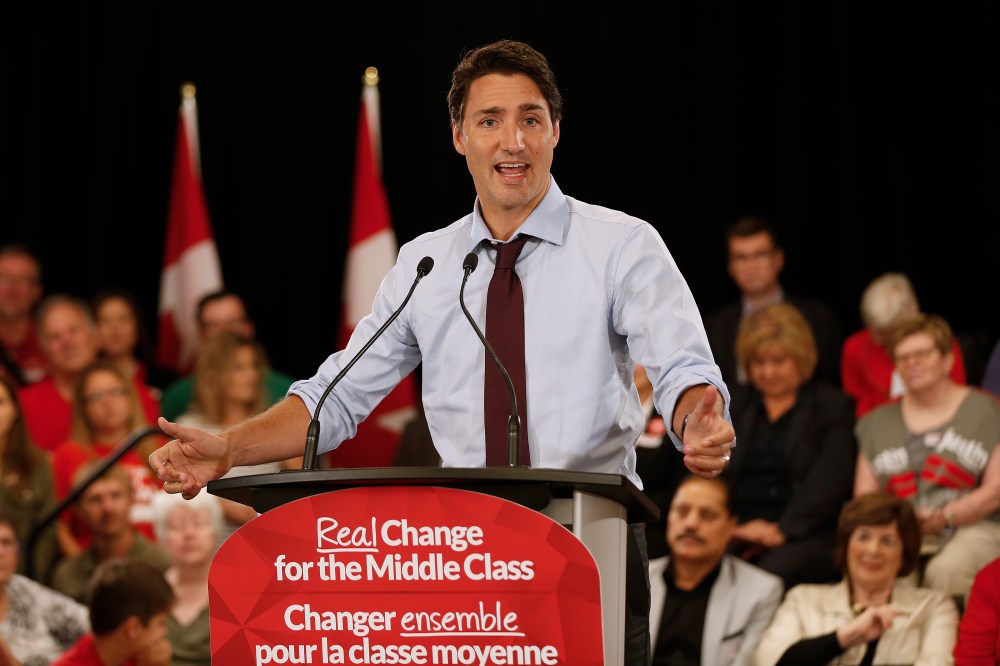
Borrowing in order to do so, Trudeau claimed, also made sense with interest rates at historic lows.
Trudeau’s most transparent intent is to put clear blue water between his Liberals and Thomas Mulcair’s NDP, which has committed itself to balanced budgets. The other, less commented on, motive is to draw votes away from the Harper Conservatives by showing the Liberals, too, have a strategy for growth, one that does not involve taxing the rich and even involves juicy contracts for low-competition, one-of-a-kind projects for large corporations.
Those who see Trudeau’s announcement as breaking the taboo against deficits that has been so dominant in our political culture are not entirely wrong. But that’s not to say there hasn’t been momentum building behind this new bandwagon.
John Maynard Keynes, the greatest economist of the 20th century, believed deficits were not the deadly economic policy sin they are portrayed to be.
Further, he viewed them as virtuous, helping address stagnation by undertaking the investment and job creation the private sector was too enervated to create.
Amid the post-2008 “new normal,” a whole range of economists, from Joe Stiglitz to Larry Summers, have been acknowledging fiscal stimuli are increasingly necessary to break out of stagnation.
Moreover, anti-austerity majorities are awakening — Scotland or Greece, to take two recent examples. In the U.K., in a stunning turnaround, left-winger Jeremy Corbyn is the bookies’ favourite to lead the Labour Party, with anti-austerity policies commanding wide electoral support.
In Canada, Kathleen Wynne’s Liberals showed one could win an election by promising public investment-led growth. And a veritable chorus of prominent Liberals, from ex-finance minister Paul Martin to former Bank of Canada governor David Dodge and former clerk of the Privy Council and head of BMO Financial Group Kevin Lynch, has chimed in with Trudeau.
Given the Martin Liberals did more than most to impose and enforce the taboo against deficits, one is glad of their none-too-early Damascene conversion.
The taboo has hung over economic policy for far too long, making it more restrictive and contractionary than it ever needed to be, slowing growth and heightening inequality by forsaking a key instrument in every government’s macroeconomic policy toolkit.
The rational kernel of the argument for deficits is simple. Since 2008, western governments have been united in relying on monetary policy alone to revive growth: if interest rates are kept low enough for long enough, they aver, eventually the private sector will borrow, invest and spend. However, seven long years later, it’s time to give up that ghost of a theory. As Keynes knew, there are times when easy monetary policy alone will not work, when it will be as effective as “pushing on a string.”
Whether or not to run deficits is only one part of the issue: the other is what for? Not all deficits are equal.
Right-wing governments can run up deficits cutting taxes for the rich and waging wars — as George W. Bush and Stephen Harper have shown.
Through most of Canada’s own postwar history, deficits have been incurred for spending on socially useful purposes. And, contrary to the widespread equation of welfare spending and deficits, many Scandinavian social democratic governments, such as Sweden’s, ran surpluses even as they maintained large welfare states.
Trudeau may have broken the anti-deficit taboo, but the far greater taboo is that against expanding public provision — on health, research, education, housing and other common and public services.

Polls conducted across the western world show people are willing to pay higher taxes for better and more public and common services.
An ambitious program of public investment in these areas is what Canada really needs to achieve growth and meaningful increases in welfare.
That is what will make ending the decade-long Conservative rule meaningful to most Canadians.
Radhika Desai is a political studies professor and the director of the Geopolitical Economy Research Group at the University of Manitoba.
Related Articles
Liberals win 4th mandate as NDP vote collapses and Singh announces he will resign







Advertisement Advertise With Us
Advertisement Advertise With Us
History
Updated on Tuesday, September 1, 2015 7:35 AM CDT: Adds photo