

Here’s an overview of the pocketbook-minded promises made in the campaign
Advertisement
Read this article for free:
or
Already have an account? Log in here »
To continue reading, please subscribe:

Digital Subscription
One year of digital access for only $205*
- Enjoy unlimited reading on winnipegfreepress.com
- Read the E-Edition, our digital replica newspaper
- Access News Break, our award-winning app
- Play interactive puzzles
*First annual payment billed as $205.00 + GST for one year. This annual subscription will automatically renew at $233.00 + GST every 52 weeks (10% off the regular annual price of $259.35). Offer available to new and qualified returning subscribers only. Cancel any time.
To continue reading, please subscribe:
Add Free Press access to your Brandon Sun subscription for only an additional
$1 for the first 4 weeks*
- Enjoy unlimited reading on winnipegfreepress.com
- Read the E-Edition, our digital replica newspaper
- Access News Break, our award-winning app
- Play interactive puzzles
*Your next Brandon Sun subscription payment will increase by $1.00 and you will be charged $17.95 plus GST for four weeks. After four weeks, your payment will increase to $24.95 plus GST every four weeks.
Read unlimited articles for free today:
or
Already have an account? Log in here »
Hey there, time traveller!
This article was published 10/10/2015 (3994 days ago), so information in it may no longer be current.
Promises, promises: there are so many made during an election it’s tough to keep up.
In particular, political parties have set their platform sights squarely on our pocketbooks.
Almost daily, the Conservatives, Liberals, New Democrats and Greens are serving up a new pledge to tease and stroke your wallet. And while most folks are somewhat familiar with one or two promises — such as the NDP’s $15-a-day daycare — after more than two months of campaigning, it might be difficult to remember which party is promising what.
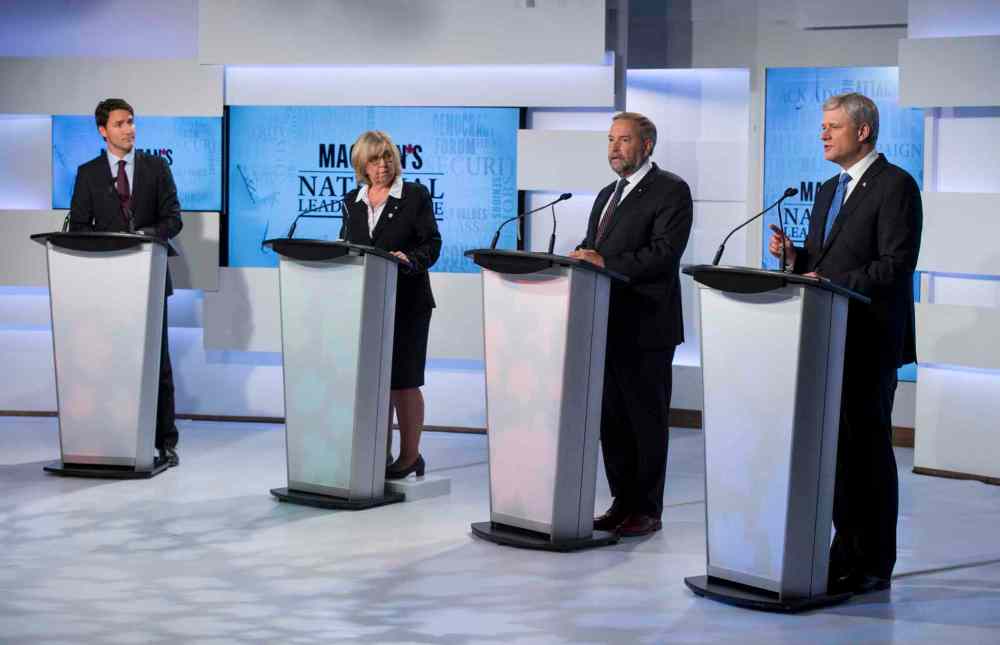
To that end, here’s a brief survey of the political landscape of most of the pocketbook-minded promises made thus far.
The Conservatives

The ruling party always has the advantage of rolling out its election goodies before dropping the writ. And that’s certainly the case with respect to your wallet this time around. The Tories hiked the universal child care benefit (UCCB) late last year from $100 a month to $160 for children under six and expanded coverage so now children age six to 17 also attract monthly cheques worth $60.
The Harper government also put in place the family tax cut, allowing income splitting for families that can still afford to live on one income, says David Macdonald, senior economist for the Canadian Centre for Policy Alternatives. Other pre-election changes affecting Canadians’ bottom lines are increasing the annual TFSA (tax-free savings account) contribution limit to $10,000 from $5,500, and lowering the mandatory minimum withdrawals for registered retirement income funds (RRIFs) for retirees.
Since the campaign got underway, the Conservatives have played it relatively safe, says Alex Laurin, director of research for the CD Howe Institute. “The biggest announcement so far for them is they will not raise taxes of any kind for Canadians for the next four years.” In fact, the Conservatives have promised to lower them slightly by reducing employment insurance (EI) premiums. Other changes involve increasing the pension income tax credit for single and widowed pensioners from $2,000 to $4,000. The Tories will also bring back the home renovation tax credit worth up to $600 in tax savings. And a Conservative government would increase the available grants on the first $500 of annual contributions to both the registered education savings plan (RESP) and the registered disability savings plan (RDSP).
The Liberals

The Grits’ main thrust is rolling out a new child-benefit regime — the Canada child benefit — that would unify many of the current programs under one umbrella. “They’re going to eliminate all the other programs — like the UCCB and the child tax benefit — and combine them into the new program that will operate somewhat similarly, only simpler,” Macdonald says. According to the Liberals, it will actually increase the amount families receive per child over the current set-up, in large part because the benefit would be tax-free unlike the UCCB. “The Liberals would take the Conservatives’ cheque-sending approach, but in contrast to the UCCB, they wouldn’t send cheques to high-income households.”
The Liberals offer a number of examples on their website of how the benefit matches up with the current system. For example, a two-parent family earning $90,000 per year with two children would get $490 a month tax-free compared with about $275 a month after tax under the current system. The Liberals also contend about half the additional cost of the program would be paid for by eliminating the family tax cut. The other $2 billion would come from somewhere else, yet to be identified.
Another pillar of the Liberal platform is hiking taxes for earners making more than $200,000 annually to 33 per cent from 29 per cent while families earning between about $44,000 and $90,000 would see their taxes lowered slightly to 20.5 per cent from 22 per cent. Other changes include expanding EI and CPP coverage, increasing the guaranteed income supplement (GIS) for seniors and lowering old age security (OAS) from 67 to 65. “Like the Conservatives, they’re also coming out with niche promises for certain groups, like teachers who will get a tax credit for school-supply expenses worth up to $150 in tax savings annually,” Laurin says.
The Greens

Sure, the Green party has a snowball’s chance in Phoenix of winning the election, but that hasn’t stopped them from setting forth a revolutionary platform. (In fact, that’s probably why they can go so far afield.) “Wow; wow… I don’t know if it’s realistic,” Laurin says with a chuckle about their major platform policy — a carbon tax.
While this and other policies may seem like pie in the sky, at least the Greens have actually gone through the trouble of drawing up budget line numbers on their website to cost their programs, matching them with projected revenues for the next four years. And the aforementioned carbon tax would be among the biggest sources of revenue. The tax is fairly straightforward: the more you pollute, the more you pay. And according to their numbers, we’d collectively pay about $22 billion annually. Yet the Greens state this would be revenue-neutral tax because it would be paid back to Canadians as a dividend. So the incentive is the less you pollute, the more you would receive, because you could be paying very little in carbon taxes but still receiving an equal share of the dividends.
Besides its other major promise of eliminating tuition for post-secondary education by 2020, the Green party would offer tax credits for energy-efficiency upgrades to your home and rebates for purchasing an electric car. The Greens also want to eliminate income tax for people earning less than $20,000 a year and cancel “boutique tax credits” such as those for enrolling children in sports and arts programs. And they also would institute a new tax on estates exceeding $1 million. (As an interesting aside, the Greens have also included revenues from legalizing and taxing marijuana — between $2 billion and $5 billion annually. Perhaps this is an indication of where the Liberals, also pledging to ‘legalize it,’ plan to find the revenue to pay for the other half of their Canada child benefit program.)
The NDP

The NDP’s biggest platform promise that will affect many working families is its national daycare program the party contends would create one million daycare spaces at just $15 a day per child.
“It’s a phased-in program, so next year you wouldn’t have $15-a-day child care,” Macdonald says. “But by the end of the term, it would be more or less in place.” This program resonates most with families in major urban centres such as Vancouver and Toronto, where daycare can cost three digits a month, but it should play well here, too, where spaces are scarce and costs are generally more than $15 a day, he adds. Where it won’t do much for the NDP is in its stronghold, Quebec, where a provincial daycare program already exists. Still, Quebec is proof government-funded daycare can increase family wealth, because about 10 per cent of mothers went back to work when it launched its program, Laurin says. “So it would likely help the bottom line for some families with young children.”
The NDP also has a number of other promises generally aimed at helping lower-income Canadians, including lowering OAS eligibility to 65 from 67 and increasing GIS for low-income seniors. It also wants to expand CPP and EI coverage. The New Democrats will also eliminate the family tax cut, but they will keep the UCCB in place while strengthening the national child benefit supplement and the working income tax benefit. The NDP would also reduce the TFSA limit to $5,500 from $10,000 a year.
Exit-poll parting thoughts…
The above list is by no means comprehensive. Nor is it suggesting your pocketbook should drive how you vote, given all the other important issues to consider: climate change, infrastructure deficits, public spending, geopolitics, indigenous affairs and crime — just to name a few. Yet, if concerns about your wallet drive you to the polling station, so be it. At least you’re exercising your democratic right. With only about six in 10 eligible voters actually casting a ballot, any promise compelling people to vote is undoubtedly worthy.
Related Articles
Liberals win 4th mandate as NDP vote collapses and Singh announces he will resign






Advertisement Advertise With Us
Advertisement Advertise With Us