

Smart policing, safer city
Analysis of crime statistics drives Winnipeg Police game plan

Advertisement
Read this article for free:
or
Already have an account? Log in here »
To continue reading, please subscribe:
Monthly Digital Subscription
$1 per week for 24 weeks*
- Enjoy unlimited reading on winnipegfreepress.com
- Read the E-Edition, our digital replica newspaper
- Access News Break, our award-winning app
- Play interactive puzzles
*Billed as $4.00 plus GST every four weeks. After 24 weeks, price increases to the regular rate of $19.95 plus GST every four weeks. Offer available to new and qualified returning subscribers only. Cancel any time.
Monthly Digital Subscription
$4.99/week*
- Enjoy unlimited reading on winnipegfreepress.com
- Read the E-Edition, our digital replica newspaper
- Access News Break, our award-winning app
- Play interactive puzzles
*Billed as $19.95 plus GST every four weeks. Cancel any time.
To continue reading, please subscribe:
Add Free Press access to your Brandon Sun subscription for only an additional
$1 for the first 4 weeks*
- Enjoy unlimited reading on winnipegfreepress.com
- Read the E-Edition, our digital replica newspaper
- Access News Break, our award-winning app
- Play interactive puzzles
*Your next Brandon Sun subscription payment will increase by $1.00 and you will be charged $17.95 plus GST for four weeks. After four weeks, your payment will increase to $24.95 plus GST every four weeks.
Read unlimited articles for free today:
or
Already have an account? Log in here »
Hey there, time traveller!
This article was published 08/01/2016 (3770 days ago), so information in it may no longer be current.
A motorist speeds down a street in east Winnipeg unaware of being watched.
A nearby Winnipeg police officer hits his cruiser’s lights and sirens and, a short time later, issues a speeding ticket.
Simple, basic policing, right?
It’s more than that. The officer, armed with data crunched by crime analysts back at the district office, knew this stretch of road near Concordia Hospital was a ‘hot spot’ for infractions. And he, along with other officers, had been targeting the area in an effort to cool down the number of offences.
That, at its core, is what the Smart Policing Initiative is all about — a proactive policing strategy that is being adopted by police departments around the world.
SPI, approved in the WPS strategic plan for 2015-19, is thus: compile information about offenders, add in high-risk locations and vulnerable crime targets and have analysts look for trends and related information, which is forwarded to front-line officers.
The intelligence-led approach is getting results.
“I think we’re one of the only police departments that can back this up,” Insp. Greg Burnett said recently. “At the end of the day, it is the men and women doing this day in and day out with their own discretion and skills that make this a success.”
Winnipeg’s crime rate has been steadily declining in recent years. Violent crime incidents dropped 24 per cent last year. The violent-crime severity index for the city dropped more than 37 per cent from 2009 to 2013. Youth crime is going down. Property crimes have gone down 27 per cent from the previous five-year averages.
But, the city still has the highest violent-crime severity index in the country. It held the dubious honour of having the second-highest homicide rate of all of Canada’s metropolitan areas in 2013. Manitoba’s youth violent-crime severity index topped all provinces in 2013 and was more than twice the Canadian average.
Winnipeggers spoke at public meetings about how they felt they weren’t safe in some city neighbourhoods. The WPS and the Winnipeg Police Board heard them and wanted to do more.
Enter SPI. First, in the WPS’s sprawling east district, which takes in all of Winnipeg east of the Red River; to be followed by the rest of the city.
“It’s one thing to give voice to the community, but if you do, you have to pay attention,” said WPS Deputy Chief Dave Thorne.
SPI first gained traction in Winnipeg in the fall of 2012, when Thorne, as the officer in charge of the service’s general patrol division, called Rick Linden for advice.
Linden, a professor at the University of Manitoba who teaches criminology courses, was a key driver in setting up Winnipeg’s auto-theft-prevention strategy, which reduced the number of stolen vehicles by more than 80 per cent, and he is on the committee that manages Winnipeg’s gang response and suppression program.
Thorne said there was a group of inspectors who knew they needed a different method to tackle crime and traffic offences.
“We needed to provide an environment for our members where they could make more of a difference in our community,” he said. “We wanted to have more impact on crime and make the city a safer place.”
SPI was the result of the conversation, Thorne said.
Linden provided two graduate students who went into the east district station to work alongside officers to set up the program.
Thorne said the reports produced by crime analysts and officers help shape the day of the officers the public sees on the streets and in cruisers.
“They give directions to members where the hot spots are, what time and day of week to go, what performances to do,” he said. “There’s no point having members looking for crime at 3 p.m., when it is happening at 3 a.m.”
Aside from identifying high-risk offenders and potential crime areas, the SPI strategy also asks officers to reduce crime in non-traditional ways, including promoting the development of economic, social, health and educational measures.
It’s not uncommon for officers to attend community events, go to community clubs and reach out to organizations such as Macdonald Youth Services.
“Let’s not be reactive anymore,” Thorne said. “We need to respond in a more prevention and intervention approach.
“If we keep dealing with just the symptoms of crime it will be like (the movie) Groundhog Day. We’ll just keep doing the same things every day.
“We’re trying to reduce the levels of violence in the crime rate to an acceptable level. People in the North End have every right to feel as safe as people in Fort Garry.”
Thorne said what slows down SPI — and other police work — is the amount of non-crime calls officers receive.
“About 75 per cent of what drives police work are non-crime-related issues,” he said. “What churns up a lot of time is public intoxication, mental-health issues and homelessness. For us to give our officers more proactive time, we need to work better with our partners.”
Thorne said these include the Main Street Project and Health Sciences Centre.
“We need to identify high users of the system. If we do this, it reduces the time spent by our officers and allows them to spend more time on core policing.”
East district Staff Sgt. Jim Anderson said he looks at SPI as one more instrument in the police work kit.

“The officers may already know a park or a bar in their area that is problematic,” Anderson said. “Through SPI, we provide them (with more information) to use their craftiness… that’s why it is important for people to report even small crimes.
“We all wish we had this when we were street constables.”
The new approach is a shift from the “reactionary police model” of the last two decades, Burnett said.
“A call comes in and you react. But that has caused an erosion of police skills. We want to get our people back to thinking and problem-solving. We want general patrol, detectives and community support to bring the entities all together and share information. Break down the silos,” he said.
“If you want to reduce crime and increase community policing, the proactive policy is the way to go, not reactionary.”
It doesn’t mean Winnipeg officers will only do SPI-type policing.
“Reactive is still the main area we do, we still react to calls,” Burnett said. “This proactive area is during officers’ discretionary time. They self-manage themselves.
“We’re taking old-school and injecting science and analysis.”
Const. Cal Bailey is taking an unmarked cruiser for a late-night ride through the east district.
Bailey taps a few keys on the cruiser’s computer and calls up a list of people who have been tagged by the division’s crime analysts as most in need of being looked in on to see if they are obeying curfew.
“In my area, I have 14 guys that need to be checked,” he said.
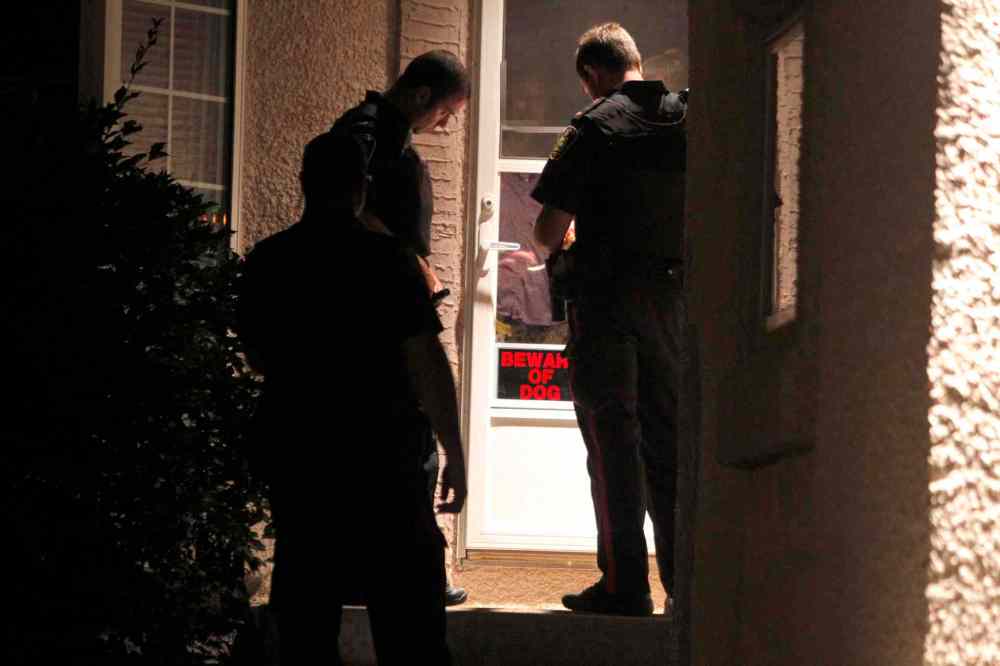
Shortly after, on a dimly lit street in a St. Vital subdivision, two uniformed officers walk up to a modest two-storey house around 11 p.m.
“Typically, curfews are in force from 10 (p.m.) to 7 (a.m.),” Bailey said, joining the officers.
They knock on the front door, a light comes on upstairs and the door opens, but the screen door remains shut while the officers speak with a woman inside.
The person on curfew isn’t there: he moved.
“Apparently, it is his girlfriend’s house, and he had permission to leave from his support worker,” Bailey said, dialing the worker’s number to confirm what the woman said was true.
“We’ll still go to his new residence. Today, with cellphones, he could be talking to the worker from Brandon.”

A few minutes later, elsewhere in St. Vital, the man answers his door and, after a brief conversation, his name is entered into the cruiser’s computer as having been checked successfully.
“He was there and he was complying — but, obviously, he was expecting us,” Bailey said chuckling, noting the girlfriend gave him a heads-up.
According to Bailey, curfew checks (research shows 20 per cent of offenders commit 80 per cent of crime) reduce crime because, “If they are complying, great, but if not, they’re put back into the court system. And we see crime in the area go down.”
East district Sgt.-Det. Darrin Kruger, who puts together the bulletins that are sent to the officers, said he knows SPI is working.
“I noticed a rash of residential break-ins (in an area),” Kruger said. “I put together a bulletin and put it out. There was a huge spike of officers to the area, and the number of break-ins has lowered down to zero lately.”
Const. Jason Dyck, another east district officer using SPI, said the example shows the ultimate goal of reducing crime can be reached even with “no arrests. It was the police visibility which stopped it.”
Dyck said it is up to the individual officers whether they want to work on a crime-related SPI bulletin or a traffic-related one.
“If it’s one (o’clock) in the afternoon, you’re not going to do curfew checks,” he said. “Or if it’s night, you might do curfew checks. They pick and choose. It is focused in the area.”
Trends and problems identified
Sitting in front of a computer, Sheri Bell is one of six Winnipeg police crime analysts. Bell reads reports from officers on the street, crunches statistics, gazes at maps and even checks the weather, which also has an impact on when offences occur. She then sorts and aggregates the information.
From that, Bell helps formulate reports going out to the general patrol officers that points them towards not only the people who need curfew checks, but hot spots of crime and traffic infractions.
“I look at all of the crime that occurs, and I identify trends and problems,” Bell said. “Have we had a number of break-and-enters? Then I start digging to look for similarities. Then I alert the officers about what is happening.”
Bell said part of her role is to look at what is happening throughout the entire police district.
“I create target areas for uniform officers to go out during their discretionary time. They can go out to high-problem areas and do high-profile policing.”
Such high-profile policing — just driving a cruiser in the area or getting out and walking the beat for a bit — reduces crime, she said.
“You don’t necessarily see a lot of big arrests or drug busts or seizures of drugs. It’s highlighting locations with a problem and, just with police visibility, the problem is declining.”
But Bell said the real credit should go to the front-line officers who take the information and act on it. “What they do every day is amazing. There’s real buy-in. And now we’re seeing a lot of the crime rates have dropped.”

There had been an 18 per cent drop in crime overall from 2014 to 2015 in the St. Boniface part of the east division, including a 35 per cent decrease in the number of disputes and fights, a 23 per cent drop in vehicle thefts, a three per cent drop in thefts and a two per cent drop in mischief.
Bell said certain calls for service have also declined, including 42 per cent fewer vice-crime calls, 29 per cent fewer disputes-fights calls, 26 per cent fewer weapons calls and seven per cent fewer break-and-enter calls.
She said the Elmwood area of the division has also experienced improvements: overall crime dropped eight per cent, including 14 per cent fewer assaults, compared to the previous year.
As well, Bell said there’s been a 35 per cent increase in the number of arrests in Elmwood since the SPI project began in 2014, triple the number of seizures, and the number of people in the area with active warrants went to 36 from 133.
“We know crime is on the decline, but in areas with this project, crime is on larger declines,” she said. “I’ve been surprised by just how well the program is working. I didn’t expect to see such dramatic drops.”
A quick check of the computer, and Bailey’s cruiser heads to another address in St. Vital. It’s 11:45 p.m., time for a curfew check on a man who had been released on parole after serving a prison sentence for manslaughter.
The three officers walk up the darkened driveway of the unlit, single-storey home. Police knock on the door, a light comes on, and a few seconds later a man opens the door. It’s not long before officers return to their cruisers.
“He was very short with us. He doesn’t like us being there. He has been checked 12 times this year.”
There is a reason, Bailey said.
“(The crime analyst) has a list of everyone with a curfew in the district. If they notice someone hasn’t been seen for a couple of weeks, we go.”
It’s now closer to 1 a.m., and no one is walking the main street in Transcona as the police cruiser turns down another street and into an alley. After passing the back doors of a few buildings, the vehicle rolls to a stop behind a small park with a bandstand.
No one is here, but that’s the point of his stop, according to Bailey.
Analysis has determined this is one of the so-called hot spots of negative activity.
“There have been complaints about noise,” Bailey said. “You can see the sign. No one is supposed to be here after 11 (p.m.). No one is here, and that’s the goal we wanted to accomplish.”
Bailey said officers came on other evenings and met with the teens who had been congregating in the park. The teens no longer go there at night.
“Sometimes, it’s just our presence that does it. That’s why we’re here tonight.”
A quick drive a short distance away leads to another hot spot: the parking lot beside a local centre for senior citizens where youth would noisily meet.
“I called their parents,” Bailey said. “Now they don’t come here. It has now been two weeks, and nothing has happened.
“Sometimes, you just have to do policing a little different. If I wag my finger at them, nothing would happen. But if I talk to their parents, well, you can see what’s happened.”
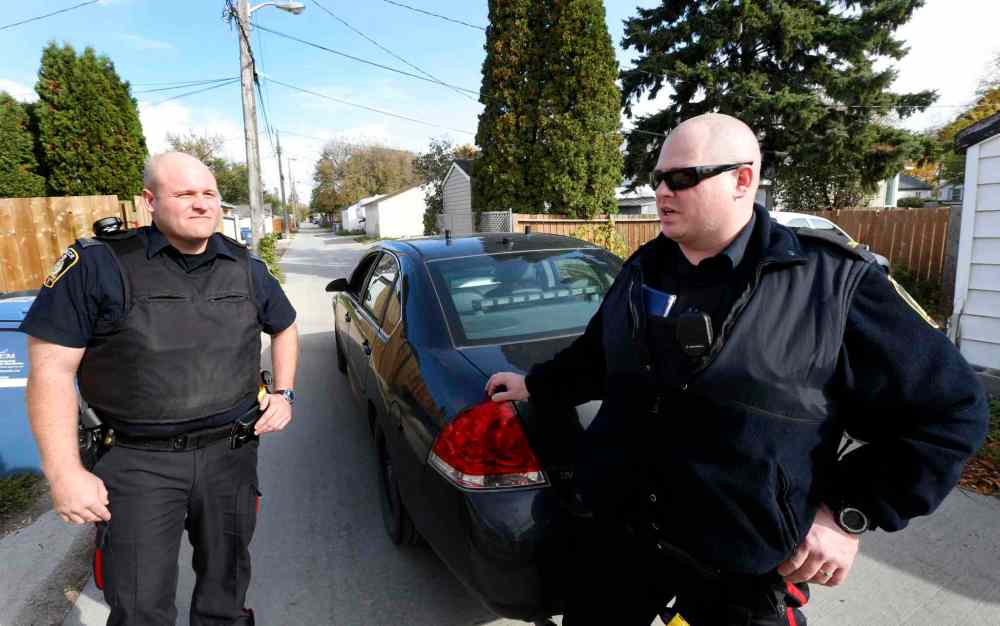
It’s a gorgeous, sunny afternoon with blue skies and, this time, the cruiser is being driven by Const. Stephen McIntyre, with Const. Justin Hicock in the jump seat.
They are in an alley in the older area of St. Vital, a few blocks off St. Anne’s Road. Most residents are either at work or elsewhere.
That’s probably why the area became a hot spot. The computer tells the officers thieves have been targeting garages.
Today, there’s no sign of suspicious activity, but McIntyre said just the act of driving the alleys every so often serves as a deterrent. His partner agrees.
“Depending on how many calls for service we get we can concentrate on things like this… a police presence a lot of times eliminates the problem,” Hicock said.
If they are busy taking urgent calls, it’s a no-brainer checking a hot spot, doing a curfew check or arresting a breach of a warrant takes a back seat, McIntyre said.
“On a slow day, we’ll concentrate on warrants and hot spots… a lot of times, if the people are unaware they have a warrant, it is easier to get them. If they know, they are more tricky because they are actively evading us.”
McIntyre is impressed by what the SPI program has accomplished.
“I see a difference with us actually focusing on certain areas,” he said. “There’s definitely a reduction in certain issues in the areas.
“Crime has definitely gone down in those areas. It has been an effective program so far.”
Focus on youth
A cruiser rolls to a stop outside a two-storey residence in Elmwood. It is one of several operated by Macdonald Youth Services to help young people, who for many reasons, have found themselves in trouble.
Const. Gerry Bernas gets out of the car and walks up the sidewalk. Bernas works in SPI’s component of crime prevention through social development, so part of his “beat” includes regularly visiting youth who end up in group homes.
“The youngest I’m dealing with are nine and the oldest is 18,” Bernas said.
None are in sight — school is in session — but group-home workers greet Bernas like an old friend, apologizing it wasn’t a baking day so they had no treats available. After dropping off invitations for residents to attend a seminar being put on by the police, Bernas heads back to his cruiser.
“What we are doing is not necessarily to target the younger ones, but the earlier we can intervene and steer them away the better,” he said. “If we can do anything positive to change them, that’s good.”
Bernas has been meeting with youth people since last May and has seen favourable progress in their relationships.
“One youth had a chance of going to a day camp or going to the farm with myself… instantly he said, ‘No, I’ll go to the farm.’ He preferred to go to the farm with a police officer instead of a day camp.”
Jenna Sparling, a program manager with Macdonald Youth Services, said youth at the homes where police in the SPI project visit are supervised 24 hours a day.
“They have a one-to-one worker at all times,” Sparling said. “They have all experienced a lot of loss or challenges in their lives. They need much more support.”
The visits are beneficial because the young people often have been fearful of police or had a negative experience, she said. Bernas has been able to break through some of those barriers.
“It’s all about building relationships,” she said. “Every time Gerry comes and hangs around, he’s telling jokes. The kids are always thrilled when he comes. It has been an amazing opportunity.”
Sparling said the residents still talk about Bernas taking them to a farm last summer.
“They rode on a quad, they hung out with a horse. It’s such an investment with the kids. It establishes a community for them. It’s something they are proud of. ‘He’s my buddy. We tell jokes.’ And Gerry is somebody they can talk to. Maybe, if they’re slipping, they’ll talk to him about it.”

Bernas said this is one part of the SPI program where it will be difficult to determine if it reduces crime. But he believes it is important.
“We would love to say any youth we deal with will not take the path of crime,” he said. “But if even one of them says that cop wasn’t a bad guy or a bad lady, maybe (they’ll say), ‘I can just drop this lifestyle and go that way, the positive way…’ To intervene with youth and get them away from the bad things, then mission accomplished.”]
Intersections flagged as hot spots
It’s mid-morning when an unmarked police cruiser tucks down a street a few metres south of a four-way stop at Concordia Avenue East and Perfanick Drive.
Const. Sal Signorino doesn’t even have a chance to come to a complete stop when a black Honda Civic crosses the intersection in front of him, rolling through the stop.
Signorino hits the lights and siren and, within minutes, issues a $203 ticket.
“Citizens had complained about people driving too fast along Concordia… so a four-way stop was put in,” Signorino said. “There’s also a playground at this intersection, so there is concern for children’s safety.
“We are now monitoring this intersection to see if people are stopping or not stopping. We will speak to anyone who does not stop.”
The intersection is one of 14 traffic hot spots in Winnipeg’s east district identified by analysts.
Signorino drives the cruiser back to the same place off Concordia. Not more than a minute passes before another vehicle, this time a black pickup truck, slows but then rolls through the intersection.
Signorino said drivers’ behaviour — disobeying a traffic-control device — make it clear why the intersection has been flagged as a hot spot.
A few minutes and a short distance later, Signorino tucks his cruiser into an alley near another hot spot — this time, for speeding vehicles.
He said area residents complained people were speeding on Concordia Avenue East, near Lagimodiere Boulevard. The complaints were verified by community support workers.
Pointing to data on the cruiser’s computer screen, Signorino said speeding is most rampant Monday to Friday between 7 a.m. and 9 a.m., and again from 3 p.m. to 5 p.m. But that doesn’t stop him from checking the area around 11 a.m. on this sunny morning.
“This file is available to all our members and general patrol is able to attend to these hot spots and support the work that needs to be done to curb whatever crime-related and traffic-related (behaviour that’s been identified).”
Signorino pulls out his radar gun and points it towards vehicles travelling on Concordia Avenue. A few minutes later, the driver of a black Chevrolet Impala is continuing west accompanied by a newly issued ticket.
“Police presence does make a difference here,” Signorino said. “Can we stop it entirely? That’s very doubtful… but we do see a reduction in crime or traffic (infractions) because of the increased police presence.”
Similar to auto-theft strategy
You can be forgiven if the SPI project feels a bit like déjà vu.
Linden said it’s similar to the auto theft-suppression strategy the city implemented a few years ago.
Winnipeg was previously known as the auto theft capital of North America. But Linden said the numbers dropped by more than 80 per cent after police used an evidence-based strategy to focus on repeat offenders, in addition to the province creating a compulsory vehicle-immobilizer program.
Linden said it is key having the police executive not only behind setting up a program initially, but also to ensure it continues to be solidly implemented.
“The important thing is to take these policies and make it how you do business,” he said.
In the past, Linden said, Winnipeg police believed the main job was answering service calls as soon as possible.
“They never thought having fewer calls would be better,” he said. “SPI is actually just taking stuff we’ve known for a long time works and doing it.”
Because of the initial success, the police service is asking the provincial government to support the hiring of crime analysts for other police districts.
And SPI isn’t just reducing crime and traffic offences — it has had a positive impact on the officers, Thorne said.
“The members themselves are starting to see the advantages of taking a positive evidence-based response,” he said. “And they feel more productive and more happy.”
kevin.rollason@freepress.mb.ca
Kevin Rollason is a general assignment reporter at the Free Press. He graduated from Western University with a Masters of Journalism in 1985 and worked at the Winnipeg Sun until 1988, when he joined the Free Press. He has served as the Free Press’s city hall and law courts reporter and has won several awards, including a National Newspaper Award. Read more about Kevin.
Every piece of reporting Kevin produces is reviewed by an editing team before it is posted online or published in print — part of the Free Press‘s tradition, since 1872, of producing reliable independent journalism. Read more about Free Press’s history and mandate, and learn how our newsroom operates.
Our newsroom depends on a growing audience of readers to power our journalism. If you are not a paid reader, please consider becoming a subscriber.
Our newsroom depends on its audience of readers to power our journalism. Thank you for your support.
Kevin Rollason is a general assignment reporter at the Free Press. He graduated from Western University with a Masters of Journalism in 1985 and worked at the Winnipeg Sun until 1988, when he joined the Free Press. He has served as the Free Press’s city hall and law courts reporter and has won several awards, including a National Newspaper Award. Read more about Kevin.
Every piece of reporting Kevin produces is reviewed by an editing team before it is posted online or published in print — part of the Free Press‘s tradition, since 1872, of producing reliable independent journalism. Read more about Free Press’s history and mandate, and learn how our newsroom operates.
Our newsroom depends on a growing audience of readers to power our journalism. If you are not a paid reader, please consider becoming a subscriber.
Our newsroom depends on its audience of readers to power our journalism. Thank you for your support.
Advertisement Advertise With Us
Advertisement Advertise With Us
History
Updated on Sunday, January 10, 2016 11:17 AM CST: Email added.