

The men behind women’s vote
Advertisement
Read this article for free:
or
Already have an account? Log in here »
To continue reading, please subscribe:
Monthly Digital Subscription
$1 per week for 24 weeks*
- Enjoy unlimited reading on winnipegfreepress.com
- Read the E-Edition, our digital replica newspaper
- Access News Break, our award-winning app
- Play interactive puzzles
*Billed as $4.00 plus GST every four weeks. After 24 weeks, price increases to the regular rate of $19.95 plus GST every four weeks. Offer available to new and qualified returning subscribers only. Cancel any time.
Monthly Digital Subscription
$4.99/week*
- Enjoy unlimited reading on winnipegfreepress.com
- Read the E-Edition, our digital replica newspaper
- Access News Break, our award-winning app
- Play interactive puzzles
*Billed as $19.95 plus GST every four weeks. Cancel any time.
To continue reading, please subscribe:
Add Free Press access to your Brandon Sun subscription for only an additional
$1 for the first 4 weeks*
*Your next subscription payment will increase by $1.00 and you will be charged $16.99 plus GST for four weeks. After four weeks, your payment will increase to $23.99 plus GST every four weeks.
Read unlimited articles for free today:
or
Already have an account? Log in here »
Hey there, time traveller!
This article was published 23/01/2016 (3754 days ago), so information in it may no longer be current.
“The glass ceiling must be broken from the top.”
That’s what Heather Tulk, the chief customer officer at MTS, said at SHEday, a leadership event for women held last week.
Tulk succinctly pointed out there can be no movement on equality issues if those in power don’t buy into the premise.
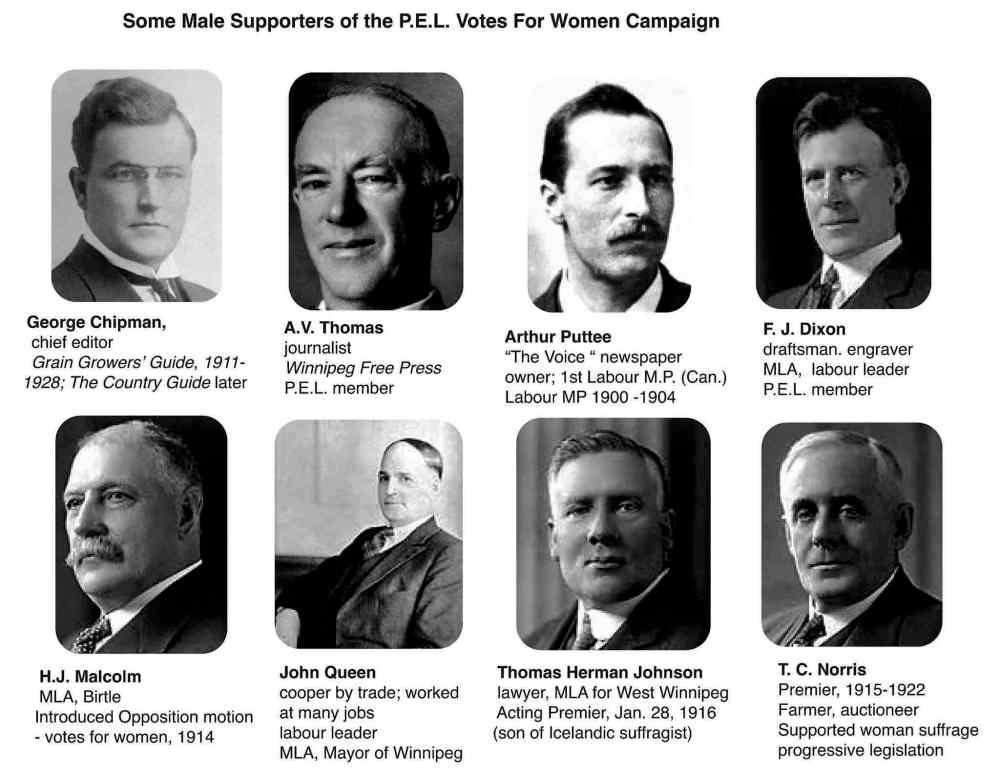
As we near the centennial anniversary of (most) Manitoba women winning suffrage, it’s important to tip our hats to the men who worked alongside women to advocate for their right to vote.
Linda McDowell, a retired history teacher who has taught at the University of Winnipeg, clocked countless hours going through the Archives of Manitoba and the Free Press archives to get a sense of these men who helped open the door for the suffragists.
According to McDowell, there were Liberal MLAs who pushed for women’s voting rights as early as 1892. For instance, that year Lakeside MLA Kenneth McKenzie pointed out legislation on prohibition “would never have the right sentiment of the country until the fair sex had the franchise.” Two days later, on April 15, Manitou MLA James Huston made a motion to extend the franchise to women. It was voted down.
The Women’s Christian Temperance Union petitioned for women’s vote in 1893, and David McNaught, the MLA for the riding of Saskatchewan, presented it to the legislature that April. The suffrage bill he proposed at the same time was not supported.
In 1912, the Political Equality League was formed, and its active members were largely journalists: E. Cora Hind, Lillian Beynon Thomas, Alfred Vernon Thomas and Kennethe McMahon Haig of the Manitoba Free Press, joined by Francis Marion Beynon and George F. Chipman of The Grain Growers’ Guide; Mrs. W. C. (Anne Anderson) Perry of the Saturday Post as well as Nellie McClung, a successful, popular novelist. Labour MLA for Centre Winnipeg Frederick Dixon was also a member, as was Labour MP for Winnipeg Arthur W. Puttee who, along with his wife, Gertrude Stroud Puttee, worked on The Voice, a weekly newspaper.
The equality league appeared before the legislature and then-premier Rodmond Roblin in January 1914, to argue for women getting the right to vote. In her appeal to Roblin, McClung argued her group was merely seeking justice: “Have we not the brains to think? Hands to work? Hearts to feel? And lives to live? Do we not bear our part in citizenship? Do we not help build the empire? Give us our due!”
Roblin, who was enjoying great popularity as premier, was not convinced, arguing suffrage would “break up the home and throw children into the arms of servant girls.”
More to the point, because the women’s vote was closely tied to the prohibition movement, it is perhaps not surprising Roblin was reluctant to extend the franchise: Roblin’s government relied on the sale of liquor as a source of taxation.
McClung then held her famous mock parliament at Walker Theatre in which she played a female premier in a make-believe country where men want the vote. As she commented: “It’s hard enough to keep them at home now… Politics unsettle men and unsettled men means unsettled bills, broken furniture, broken vows, and divorce… There is no use giving men the vote … Man has a higher destiny than politics.”
Roblin was forced to resign in 1915 over allegations of fraud, and his successor, James Aikins, faced off against Liberal Tobias Crawford in the provincial election in 1915. Both men promised suffrage for women, but Norris won. In January 1916, acting premier Thomas Herman Johnson oversaw the passage of the legislation for women’s suffrage, which according to McDowell, was in honour of his mother’s early work as a suffragist in the Icelandic community.
These men should be remembered for working hard as the march for women’s equality began here. That march for equality continues.
There have been other firsts for women in Manitoba setting the course for full equality. Edith Rogers was among the first women to run for office. A Liberal, she was the only woman to win, sitting as MLA from 1920 to 1932.
Thelma Forbes was the first woman to be named to cabinet, in 1966. The premier who first named her to cabinet? Conservative Duff Roblin, Rodmond Roblin’s grandson.
Liberal Sharon Carstairs became the first woman to lead a political party in Manitoba, in 1984. Muriel Smith, in 1979, was the first woman in Manitoba to run for leadership, losing to Howard Pawley.
The first visible minority female to win office (2007) and to sit in cabinet (2011) was Flor Marcelino, under Greg Selinger.
The first publicly identified lesbian to win officer was Jennifer Howard, who entered the legislature in 2007. She was named house leader in 2010 — the first woman to be given that honour. In 2015, Amanda Lathlin (The Pas) was the first woman who publicly identified herself as aboriginal or First Nations woman to win a seat.
None of these firsts could have happened without the courage and stamina of the women who fought for those early rights. But the early victories would never have happened without the sympathetic men who broke the glass ceiling for us all.

With a nod to Sir Isaac Newton, we stand on the shoulders of giants.
Shannon Sampert is the perspectives and politics editor of the Winnipeg Free Press.
Advertisement Advertise With Us
Advertisement Advertise With Us