Personal films, powerful impact

Advertisement

Advertise with us

I like conceptual art. I like being asked to think. I enjoy coming to a place of profound appreciation for works of art I did not, at first, understand.

Read this article for free:


or

Already have an account? Log in here »

To continue reading, please subscribe:

Subscribe and receive a limited-edition Free Press branded hat or tote.

Digital Subscription

One year of digital access for only $205*

  • Enjoy unlimited reading on winnipegfreepress.com
  • Read the E-Edition, our digital replica newspaper
  • Access News Break, our award-winning app
  • Play interactive puzzles

*First annual payment billed as $205.00 + GST for one year. This annual subscription will automatically renew at $233.00 + GST every 52 weeks (10% off the regular annual price of $259.35). Offer available to new and qualified returning subscribers only. Cancel any time.

To continue reading, please subscribe:

Add Free Press access to your Brandon Sun subscription for only an additional

$1 for the first 4 weeks*

  • Enjoy unlimited reading on winnipegfreepress.com
  • Read the E-Edition, our digital replica newspaper
  • Access News Break, our award-winning app
  • Play interactive puzzles
Start now

*Your next Brandon Sun subscription payment will increase by $1.00 and you will be charged $17.95 plus GST for four weeks. After four weeks, your payment will increase to $24.95 plus GST every four weeks.

Hey there, time traveller!
This article was published 01/02/2016 (3884 days ago), so information in it may no longer be current.

I like conceptual art. I like being asked to think. I enjoy coming to a place of profound appreciation for works of art I did not, at first, understand.

There are times though when I prefer — even need — art that connects me to others via less circuitous routes. The personal is political, as the second-wave feminist mantra goes.

On Friday at the Winnipeg Free Press News Café, First Fridays in the Exchange and the Winnipeg Free Press will celebrate powerful, female voices in film. Jackie Traverse and Hagere Selam Zegeye-Gebrehiwot (“Shimby” to her friends) make films that are autobiographical and full of intense feeling. Audiences will view their short films (each no longer than five minutes), followed by an interview and discussion.
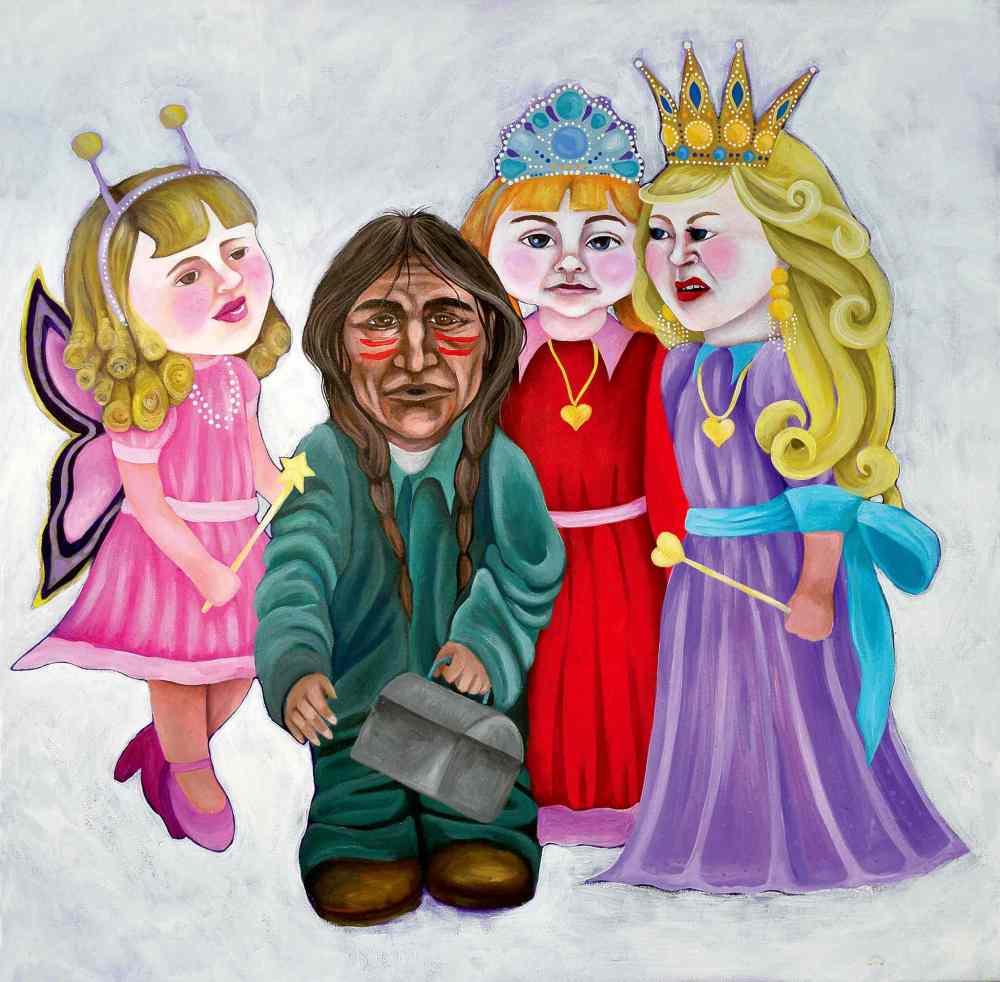
Neechi with a job, acrylic on canvas, by Jackie Traverse.

Zegeye-Gebrehiwot’s film feels particularly timely. Titled yaya/ayat, it was made in 2010 under the mentorship of local filmmaker Danishka Esterhazy and as part of the Winnipeg Film Group’s Mosaic Women’s Film Project. It describes the effects of diaspora and the way geographical distance shapes identity.

Zegeye-Gebrehiwot’s family history spans three countries: Greece, Ethiopia and Canada. Over a beautiful haze of grainy travel imagery, the artist expresses longing for her distant grandmother and tells the story of journeying to meet her for the first time.

Though the story is a painful one, it is ultimately hopeful. Even without common language and culture, it is sometimes possible to form unique, albeit oblique connections.

“Perhaps I was more brazen at the time,” said Zegeye-Gebrehiwot with a laugh when asked about how she was able to be so personal and vulnerable in the film. “But it did seem like the perfect moment to explore real and pressing things, and to let people in in a way that was genuine. Diaspora is a complicated thing but it’s also a common experience.”

Zegeye-Gebrehiwot now cares for the histories of others; she was recently bequeathed a box of Super 8 film footage, the entire recorded history of an elderly woman’s life. “She was a relative stranger, but I felt like I was handed this huge gift,” says the artist.

She turned parts of the films into an art installation, shown recently at Winnipeg’s Aceartinc.

Jackie Traverse, an Anishinabe painter who is represented by Wah-Sa gallery at The Forks, made the films Empty and Two Scoops in 2008 and 2009. The Winnipeg Film Group, which distributes the films, says they continue to rank among its most popular.

The hand-painted animations may resonate with audiences partly because they tell one of the most vital and important Canadian stories; the so-called “scoop” of aboriginal children into the Canadian child-welfare system from the 1960s to the late ’80s. But more than that, as the stories are personal memories told from the point of view of Traverse as a child, they have an openness and frankness that goes right to the heart, making the statistics — more than 20,000 children were taken — seem all the more staggering.

Traverse was studying art at the University of Manitoba when she made her films, benefiting from the Crossing Communities Art Project, a Winnipeg-based organization that supports the making of art by marginalized youth and women.

“I tried telling my story with sculpture,” says the artist, “and I tried with painting and I tried with printmaking. It didn’t work. The stories needed to be animated and needed my voice.”

Traverse acknowledges that there is a particular power in the medium of film –it’s so easy to absorb. Film critic Roger Ebert once noted that, for better or for worse, every new Disney film immediately becomes part of the consciousness of almost every child in America. Filmmaker Ingmar Bergman said it more poetically: “No art passes our conscience in the way film does, and goes directly to our feelings, deep down into the dark rooms of our souls.”

Traverse and Zegeye-Gebrehiwot’s films portray the divisions and rifts in relationship — on both large and intimate scale. They are personal, but they also are far larger than the individual. There is pain, yes. But in the telling there is at least a little consolation.


Sarah Swan is the host of Art Talk/Art Walk. To reserve seats for this event please call 204-697-7069 or email wfpnewscafe@gmail.com.

Report Error Submit a Tip

More Stories

Desperate Poilievre wants Canadians to believe the sky is falling when it’s just cloudy outside

Tom Brodbeck 5 minute read Preview

Desperate Poilievre wants Canadians to believe the sky is falling when it’s just cloudy outside

Tom Brodbeck 5 minute read Friday, Sep. 18, 2026

Pierre Poilievre has a problem.

Canadians just don’t seem to be paying much attention to him anymore.

So, naturally, the Conservative Opposition leader has decided to turn up the volume.

At a recent party caucus retreat in Penticton, B.C., Poilievre delivered the familiar message: Canada is in trouble, Canadians are hurting and the Liberal government is making everything worse.

Read
Friday, Sep. 18, 2026

A life’s story: activist, educator, organizer knew the true meaning of community

Janine LeGal 7 minute read Preview

A life’s story: activist, educator, organizer knew the true meaning of community

Janine LeGal 7 minute read Yesterday at 3:00 AM CDT

Somewhere between a love for sharing stories and a love of community connections, Michael (Mike) Maunder lived his life. Giving voice to people and neighbourhoods was a passion for the natural-born community organizer.

An author, teacher and principal, Maunder lived in a one-bedroom apartment in West Broadway and devoted himself to community development, education and neighbourhood renewal.

He maintained a connection with Augustine United Church, whose commitment to social justice he appreciated, volunteered at the Sandy-Saulteaux Spiritual Centre, and found comfort in a Buddhist prayer community.

Maunder died on July 15 at the age of 80.

Read
Yesterday at 3:00 AM CDT

Hellebuyck standoff caused by… Nathan MacKinnon?

Mike McIntyre 6 minute read Preview

Hellebuyck standoff caused by… Nathan MacKinnon?

Mike McIntyre 6 minute read Friday, Sep. 18, 2026

Looking for someone to blame in the Connor Hellebuyck fiasco and cast as public enemy No. 1? How about long-time Winnipeg Jets nemesis Nathan MacKinnon?

Allow us to explain as we fire up the time machine and head back to February in Italy.

Oh, what could have been if MacKinnon had been able to score on what appeared to be an open net late in the third period of the men’s gold medal game with Hellebuyck down and seemingly out of position.

Instead, the star forward fired wide, keeping the score deadlocked at 1-1 as the clock ticked down on regulation.

Read
Friday, Sep. 18, 2026

Grieving child builds backyard rocket ship

Harriet Zaidman 4 minute read Yesterday at 2:01 AM CDT

I Built a Rocket Ship (Kids Can Press, 32 pages, hardcover, $22) by Winnipegger Anna Lazowski is a tender story for children ages 4-8 about a little girl trying to make sense of her mother’s death. The child engages in conversation with her late mom, agreeing and disagreeing about things said as she carries objects (and of course, the cat) to the backyard. There, she is building a rocket ship she will pilot into the skies to find her mom again.

Jennica Lounsbury’s varied perspectives show the range of emotions the little girl experiences.

● ● ●

Northwoods Lullaby by Mary Casanova (University of Minnesota Press, 32 pages, hardover, $25) is a bedtime book for readers up to age eight, perfect to bring a busy, happy day to a close. Just like children who are listening to adults reading the book, all the animal babies are being tucked into their nests and burrows by loving parents: “Thump and scamper,/nimble clover./ Soon it’s time to rest. Baby loon/ nestles in/as Papa floats along.”

Not falling back means time loop remains unclosed

Jen Zoratti 4 minute read Yesterday at 2:01 AM CDT

I demand restitution. Where’s my hour?

In the traditional fall-back, spring-forward time change set up — you know, ol’ trusty that’s been effect for lo these 63 years — we lost an hour in the spring that we got back in the fall.

That was the social contract: you commit to feeling like you’re on cold medication for a week in March because you know a glorious extra hour of sleep will be returned to you in November. (Unless, of course, you have little kids, but look: we all make our choices.)

Well, that transaction, flawed as it was, isn’t happening this year. That hour you sacrificed to the sun gods in the spring? Gone. Not coming back. We’ve sprung forward and we shan’t be falling back — not in November, and (possibly) not ever. The scale shall remain unbalanced and the loop shall remain unclosed as Manitoba has adopted permanent daylight time.

Give-and-take relationship of Roman leaders takes centre stage in Harris’s historical fiction

Reviewed by Kathryne Cardwell 4 minute read Preview

Give-and-take relationship of Roman leaders takes centre stage in Harris’s historical fiction

Reviewed by Kathryne Cardwell 4 minute read Yesterday at 2:01 AM CDT

British novelist Robert Harris’s latest work is a reflection on tyranny, corruption and betrayal among all-powerful political leaders.

You might be forgiven for thinking it’s a contemporary thriller — it’s actually historical fiction set in ancient Rome.

A former BBC journalist, Harris debuted as a novelist in 1992 with Fatherland, an alternative history where Nazi Germany won the Second World War.

Since then, the prolific author has become best-known for his works of historical fiction, especially his ancient Rome trilogy released from 2006-2015 and the novel Conclave, which was published in 2016 and was made into the film of the same name in 2024.

Read
Yesterday at 2:01 AM CDT