Where there’s a willow
Projects seek solutions to shoreline erosion

Advertisement
Read this article for free:
or
Already have an account? Log in here »
To continue reading, please subscribe:

Digital Subscription
One year of digital access for only $205*
- Enjoy unlimited reading on winnipegfreepress.com
- Read the E-Edition, our digital replica newspaper
- Access News Break, our award-winning app
- Play interactive puzzles
*First annual payment billed as $205.00 + GST for one year. This annual subscription will automatically renew at $233.00 + GST every 52 weeks (10% off the regular annual price of $259.35). Offer available to new and qualified returning subscribers only. Cancel any time.
To continue reading, please subscribe:
Add Free Press access to your Brandon Sun subscription for only an additional
$1 for the first 4 weeks*
- Enjoy unlimited reading on winnipegfreepress.com
- Read the E-Edition, our digital replica newspaper
- Access News Break, our award-winning app
- Play interactive puzzles
*Your next Brandon Sun subscription payment will increase by $1.00 and you will be charged $17.95 plus GST for four weeks. After four weeks, your payment will increase to $24.95 plus GST every four weeks.
Read unlimited articles for free today:
or
Already have an account? Log in here »
Hey there, time traveller!
This article was published 19/03/2016 (3861 days ago), so information in it may no longer be current.
Round 1 winner: Lake Winnipeg.
Up next is round 2 rematch: Lake Winnipeg vs. willows.
After launching a shoreline protection pilot project involving willows in 2013 — and then having it wash away into the lake’s high water a few months later — the East Interlake Conservation District decided to try again.
But this time, not only has the EICD brought in partners — the federal Fisheries and Oceans Department, Ducks Unlimited, and Agrium, a producer of agricultural nutrients — under its Caring for our Watersheds program, it also has tweaked its willow strategy.
Armand Belanger, the EICD’s manager, recently called the original willow project “a great attempt.”
“It was good because we had a workshop about it at the time,” he said. “It showed what you can do with little investment. And it showed that when you plant willows at the shore, they are at more risk of erosion.
“This year, there’s more of an investment, and we have placed them a few feet back from the edge of the shoreline. By the time the shore erodes back that far, they will be more mature than they were when they were planted in the sand. In a perfect scenario, they will establish and be fairly permanent.”
The idea of the willows protecting the shoreline is simple. As the trees mature, the roots in the ground fortify the shoreline with what has been called nature’s rebar. At the same time, the willows help stop nutrient runoff from getting into the lake.
The project in 2013 saw EICD staff and volunteers come up to an area of eroded shoreline, between Hnausa and Balaton Beach about 30 kilometres north of Gimli, to bury a few bundles of dormant willow branches in rows under beach sand perpendicular to the lake in the fall, followed by a few more in the early spring of 2014.
Through most of the summer of 2014, the willows sprang to life out of the beach, growing to about a half-metre high and beginning to hold back sand in front of the shoreline erosion.
But then came days of rain through much of the summer, causing lake levels to rise to the point that on many days the beach was underwater. Despite a valiant attempt by adjacent property owners to save the willows (full disclosure: the adjacent property is owned by my wife and me), the water immersed the fledgling trees and roots before the waves tore them away for good.
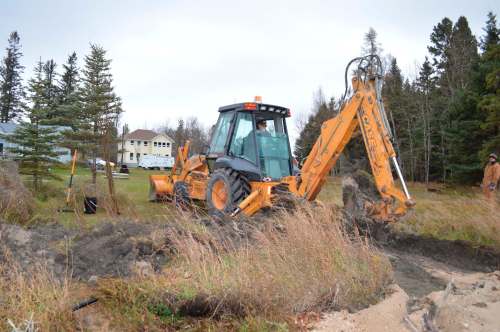
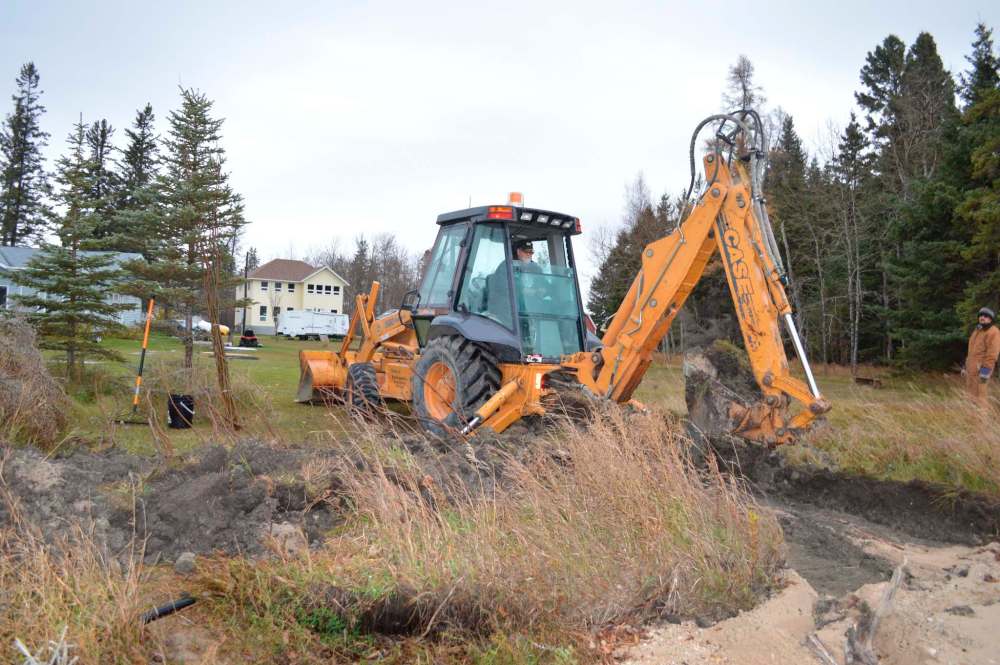
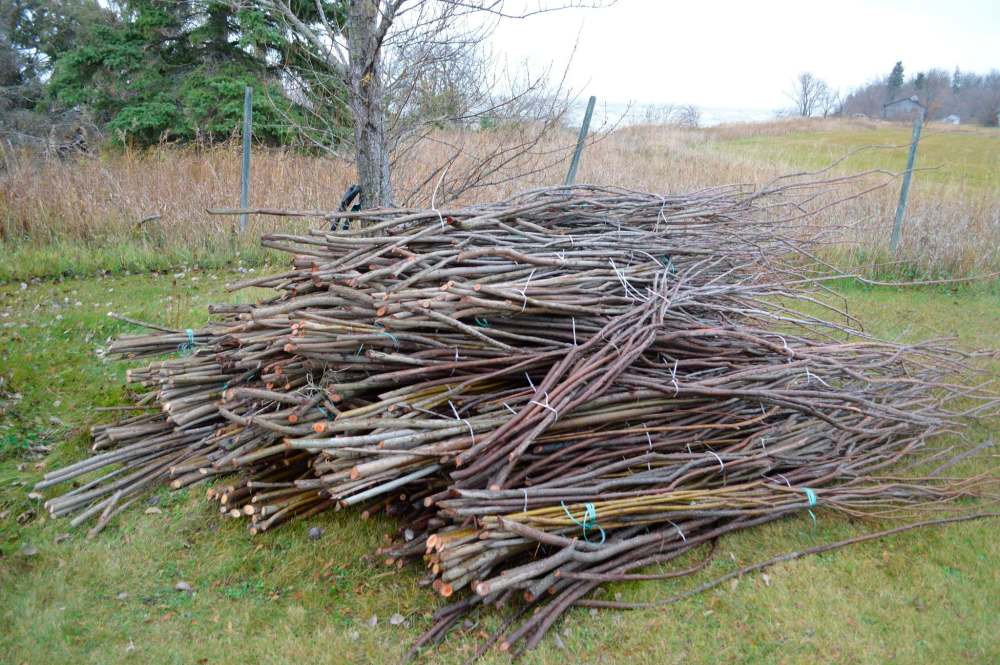
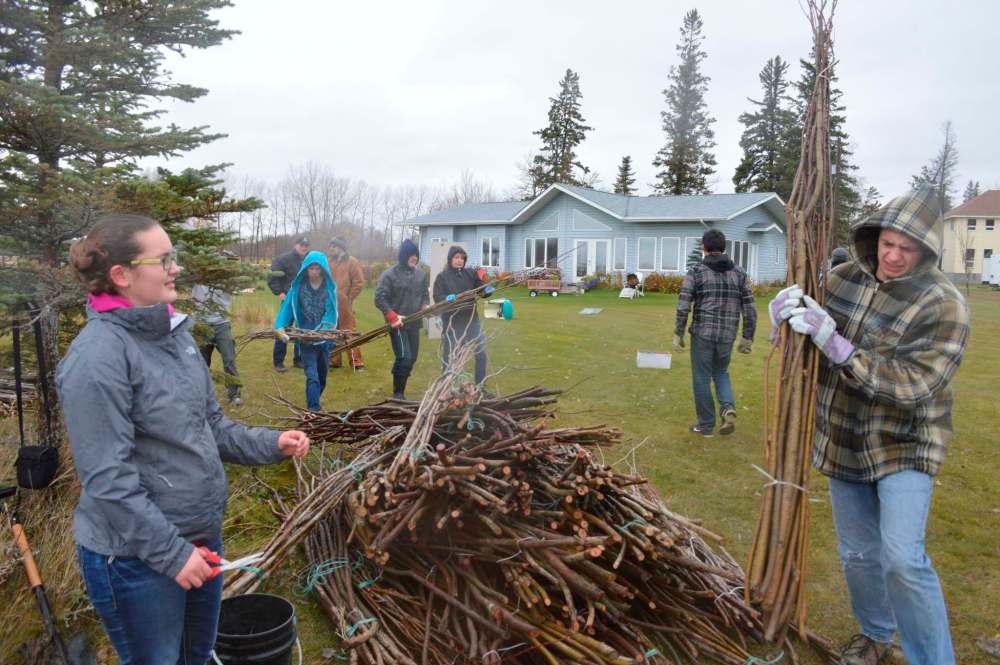
Last October, on a cold, grey and windy day just before the first snow of the season, the team from the EICD came back, this time bolstered with a couple of dozen Riverton Collegiate students and a front-end loader. The students had earlier harvested hundreds of dormant branches from willows growing around Hnausa Provincial Park.
In short order, the piece of heavy equipment slashed open a wide trench parallel to the lakefront, a couple of metres from the shoreline itself, the students laid down the willow branches, and then the soil was plopped back on top.
Belanger said up to 1,500 willows were planted in just a few hours.
“It was great to continue with the students and the teacher to get them involved in the environment,” he said.
“Projects like this really add up to helping trees, water quality, and to reduce erosion. Another benefit is we have another willow cache we know of which will help us do another project. The willows we used here were planted nine years ago at Hnausa Provincial Park. You don’t know if your willow patch will be there when you need it when you go back to ditches and Crown land.”
The latest idea was sparked, in part, by a project proposal submitted by Meghan Gallagher, a Grade 12 student at Gimli High School, to the Caring for our Watersheds program. The program here is a joint initiative of Agrium and Oak Hammock Marsh.
Gallagher came up with the idea of planting willows along the shores of Willow Creek, south of Gimli, to help filter out the nutrients from runoff before they ended up in the creek and then Lake Winnipeg.
While the lakeside willows weren’t exactly what Gallagher proposed, and she still hopes her creek project can go ahead this year, she said, “It’s great to see something done.
“The lake is in bad shape and I’d like to see it helped.”
Cheryl Bailey, Gallagher’s science teacher, said the Caring for our Watersheds program is “fantastic.”
“The students have to submit some project proposals. They have to research, rationalize it, write a grant portfolio. And then you might be able to do it.”
Bailey said a wetland project next to the school is another proposal that was fully realized but others, such as Gallagher’s, sometimes have pieces of it done at a time.
“The idea is what is important.”
Caring for our Watersheds program manager Tabitha Martens said the program “asks students to come up with environmental solutions to problems they see in their community.”
Students from grades 7 to 12 can be awarded as much as $1,000 for their idea and $10,000 in funding can be given to implement a project.
“What I love is we get to see the students rewarded for their positive ideas and to be active citizens,” Martens said.
“We hope to stimulate and energize their drive. And with this, they also have immediate insight of how they want to change the environment and help make it better.
“If they can learn the importance of protecting the shore for Lake Winnipeg, that would be wonderful.”
Lisette Ross, a senior wetland and upland specialist with Ducks Unlimited Canada’s Native Plant Solutions, said she was part of a shoreline study project completed by the Lake Winnipeg Foundation in 2011.
Ross said the project looked at the various shoreline-protection methods along the lake, including natural versus man-made and how slope, prevailing winds and location can effect erosion negatively or positively.
“We started north of Gimli and went right around to Victoria Beach,” she said.
“The shoreline changes from sandy-like to rocky. We also looked at what types of rock, debris or natural vegetation was there.”
Ross said they just didn’t look at the ground part of the shore, but also what was in the water.
“We came back to representative shorelines, and we netted for fish to see what was spawning.
“The project started to give me an idea of man-made versus natural for stopping shoreline erosion.”
Ross said she also saw a lot of examples where there was only sod at the shoreline.
“People want to have a nice view, so they take out the trees and they put down sod, but how many years will it take before erosion takes it away? It will happen at some point.”
Belanger said if the latest project fails to slow down the shoreline erosion, the next step would be to plant more willows further inland and install a combination of riprap rock and willows where the waves would first hit.
But that comes at a higher cost.
“Right now, there’s little investment, but rock is more of an investment.”
Belanger said it is great that when nearby mature trees have blown down onto the beach, or fallen when shoreline erosion has taken out the roots, they were left and not taken away and disposed of or burned.
“The trees dissipate the energy of the waves,” he said.
“And fish love the woody debris. It increases fish habitat. Not only does it slow down erosion, but it also serves as a catalyst for other vegetation to start growing.”
Belanger said the heavy equipment needed to plant the willows left a ridge of upturned soil, but by the time the trees establish themselves, the dirt will have settled down and be hidden by the foliage.
Belanger said he can go to any shoreline along Lake Winnipeg, and he can predict in advance whether there will be erosion.
“I think it is just human nature. The first thing people want to do when they buy a property is see the horizon, so they pull out their trees.”
kevin.rollason@freepress.mb.ca
Kevin Rollason
Reporter
Kevin Rollason was a general assignment reporter at the Free Press.
Our newsroom depends on a growing audience of readers to power our journalism. If you are not a paid reader, please consider becoming a subscriber.
Our newsroom depends on its audience of readers to power our journalism. Thank you for your support.
Kevin Rollason
Reporter
Kevin Rollason was a general assignment reporter at the Free Press.
Our newsroom depends on a growing audience of readers to power our journalism. If you are not a paid reader, please consider becoming a subscriber.
Our newsroom depends on its audience of readers to power our journalism. Thank you for your support.
Advertisement Advertise With Us
Advertisement Advertise With Us
History
Updated on Sunday, March 20, 2016 10:12 AM CDT: Removed photo.