

Dreams go up in flames
Don't blame Fort McMurray workers for climate change

Advertisement
Read this article for free:
or
Already have an account? Log in here »
To continue reading, please subscribe:

Digital Subscription
One year of digital access for only $205*
- Enjoy unlimited reading on winnipegfreepress.com
- Read the E-Edition, our digital replica newspaper
- Access News Break, our award-winning app
- Play interactive puzzles
*First annual payment billed as $205.00 + GST for one year. This annual subscription will automatically renew at $233.00 + GST every 52 weeks (10% off the regular annual price of $259.35). Offer available to new and qualified returning subscribers only. Cancel any time.
To continue reading, please subscribe:
Add Free Press access to your Brandon Sun subscription for only an additional
$1 for the first 4 weeks*
- Enjoy unlimited reading on winnipegfreepress.com
- Read the E-Edition, our digital replica newspaper
- Access News Break, our award-winning app
- Play interactive puzzles
*Your next Brandon Sun subscription payment will increase by $1.00 and you will be charged $17.95 plus GST for four weeks. After four weeks, your payment will increase to $24.95 plus GST every four weeks.
Read unlimited articles for free today:
or
Already have an account? Log in here »
Hey there, time traveller!
This article was published 05/05/2016 (3774 days ago), so information in it may no longer be current.
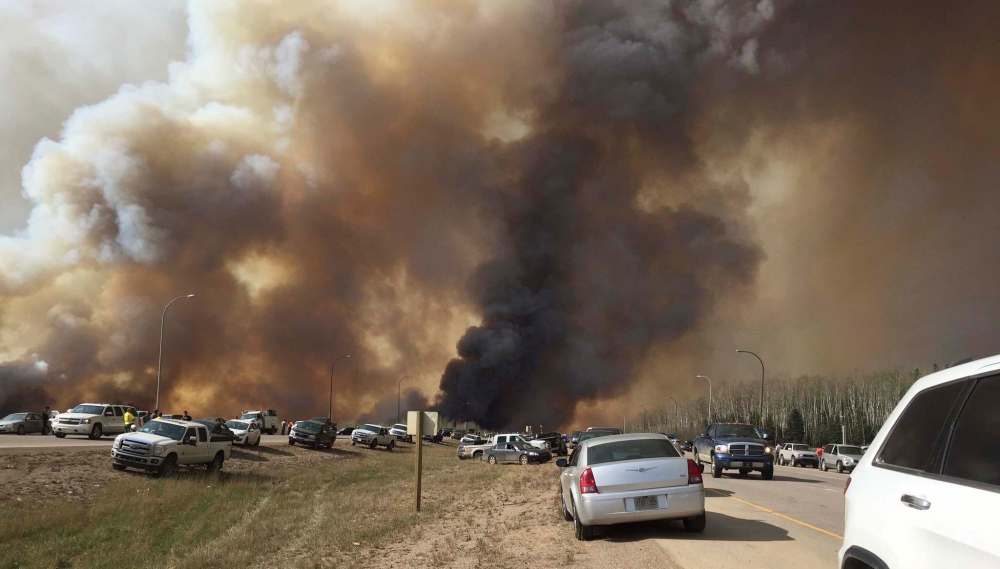
As northern Alberta was burning, the best parts of its people light up just as bright, shining beneath a smoke-choked sky.
That afternoon and throughout the night, all of Canada bore witness to their caring. Tanker drivers sped up highways delivering free fuel to stranded vehicles. One woman, lingering in smouldering Fort McMurray, broke into homes (at the evacuated owners’ request) to save trapped pets.
Wherever people fled, they found open doors. Mosques in Lac la Biche and Edmonton invited evacuees to come stay. So did regional First Nations, hotels and everyday citizens. Bowling alleys offered free games to those who escaped.
Humbled by this, Canadians opened their wallets. While the Red Cross’s donation figures had not been released as of Wednesday, the cash flow has surely been massive. (The need will be great, so please consider texting “REDCROSS” to 30333 to donate $5, or donate online at redcross.ca.)
So maybe it’s just a cranky sidenote to point out how this beautiful compassion was accompanied by an uglier streak.
There are few things that inflame public disgust as severely as to be seen talking politics during tragedy. In truth, that disgust can be misdirected: in a world where so many hurts are inextricably intertwined with politics, what some deem “politicizing tragedy” is often valuable, even necessary.
After all, with every harm that assails us — whether dealt by weapons or weather — politics has something to do with the background, the first responses and the long-term solutions. At the end of the day, politics is just a series of competing views on how communities ought to navigate the challenges they face.
Still, not every post-tragedy channel is wide enough for a soapbox, though many tried to jam one in there this week. At the same time as many of the 88,000 people who fled Fort McMurray were sitting gridlocked between the flames, some distant folks jumped on social media to flog their point of view.
Having an opinion is one thing, flaunting it on the same Twitter hashtag that evacuees were using to share vital information is something else entirely. If there was any thought that would most assuredly not help evacuees in that moment, it was the airing of grievances against Justin Trudeau, climate change and Rachel Notley.
Much of that was just noise. Some of the sharpest barbs were hurled at Trudeau, whose standard-issue Tweets conveying Canada’s sympathy were taken as prima facie evidence that all the federal government would do was Tweet; and at Notley, who was decried for pretty much everything she said or did not say.
This was inevitable, some mix of partisanship and acute frustration, seeking out a human to shoulder the blame. What was more galling was the third theme in that barrage of political comments: the distinct whiff of something approaching a self-satisfied glee that Fort McMurray specifically was burning.
It’s strange. On Tuesday night, the same type of folks who usually (correctly) point out that “weather isn’t climate” when climate-change skeptics use winter chill as debate fodder, were suddenly quite sure that this instance of extreme weather was an effective stand-in for climate.
In perhaps the most infamous example, former Alberta NDP candidate Tom Moffatt Tweeted that “Karmic #climatechange fire burns CDN oilsands city.” (He also attached Bernie Sanders’ slogan, #FeelTheBern, which is either a staggering act of tone-deafness if it was not intended as a pun, or downright cruelty if it was.)
Though Moffatt later deleted the Tweet and apologized, many others sang a similar refrain. “I’m glad the #FortMacFire is happening in the province most responsible for the climate change that caused the fire in the first place,” Tweeted one man in British Columbia, though he also later apologized.
The ill-considered choice to point at Alberta’s flames, instead of mourn what was lost to them, tells us that at least some of today’s climate-change voices have failed to keep their eyes focused in the right direction.
To be clear, I don’t say this as an opponent. Indeed, I accept what the sum of climate science tells us, which is that the planet is rapidly becoming hotter, drier and more prone to extreme weather. I accept these changes are wrought by human activity, and that if we do not find a way to slow it, the effects will be increasingly catastrophic.
What is the point in fearing catastrophe, if we cannot spare compassion for all who endure it?
The folks who have landed in Fort McMurray over the last four decades were, for the most part, far from the architects of international hydrocarbon policy. Many of them are simply workers, including many Newfoundlanders who headed west in search of work, and an opportunity to build a life for their family.
Meanwhile, if we assign responsibility for hydrocarbon policy correctly, we understand the landscape of Alberta bears the scars of our collective demand. It is just one site of a global struggle to determine what pact humans will make with our environment.
More than that, we understand that the folks working in and around the tar sands may benefit from oil money, but they are also among the most vulnerable to the industry’s problems. Some of the folks who fled Fort McMurray had already lost their jobs. Now, many of them have lost all they had left.

As for the people who do wield heavy influence on global carbon policy, few of them were staring down flames in northern Alberta. If we are to critique the hydrocarbon industry, that is where we ought to direct the pressure; most everyone else in the system is just trying to get on with their life.
So if there is a path out of our current predicament, we will not find it by rhetorically stepping on the backs of frightened and devastated Albertans. This much, at least for me, is certain: we are facing a future where this type of tragedy may happen more often. Can advocates love all communities enough to embrace them, when dreams turn to ash?
Any climate-change ethic that cannot at least centre itself around that, ought to be rejected.
melissa.martin@freepress.mb.ca
Melissa Martin
Reporter-at-large
Melissa Martin reports and opines for the Winnipeg Free Press.
Every piece of reporting Melissa produces is reviewed by an editing team before it is posted online or published in print — part of the Free Press‘s tradition, since 1872, of producing reliable independent journalism. Read more about Free Press’s history and mandate, and learn how our newsroom operates.
Our newsroom depends on a growing audience of readers to power our journalism. If you are not a paid reader, please consider becoming a subscriber.
Our newsroom depends on its audience of readers to power our journalism. Thank you for your support.
Melissa Martin
Reporter-at-large
Melissa Martin reports and opines for the Winnipeg Free Press.
Every piece of reporting Melissa produces is reviewed by an editing team before it is posted online or published in print — part of the Free Press‘s tradition, since 1872, of producing reliable independent journalism. Read more about Free Press’s history and mandate, and learn how our newsroom operates.
Our newsroom depends on a growing audience of readers to power our journalism. If you are not a paid reader, please consider becoming a subscriber.
Our newsroom depends on its audience of readers to power our journalism. Thank you for your support.
Related Articles
Lac-Megantic fundraises for Fort McMurray Don't blame Fort McMurray workers for climate change


338178_high.jpg?w=100)




Advertisement Advertise With Us
Advertisement Advertise With Us