Joseph Wapner, star of ‘The People’s Court,’ dead at 97

Advertisement

Advertise with us

LOS ANGELES - Joseph Wapner, the retired Los Angeles judge who presided over "The People's Court" with steady force during the heyday of the reality courtroom show, died Sunday at age 97.

Read this article for free:


or

Already have an account? Log in here »

To continue reading, please subscribe:

Subscribe and receive a limited-edition Free Press branded hat or tote.

Digital Subscription

One year of digital access for only $205*

  • Enjoy unlimited reading on winnipegfreepress.com
  • Read the E-Edition, our digital replica newspaper
  • Access News Break, our award-winning app
  • Play interactive puzzles

*First annual payment billed as $205.00 + GST for one year. This annual subscription will automatically renew at $233.00 + GST every 52 weeks (10% off the regular annual price of $259.35). Offer available to new and qualified returning subscribers only. Cancel any time.

To continue reading, please subscribe:

Add Free Press access to your Brandon Sun subscription for only an additional

$1 for the first 4 weeks*

  • Enjoy unlimited reading on winnipegfreepress.com
  • Read the E-Edition, our digital replica newspaper
  • Access News Break, our award-winning app
  • Play interactive puzzles
Start now

*Your next Brandon Sun subscription payment will increase by $1.00 and you will be charged $17.95 plus GST for four weeks. After four weeks, your payment will increase to $24.95 plus GST every four weeks.

Hey there, time traveller!
This article was published 26/02/2017 (3493 days ago), so information in it may no longer be current.

LOS ANGELES – Joseph Wapner, the retired Los Angeles judge who presided over “The People’s Court” with steady force during the heyday of the reality courtroom show, died Sunday at age 97.

Son David Wapner told The Associated Press that his father died at home in his sleep. Joseph Wapner was hospitalized a week ago with breathing problems and had been under home hospice care.

“The People’s Court,” on which Wapner decided real small-claims from 1981 to 1993, was one of the granddaddies of the syndicated reality shows of today. His affable, no-nonsense approach attracted many fans, putting “The People’s Court” in the top five in syndication at its peak.

FILE - In this Friday, Oct. 13, 1989, file photo, retired Judge Joseph A. Wapner of TV's 'The People's Court' congratulates his son, Judge Frederick N. Wapner, right, as he was enrobed as a Municipal Court judge in Los Angeles. Wapner, who presided over
FILE - In this Friday, Oct. 13, 1989, file photo, retired Judge Joseph A. Wapner of TV's 'The People's Court' congratulates his son, Judge Frederick N. Wapner, right, as he was enrobed as a Municipal Court judge in Los Angeles. Wapner, who presided over "The People's Court" with steady force during the heyday of the reality courtroom show, has died. Wapner died at home in his sleep Sunday, Feb. 26, 2017, according to his son, David Wapner. (AP Photo/Nick Ut, File)

Before auditioning for the show, Wapner had spent more than 20 years on the bench in Los Angeles, first in Municipal Court and then in Superior Court. At one time he was presiding judge of the Los Angeles Superior Court, the largest court in the United States. He retired as judge in November 1979, the day after his 60th birthday.

“Everything on the show is real,” Wapner told the AP in a 1986 interview. “There’s no script, no rehearsal, no retakes. Everything from beginning to end is like a real courtroom, and I personally consider each case as a trial.”

“Sometimes I don’t even deliberate,” he added. “I just decide from the bench, it’s so obvious. The beautiful part is that I have carte blanche.”

“The People’s Court” cases were tried without lawyers by the rules of Small Claims Court, which has a damage limit of $1,500. Researchers for the producer, Ralph Edwards Productions, checked claims filed in Southern California for interesting cases.

The plaintiff and defendant had to agree to have the case settled on the show and sign a binding arbitration agreement; the show paid for the settlements.

In some metropolitan counties, the number of small claims cases more than tripled during the 1980s; some cited Wapner as a cause.

Johnny Carson invited Wapner him to come on “The Tonight Show” and settle a dispute between himself and David Letterman. Carson wanted to do it as a skit, but Wapner said no and conducted it like a trial.

The dispute was over an old truck that Letterman kept parked by his property in Malibu. Carson said it was an eyesore and had it hauled away. When Letterman got it back, the headlights had been broken.

“I awarded Letterman $24.95,” said Wapner.

By the time Wapner left the show, in 1993, interest in the genre had cooled, but trials such as the Simpson trial and the courtroom theatrics of “Judge Judy” revived the TV-court craze starting in 1997.

Wapner returned to “The People’s Court” show in 2000 to help celebrate its 3,000th episode, judging the case of a man suing over a piece of sports memorabilia. He said he had seen snippets of Judge Judy’s work, but generally never watched such shows.

FILE - In this Friday, Oct. 13, 1989, file photo, retired Judge Joseph A. Wapner of TV's 'The People's Court' congratulates his son, Judge Frederick N. Wapner, right, as he was enrobed as a Municipal Court judge in Los Angeles. Wapner, who presided over
FILE - In this Friday, Oct. 13, 1989, file photo, retired Judge Joseph A. Wapner of TV's 'The People's Court' congratulates his son, Judge Frederick N. Wapner, right, as he was enrobed as a Municipal Court judge in Los Angeles. Wapner, who presided over "The People's Court" with steady force during the heyday of the reality courtroom show, has died. Wapner died at home in his sleep Sunday, Feb. 26, 2017, according to his son, David Wapner. (AP Photo/Nick Ut, File)

“I never watched myself,” he said. “Why should I watch them?”

He also had a series on the Animal Planet cable channel called “Judge Wapner’s Animal Court.”

Wapner was a Los Angeles native and received a law degree from the University of Southern California. He is survived by his wife of 70 years, Mickey, and by two sons, both of whom joined the legal profession. A daughter, Sarah, died in 2015.

During his days as presiding Superior Court judge, Wapner was credited with innovations aimed at saving time for trial participants. A 1971 Los Angeles Times article described his steps to streamline jury selection or even dispense with juries altogether by increasing the number of cases heard solely by a judge chosen to be acceptable to both sides in the case.

His courtroom was also used in 1971 in a brief test of a system to videotape trials to save on the cost of making a trial transcript.

Wapner said he was often amazed at the lengths people would go to to prove a point: “A woman bought a birthday cake for her daughter for $9. She said it was mouldy, and the baker offered to refund only $4.50. She picketed the bakery for six hours, then filed the claim. I found against the baker for $9.”

He generally turned down guest shots on other shows, saying, “I’m not an actor, I’m a judge.”

Report Error Submit a Tip

More Stories

National Black Canadians Summit celebrates culture, combats racism

Gabrielle Piché 4 minute read Preview

National Black Canadians Summit celebrates culture, combats racism

Gabrielle Piché 4 minute read Yesterday at 6:06 PM CDT

Despite the event’s name — the National Black Canadians Summit — Bruce Miller felt he should attend.

He booked a ticket. And so, this weekend, the Indigenous Manitoban joined roughly 1,500 people flocking to the RBC Convention Centre.

It’s a full schedule — addresses from a former Canadian governor general, sessions on Black mental health and anti-Black racism.

The annual event draws politicians, artists and other professionals from across the country.

Read
Yesterday at 6:06 PM CDT

Desperate Poilievre wants Canadians to believe the sky is falling when it’s just cloudy outside

Tom Brodbeck 5 minute read Preview

Desperate Poilievre wants Canadians to believe the sky is falling when it’s just cloudy outside

Tom Brodbeck 5 minute read Friday, Sep. 18, 2026

Pierre Poilievre has a problem.

Canadians just don’t seem to be paying much attention to him anymore.

So, naturally, the Conservative Opposition leader has decided to turn up the volume.

At a recent party caucus retreat in Penticton, B.C., Poilievre delivered the familiar message: Canada is in trouble, Canadians are hurting and the Liberal government is making everything worse.

Read
Friday, Sep. 18, 2026

Cabernet Sauvignon star of wine festival

Ben Sigurdson 5 minute read Preview

Cabernet Sauvignon star of wine festival

Ben Sigurdson 5 minute read Yesterday at 3:00 AM CDT

The Winnipeg Wine Festival will celebrate the king of red wine grapes next weekend — the theme of this year’s festival, which takes place Sept. 25 and 26 at the RBC Convention Centre, is Cabernet Sauvignon.

Cab Sauv, as it’s also known, is the world’s most widely planted wine grape of any colour, first coming to prominence in the 1800s in France’s Bordeaux region, where the grape is still popular. Rather than single-variety wines, Bordeaux reds tend to be blends, with those coming from the left bank of the Gironde estuary being Cabernet-dominant, while right-bank wines are Merlot-dominant, with Cabernet Sauvignon playing a supporting role. Cabernet and Merlot work well together and many other countries have followed suit in blending the two.

A team at University of California Davis put Cabernet Sauvignon through a DNA test in 1996 and discovered its parent grapes are Cabernet Franc and Sauvignon Blanc — it’s likely that at some point the two varieties, planted next to each other in some vineyard, crossed and mutated and became the grape we know today. (Someone growing grapes in the 19th century must have had an inkling of what was up, as the grape has been called Cabernet Sauvignon since long before the DNA test.)

Flavour-wise, most Cabernet Sauvignon wines are big and bold, with a core of deep dark berry flavours, some graphite and spice notes and relatively bright acidity. It’s a grape that is well-suited to barrel aging, with most examples seeing at least some time in wood.

Read
Yesterday at 3:00 AM CDT

Not good bet to shoulder gambling issue alone

Maureen Scurfield 5 minute read Yesterday at 2:01 AM CDT

DEAR MISS LONELYHEARTS: We’re living a lie over at our house, but it’s holding the family together.

I know my husband is deeply into gambling. If it weren’t for my steady job I don’t know where the family would be! I insist on paying all of our bills. I also funnel some major cash off to my sister, in case my husband tries to tap into my accounts somehow when I’m out of the house.

He doesn’t know my passwords, since I keep changing them, but he sometimes shows up behind me when I’m online, like he’s dying to ask something.

I say, “What are you looking at? Stop looking over my shoulder!” Then he makes a lame joke and goes away.

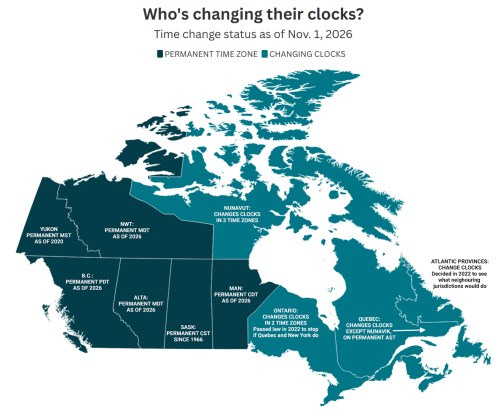
A quick look at where provinces and territories stand on time changes

The Canadian Press 2 minute read Preview

A quick look at where provinces and territories stand on time changes

The Canadian Press 2 minute read Friday, Sep. 18, 2026

WINNIPEG - Manitoba's government said Thursday the province will be sticking with daylight time year-round, making it the latest jurisdiction to move away from twice-annual time changes. Here's a look at where things stand across Canada:

British Columbia said in March that it was moving to permanent Pacific daylight time. The change also means that parts of northeastern B.C., which have been on mountain standard time year round, are now in alignment with the rest of the province.

Alberta also switched to permanent daylight time this year in what it calls Alberta time. The change means it now has the same time as Saskatchewan year round.

Saskatchewan has been on permanent central standard time since 1966.

Read
Friday, Sep. 18, 2026

Klein has burned bridges with PM, Gillingham says

Joyanne Pursaga 3 minute read Preview

Klein has burned bridges with PM, Gillingham says

Joyanne Pursaga 3 minute read Friday, Sep. 18, 2026

One mayoral candidate accused another of writing a column so critical it could compromise his ability to work with the federal government.

Read
Friday, Sep. 18, 2026