Henry J not too shabby for an impulse buy

Yesterday's 'bare-bones' offering is today's special ride

Advertisement

Advertise with us

The Kaiser-Frazer Corporation introduced the Henry J in 1951. It was envisioned as an economy entry vehicle for mass marketing and drew on the styling of the corporation’s full-size line.

Read this article for free:


or

Already have an account? Log in here »

To continue reading, please subscribe:

Subscribe and receive a limited-edition Free Press branded hat or tote.

Digital Subscription

One year of digital access for only $205*

  • Enjoy unlimited reading on winnipegfreepress.com
  • Read the E-Edition, our digital replica newspaper
  • Access News Break, our award-winning app
  • Play interactive puzzles

*First annual payment billed as $205.00 + GST for one year. This annual subscription will automatically renew at $233.00 + GST every 52 weeks (10% off the regular annual price of $259.35). Offer available to new and qualified returning subscribers only. Cancel any time.

To continue reading, please subscribe:

Add Free Press access to your Brandon Sun subscription for only an additional

$1 for the first 4 weeks*

  • Enjoy unlimited reading on winnipegfreepress.com
  • Read the E-Edition, our digital replica newspaper
  • Access News Break, our award-winning app
  • Play interactive puzzles
Start now

*Your next Brandon Sun subscription payment will increase by $1.00 and you will be charged $17.95 plus GST for four weeks. After four weeks, your payment will increase to $24.95 plus GST every four weeks.

Hey there, time traveller!
This article was published 08/06/2018 (3025 days ago), so information in it may no longer be current.

The Kaiser-Frazer Corporation introduced the Henry J in 1951. It was envisioned as an economy entry vehicle for mass marketing and drew on the styling of the corporation’s full-size line.

Named after its corporate chairman, Henry John Kaiser, it was being offered as a basic transportation vehicle with few options. Some say Kaiser was stubborn, as he thrust the car into the market as a bare-bones offering when most buyers were looking for something more opulent.

Advertised as a five-passenger model riding on a 100-inch wheelbase, it featured either an L-Head four-cylinder with three-speed manual or optional six-cylinder engine with three-speed manual or overdrive transmission. Other amenities included an optional heater and defroster, radio, directional signals, full wheel covers or trim rings and bumper guards.
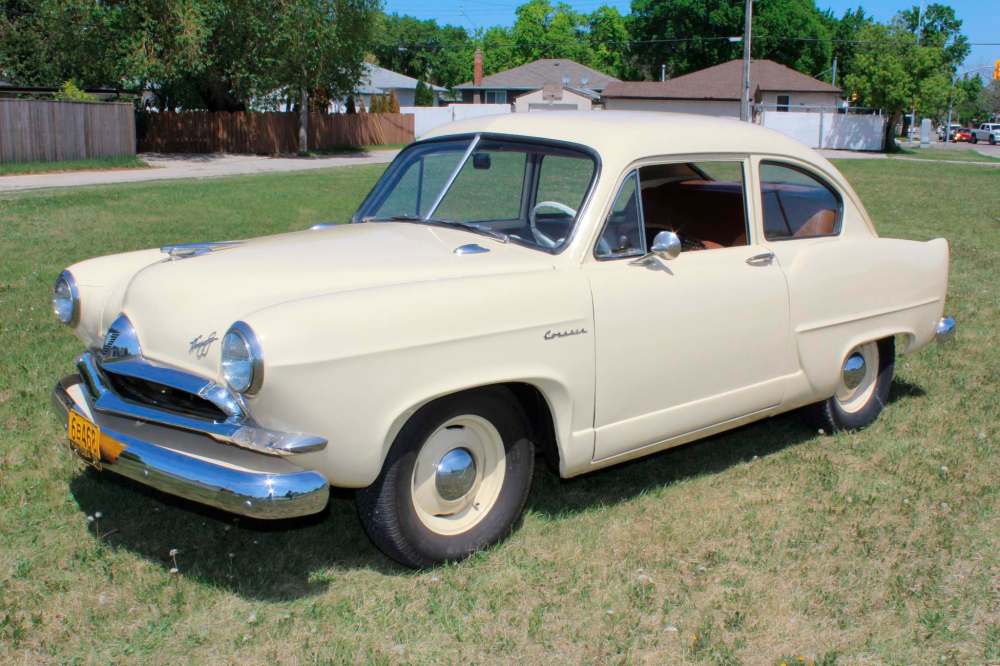
Tom Dudych of Winnipeg found his 1953 Henry J Corsair in 2001. The bare-bones classic seemed to be a good fit for Dudych and his brother Jim’s small, eclectic collection of vehicles, so he made the deal. (Larry D’Argis photos / Winnipeg Free Press)

With base-model pricing starting at US$1,363, the 2,300-pound car was a bargain. Styling was unique, and it did offer room for the family with a full trunk and with fuel economy in the 30 miles-per-gallon range, it was economical.

Reviewed as everything from cute to misproportioned, the Henry J had only a four-year run, producing just over 125,000 units. Model names changed over the years. Initially offered in 1951 as Standard and Deluxe, it later became Vagabond and Corsair. Aside from some minor trim changes, its look varied little and the bolt-together construction of body panels often left lead seams uneven and visible under the painted surface.

For Tom Dudych of Winnipeg, his 1953 Henry J Corsair could be called an impulse buy. “I saw it advertised in 2001 just north of Winnipeg and it was just an interesting vehicle, so I took a look at it,” Dudych says. The owner had wanted to hotrod the car, but time constraints didn’t allow for it, so he put it up for sale. Dudych and his brother Jim have a small, eclectic collection of vehicles and the Henry J seemed to be a good fit, so he purchased it.

The car was complete, apart from the rear window being out, awaiting a seal replacement. Originally, the car was turquoise blue, but had been repainted beige and the interior upholstery updated to a brown vinyl and beige cloth.

The car is solid, with no rust and has only travelled 120,700 kilometres since it left the factory. The delivery region on the vehicle identification plate and serial number loosely identify the Georgia or Alabama area as its original point of sale when new.
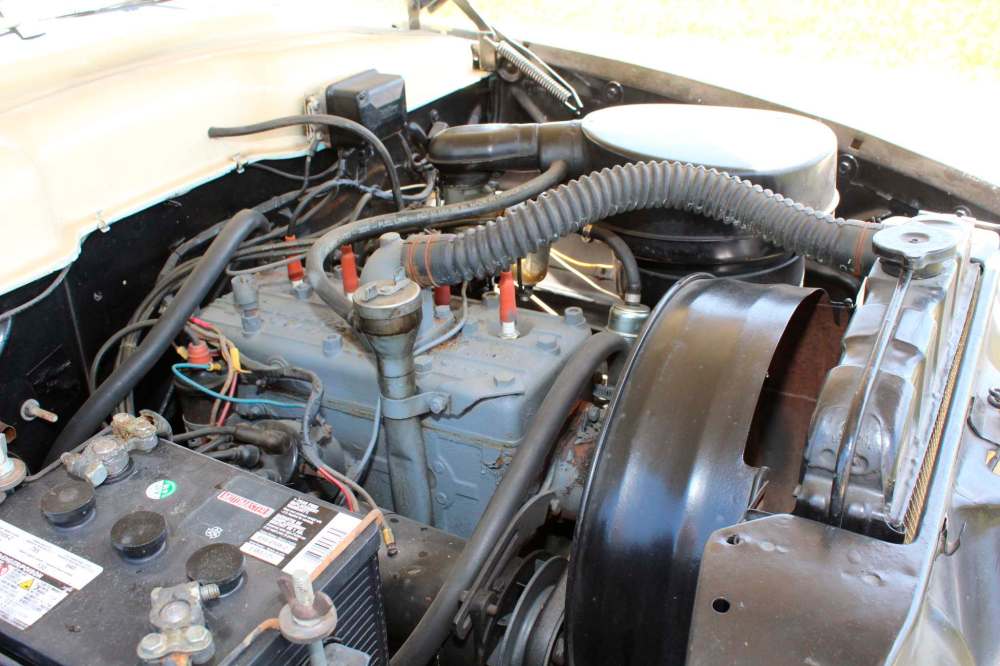
Dudych put in a lot of work on the vehicle’s engine to get it running properly.

Powering the Henry J is the standard L-Head, in-line four-cylinder engine. Displacing 134.2 cubic-inches with a 7:1 compression ratio, it produces 68 horsepower at 4,000 rpm and is backed by a column-mounted three-speed manual transmission. Optional equipment is sparse, including only the heater and defroster unit.

Going over the car, Dudych found the brakes were new and there were no issues with the factory suspension and steering. To get the car running properly and roadworthy, Dudych rebuilt the carburetor, tuned-up the engine, installed turn signal indicators, a new sending unit for the fuel tank, replaced the rear window seal and added a new set of 15-inch radial tires. To clean the car up, he had a friend repaint it in a similar beige colour called French vanilla and the House of Silver replated the chrome grille surround.

While Dudych admits he hasn’t driven his Henry J very much, he always gets the thumbs-up from people when he does.

“I have thought of maybe selling it at times, but the reaction I get from people when they see it and the questions they ask about it, really makes it special,” Dudych says.

Of the 17,505 Henry J models produced in 1953, there were 9,333 Corsair models equipped with the four-cylinder engine, with the balance carrying the 80-horsepower “Supersonic Six” engine.
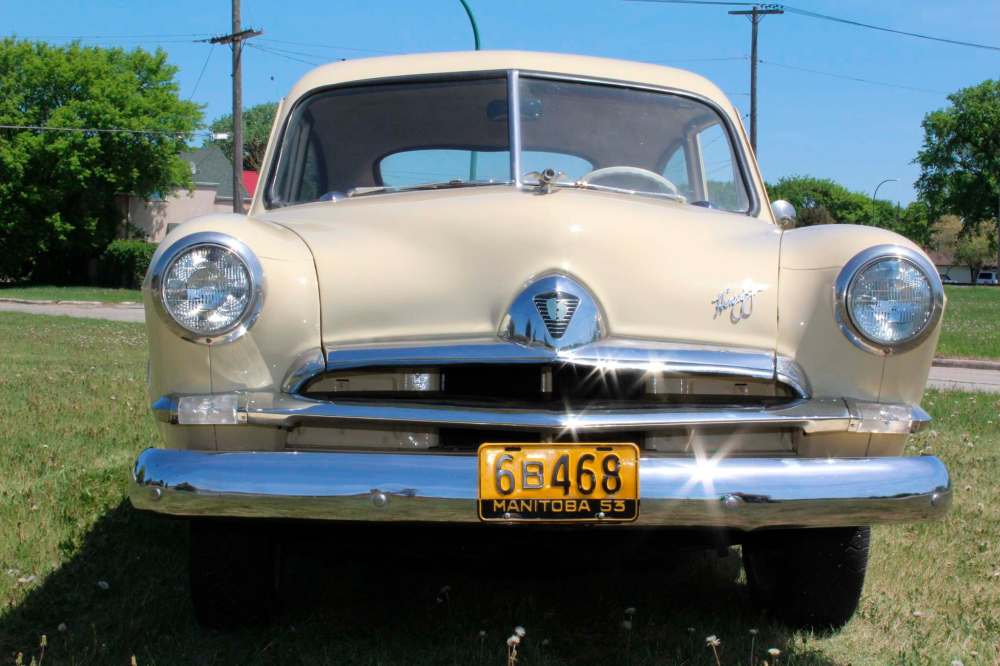
During 1952 and ’53, Sears would also offer the Henry J through their catalogue sales. Renamed the Allstate, it had only a minor change to the grille cavity, adding two horizontal chrome bars. There were also special Allstate name scripts affixed to the car and they all came equipped with Allstate tires and batteries. All other standard Henry J features and optional equipment were available. Introduced in October 1952, Sears cancelled the Allstate in July 1953 over poor sales, having only sold 2,689 units.

For 1954, most Henry J models were carry-overs with no changes from the ’53 model other than the serial number. Production of the Henry J ceased at Kaiser on Nov. 20, 1953, with only 1,119 units built for ’54. In its four-year availability, a grand total of 206,803 units were built, including the Allstate cars.

57ford@mymts.net
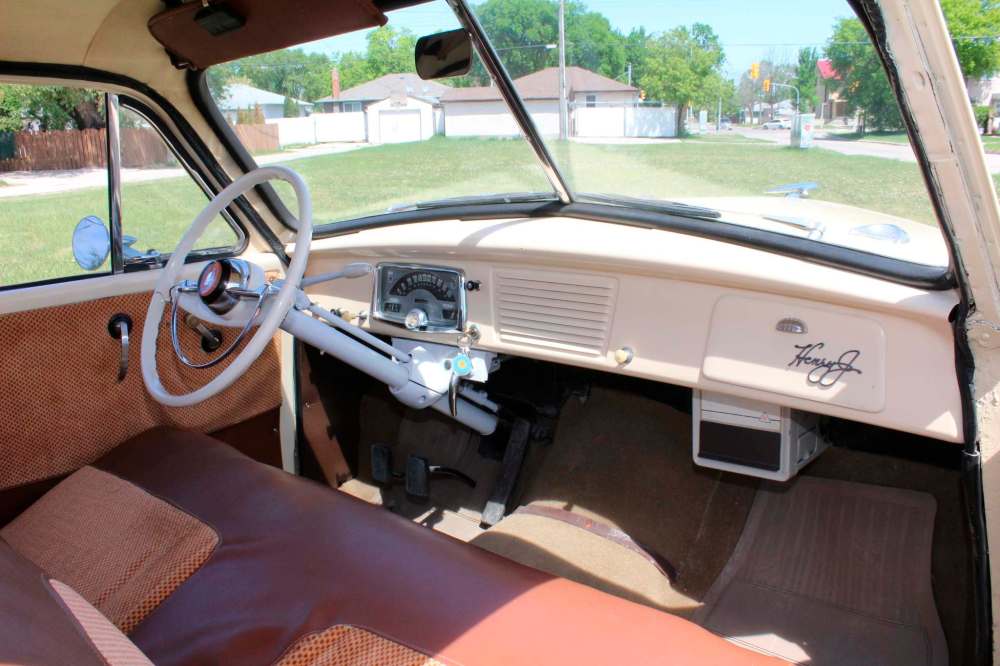
With only 120,700 kilometres since leaving the factory and no rust, Dudych’s ’53 Henry J is solid.
Report Error Submit a Tip

More Stories

Not falling back means time loop remains unclosed

Jen Zoratti 4 minute read 2:01 AM CDT

I demand restitution. Where’s my hour?

In the traditional fall-back, spring-forward time change set up — you know, ol’ trusty that’s been effect for lo these 63 years — we lost an hour in the spring that we got back in the fall.

That was the social contract: you commit to feeling like you’re on cold medication for a week in March because you know a glorious extra hour of sleep will be returned to you in November. (Unless, of course, you have little kids, but look: we all make our choices.)

Well, that transaction, flawed as it was, isn’t happening this year. That hour you sacrificed to the sun gods in the spring? Gone. Not coming back. We’ve sprung forward and we shan’t be falling back — not in November, and (possibly) not ever. The scale shall remain unbalanced and the loop shall remain unclosed as Manitoba has adopted permanent daylight time.

Hellebuyck standoff caused by… Nathan MacKinnon?

Mike McIntyre 7 minute read Preview

Hellebuyck standoff caused by… Nathan MacKinnon?

Mike McIntyre 7 minute read Yesterday at 6:34 PM CDT

Looking for someone to blame in the Connor Hellebuyck fiasco and cast as public enemy No. 1? How about long-time Winnipeg Jets nemesis Nathan MacKinnon?

Allow us to explain as we fire up the time machine and head back to February in Italy.

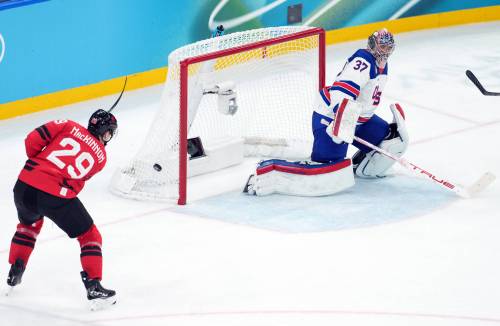
Oh, what could have been if MacKinnon had been able to score on what appeared to be an open net late in the third period of the men’s gold medal game with Hellebuyck down and seemingly out of position.

Instead, the star forward fired wide, keeping the score deadlocked at 1-1 as the clock ticked down on regulation.

Read
Yesterday at 6:34 PM CDT

Canada must not accept another Iranian autocracy

David Matas 5 minute read 2:01 AM CDT

Iran is a state run by a radical government victimizing its citizens and its neighbours. How do we change that? Any regime change that repeats the mistakes of the past is not a solution.

What went wrong in the past which led to the current regime? One answer is the U.K. and American aided coup which led to the ouster in 1953 of a democratically elected government headed at the time by Mohammad Mossadegh and its replacement with an American friendly autocrat, the Shah of Iran, Mohammad Reza Pahlavi.

The Shah imposed his rule through the Iranian National Intelligence and Security Organization — SAVAK, the acronym of its Persian name. SAVAK systematically inflicted torture, arbitrary killings and extra-judicial killings on perceived opponents of the regime. It was only a matter of time before repression of a regime directed to serving foreign interests would be overthrown.

What replaced the regime of the Shah, in 1979, the current regime of the mullahs, is a regime as intolerant and violent as the regime of the Shah and then some. That was not inevitable. But neither was it surprising. The vicious nature of the current regime, following the example set by the Shah, and its hatred for the United States, reacting to the U.S. aided imposition of the Shah, both echoes and reacts to the past. In 1979, the U.S. reaped what it sowed in 1953.

Give-and-take relationship of Roman leaders takes centre stage in Harris’s historical fiction

Reviewed by Kathryne Cardwell 4 minute read Preview

Give-and-take relationship of Roman leaders takes centre stage in Harris’s historical fiction

Reviewed by Kathryne Cardwell 4 minute read 2:01 AM CDT

British novelist Robert Harris’s latest work is a reflection on tyranny, corruption and betrayal among all-powerful political leaders.

You might be forgiven for thinking it’s a contemporary thriller — it’s actually historical fiction set in ancient Rome.

A former BBC journalist, Harris debuted as a novelist in 1992 with Fatherland, an alternative history where Nazi Germany won the Second World War.

Since then, the prolific author has become best-known for his works of historical fiction, especially his ancient Rome trilogy released from 2006-2015 and the novel Conclave, which was published in 2016 and was made into the film of the same name in 2024.

Read
2:01 AM CDT

Steinbach Credit Union member warns others after scammer steals $10K

Scott Billeck 5 minute read Preview

Steinbach Credit Union member warns others after scammer steals $10K

Scott Billeck 5 minute read Yesterday at 5:19 PM CDT

A Winnipeg single mother whose bank account was drained of nearly $10,000 says Steinbach Credit Union needs to warn its members about what she believes is a broader security problem.

The woman, who is not being named to protect her identity, said a scammer gained access to her account earlier this week after calling SCU’s contact centre, claiming to be her and successfully completing the credit union’s authentication process.

She said she knows of at least six others who have experienced similar incidents in which callers impersonate SCU account holders and pass the authentication checks.

The woman discovered something was wrong when her minor son asked why money had been transferred out of an account they jointly hold.

Read
Yesterday at 5:19 PM CDT

Canada-U.S. trade relationship is broken, but the damage can — and will — be repaired

Tom Brodbeck 5 minute read Preview

Canada-U.S. trade relationship is broken, but the damage can — and will — be repaired

Tom Brodbeck 5 minute read Thursday, Sep. 17, 2026

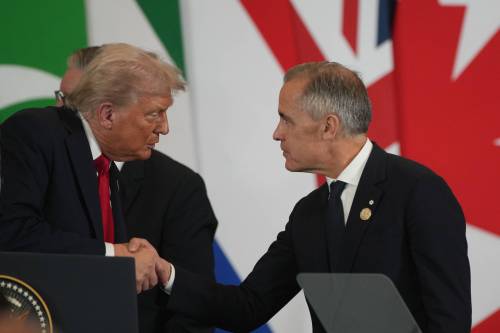
Canada needs to get serious about diversifying its trade beyond the United States. But at the same time, Canadians should expect relations with the U.S. to normalize after Donald Trump is no longer in the White House.

For generations, Canada-U.S. trade was considered almost a fact of geography. The two countries share the world’s longest undefended border, deeply integrated supply chains and a century of commercial relationships.

Canadian manufacturers depend on American customers. American manufacturers depend on Canadian suppliers. Energy, agriculture, automotive production and countless other industries operate across the border as though it barely exists.

That isn’t going to change dramatically, even in the midst of a bitter trade war unleashed by the U.S. president.

Read
Thursday, Sep. 17, 2026