

Urban lifestyle keeps young people here

Advertisement
Read this article for free:
or
Already have an account? Log in here »
To continue reading, please subscribe:

Digital Subscription
One year of digital access for only $205*
- Enjoy unlimited reading on winnipegfreepress.com
- Read the E-Edition, our digital replica newspaper
- Access News Break, our award-winning app
- Play interactive puzzles
*First annual payment billed as $205.00 + GST for one year. This annual subscription will automatically renew at $233.00 + GST every 52 weeks (10% off the regular annual price of $259.35). Offer available to new and qualified returning subscribers only. Cancel any time.
To continue reading, please subscribe:
Add Free Press access to your Brandon Sun subscription for only an additional
$1 for the first 4 weeks*
- Enjoy unlimited reading on winnipegfreepress.com
- Read the E-Edition, our digital replica newspaper
- Access News Break, our award-winning app
- Play interactive puzzles
*Your next Brandon Sun subscription payment will increase by $1.00 and you will be charged $17.95 plus GST for four weeks. After four weeks, your payment will increase to $24.95 plus GST every four weeks.
Read unlimited articles for free today:
or
Already have an account? Log in here »
Hey there, time traveller!
This article was published 24/12/2018 (2823 days ago), so information in it may no longer be current.
A few weeks ago, I wrote a column mentioning that an alarmingly large number of people are leaving Manitoba for other provinces. The point appeared to inspire enough discussion that further investigation seems warranted.
Statistics Canada data indicate 9,199 more people moved away from Manitoba than came to the province from June 30, 2017, to July 1, 2018. This net loss in provincial migration was the highest number since 1989. Statistics for the third quarter of 2018 show the decline continuing, with the province losing 3,000 more people over that three-month period.
Most of Manitoba’s interprovincial migration losses come from Winnipeg. In 2016-17, Winnipeg lost the second-highest number of people in the country, losing far more than any other city as a proportion of overall population. Typically, about 40 per cent of this migration is people between the ages of 20 and 34.
Winnipeg and Manitoba are continuing to grow through natural increase and international immigration, but the loss of so many young people is a disconcerting trend for the city and province. In an increasingly mobile world, cities that find strategies to successfully attract young people realize the highest levels of economic prosperity.
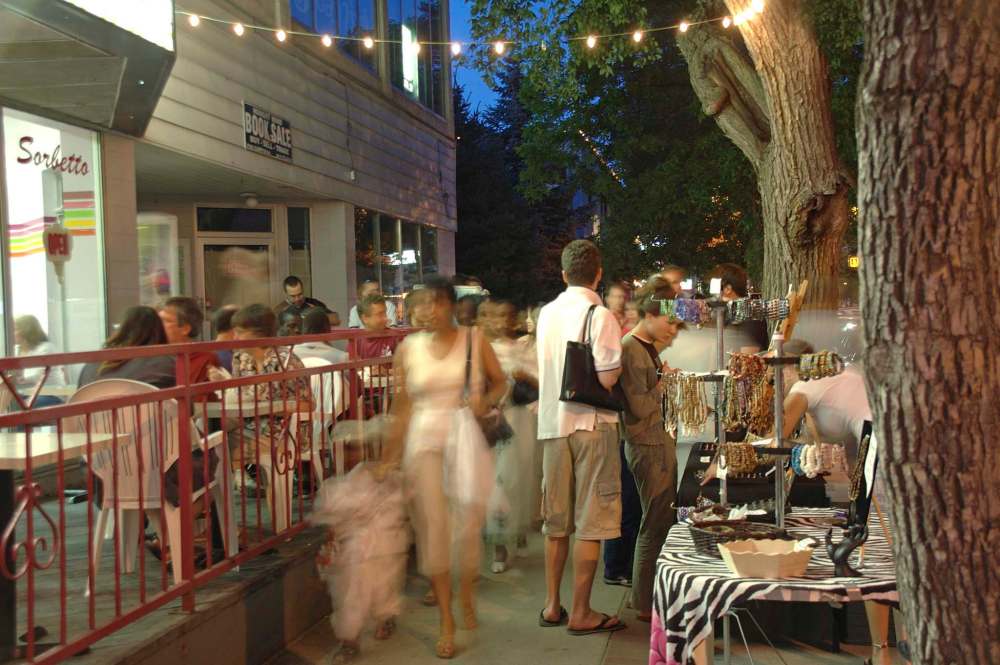
There is a growing body of data indicating that young people today, in greater numbers than previous generations, are looking for a more urban experience in the places they live.
They are more often seeking walkable neighbourhoods, vibrant street life, and places that foster social connection such as cultural amenities, shops and restaurants.
A Nielsen survey from 2014 found that 62 per cent of young adults indicated a preference for living in pedestrian- and transit-oriented mixed-use urban communities.
These evolving lifestyle preferences are changing North American cities. A 2014 study by the City Observatory think tank found that in the United States, the number of college-educated people age 25 to 34 living in urban neighbourhoods had grown by almost 40 per cent since 2000. It also found that in 1980, young people were 10 per cent more likely than other age demographics to live in the urban cores of cities.
By 2010, this number had grown to 51 per cent and young people with university degrees were 126 per cent more likely to live in an urban neighbourhood. A study by Forbes earlier this year reinforced that finding, indicating that in the 33 largest cities in the U.S., for every young university graduate added to a city’s suburban areas, 1.52 were being added to inner-city communities.
The latest available neighbourhood data show Winnipeg is no different than these continental trends. Citywide, 21 per cent of the population is between the ages of 20 and 34, 22 per cent have a university degree, 14 per cent use public transit and seven per cent walk or bike to work. In the city’s most walkable, urban neighbourhoods such as Osborne Village, Corydon-Earl Grey and Broadway-Assiniboine, 40 per cent (double the city average) are young adults, one-third have university degrees (50 per cent higher than the city average), up to 25 per cent use transit and 20-30 per cent walk and bike.
Wolseley has slightly fewer young people but a higher percentage of educated residents and similar transportation habits.
By contrast, 17 per cent of North Kildonan is between the ages of 20 and 34, 16 per cent of Linden Woods, 14 per cent of Westwood and 13 per cent of Whyte Ridge. Transit use ranges from four per cent in Whyte Ridge to eight per cent in Linden Woods and 10 per cent in Westwood. Cycling as a mode of commuting is almost non-existent, and walking is reduced to a few per cent in these areas.
With young, educated people settling in central neighbourhoods in greater numbers, car ownership in this demographic is declining and, as the numbers demonstrate, transit ridership, walking and cycling as primary modes of transportation are becoming a higher priority. Cities that are focused on building walkable neighbourhoods and making investments in mobility options are proving to be the most successful at attracting a young, educated population.

Lifestyle factors influence where young people choose to live, but jobs and opportunity are still the primary drivers. In a chicken-and-egg scenario, young people are moving to the cities where the jobs are, and companies are moving to the cities where the young people are. A recent study by Endeavor Insight surveyed 150 of America’s fastest-growing companies and found the most important factor determining where businesses choose to locate is access to a young, educated workforce and the quality-of-life amenities that attract them. Less than five per cent of these entrepreneurs cited low taxes and business-friendly regulations as reasons to locate in a city.
This changing business environment has many leading cities shifting their economic development strategies to ones that attract a young, educated labour pool, as a means of luring investment and business growth.
A 2014 study by Higher Education Strategy Associates found that Manitoba university graduates ranked second in willingness to consider relocating to a different province, and for graduates from across Canada, Manitoba was perceived to be the least desirable place to relocate to. When we freeze transit funding, vote to prioritize cars over pedestrians, oppose infill and higher-density development or fight against protected bike lanes, we are telling a large proportion of young, educated people that the city we are building is not for them.
Many young people are drawn to suburbs, particularly new ones, but if we hope to grow our young labour pool, attract business and stem the migration outflow, it is important that we offer a diversity of lifestyle options, and begin to give priority to what a greater proportion of the next generation are looking for in the city they will choose to live in.
Brent Bellamy is a senior design architect for Number Ten Architectural Group.
Brent Bellamy is creative director for Number Ten Architectural Group.
Our newsroom depends on a growing audience of readers to power our journalism. If you are not a paid reader, please consider becoming a subscriber.
Our newsroom depends on its audience of readers to power our journalism. Thank you for your support.
Brent Bellamy is creative director for Number Ten Architectural Group.
Our newsroom depends on a growing audience of readers to power our journalism. If you are not a paid reader, please consider becoming a subscriber.
Our newsroom depends on its audience of readers to power our journalism. Thank you for your support.
Advertisement Advertise With Us
Advertisement Advertise With Us