Au pairs win $65.5 million settlement in Denver lawsuit

Advertisement

Advertise with us

DENVER - Young people from around the world who provided low-cost child care for American families will share in a proposed $65.5 million settlement of a lawsuit brought by a dozen former au pairs against the companies that bring the workers to the United States.

Read this article for free:


or

Already have an account? Log in here »

To continue reading, please subscribe:

Subscribe and receive a limited-edition Free Press branded hat or tote.

Digital Subscription

One year of digital access for only $205*

  • Enjoy unlimited reading on winnipegfreepress.com
  • Read the E-Edition, our digital replica newspaper
  • Access News Break, our award-winning app
  • Play interactive puzzles

*First annual payment billed as $205.00 + GST for one year. This annual subscription will automatically renew at $233.00 + GST every 52 weeks (10% off the regular annual price of $259.35). Offer available to new and qualified returning subscribers only. Cancel any time.

To continue reading, please subscribe:

Add Free Press access to your Brandon Sun subscription for only an additional

$1 for the first 4 weeks*

  • Enjoy unlimited reading on winnipegfreepress.com
  • Read the E-Edition, our digital replica newspaper
  • Access News Break, our award-winning app
  • Play interactive puzzles
Start now

*Your next Brandon Sun subscription payment will increase by $1.00 and you will be charged $17.95 plus GST for four weeks. After four weeks, your payment will increase to $24.95 plus GST every four weeks.

Hey there, time traveller!
This article was published 09/01/2019 (2775 days ago), so information in it may no longer be current.

DENVER – Young people from around the world who provided low-cost child care for American families will share in a proposed $65.5 million settlement of a lawsuit brought by a dozen former au pairs against the companies that bring the workers to the United States.

Nearly 100,000 au pairs, mostly women, who worked in American homes over the past decade will be entitled to payment under the proposed settlement filed in Denver federal court Wednesday, a month before the case brought by a dozen former au pairs from Colombia, Australia, Germany, South Africa and Mexico was set to go to trial.

They claimed 15 companies authorized to bring au pairs to the United States colluded to keep their wages low, ignoring overtime and state minimum wage laws and treating the federal minimum wage for au pairs as a maximum amount they can earn. In some cases, the lawsuit said, families pushed the limits of their duties, requiring au pairs to do things like feed backyard chickens, help families move and do gardening, and not allowing them to eat with the family.
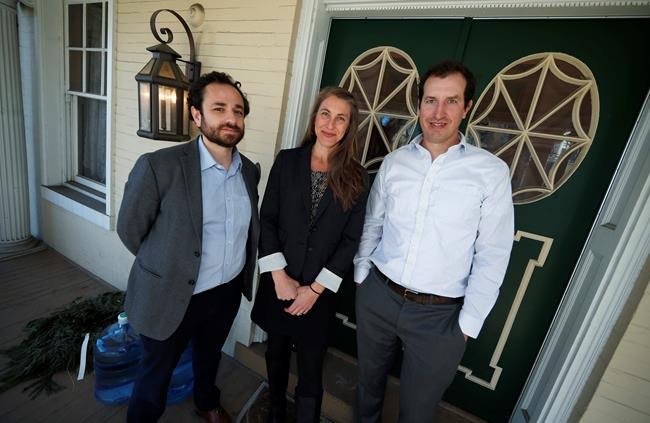
In this Thursday, Dec. 20, 2018 photo, from left, attorneys David Seligman, Nina DiSalvo and Alexander Hood of Denver's Towards Justice are shown outside the organization's office east of downtown Denver. A deal filed in federal court in Denver Wednesday, Jan. 9, 2019, will allow young people who have provided low-cost child care for American families to share in a $65.5-million class action settlement with the companies that brought the workers to the United States. (AP Photo/David Zalubowski)

“This settlement, the hard-fought victory of our clients who fought for years on behalf of about 100,000 fellow au pairs, will be perhaps the largest settlement ever on behalf of minimum wage workers and will finally give au pairs the opportunity to seek higher wages and better working conditions,” said David Seligman, director of Denver-based Towards Justice, which filed the lawsuit in 2014. It was later litigated by New York-based firm Boies Schiller Flexner.

Under the settlement, which still must be approved by a judge, the companies agreed to make sure au pairs are informed about their legal rights in the future, but they denied any wrongdoing.

Lawyers now need to track down au pairs who came to the U.S. on J-1 visas between Jan. 1, 2009, and Oct. 28, 2018, and have set up a website to help spread the word about the deal.

While sometimes confused with nannies, au pairs have much less experience and earn a lot less.

The program, overseen by the U.S. State Department, was launched as a cultural exchange program in 1986 as demand for child care grew. At first there were only 3,000 participants as part of a pilot, but last year there were over 20,000. The program occupies a grey area between work and an international relations effort, and critics say that makes it ripe for abuse.

The sponsors said they were just following regulations from the State Department — which last adjusted au pair pay to $195.75 for a 45-hour work week in 2009 after the federal minimum wage rose to $7.25. Their hourly wage has actually been $4.25 though: Families were told to deduct 40 per cent of their pay to cover the room and board they’re required to provide the au pairs, a practice challenged by the lawsuit.

In court filings, the sponsors argued requiring families to pay more in states with higher minimum wages would destroy the program by making au pairs unaffordable, hurting its foreign policy goals.

According to a 2016 report on U.S. child care by the Washington-based think-tank New America, the average cost of full-time child care in a daycare centre for children up to 4 years old is $9,589 a year for each child, more than the average cost of in-state college tuition. The average cost of full-time care at home with a nanny was $28,353 — 53 per cent of the median U.S. household income and nearly three times the annual pay for an au pair.

The practice of having au pairs — French for “on par with” — developed in postwar Europe, where young people lived with families in other countries to learn a language in exchange for helping with childcare and some housework. In Europe, au pairs generally are limited to working 30 hours a week.

Sarah Azuela said the ad she saw her final year of college in Mexico promised coming to the United States to work as an au pair would be the best year of her life, full of travel, meeting new people and becoming part of an American family. But she says what grew into a two-year stay turned out to be the worst time of her life, with her feeling more like a slave subject to the whims of her host families than a member of the household.

At her last placement — working for a single mother in Virginia — Azuela said that in addition to helping care for three children, she cooked all the meals, cleaned, planted flowers and packed the family’s belongings and helped move them twice, first to an interim apartment and then to a permanent home.

Nevertheless, Azuela was grateful her host mother gave her time to study for a business certificate at a university, which led her to extend her stay, and for not yelling or threatening to hit her as a previous host had done.
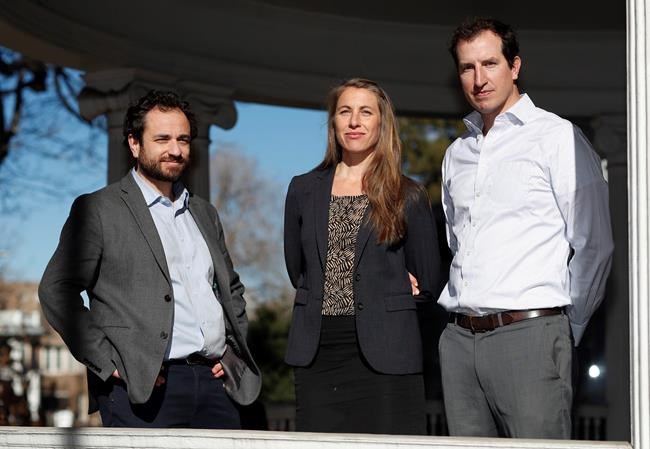
In this Thursday, Dec. 20, 2018, photo, attorneys, from left, David Seligman, Nina DiSalvo and Alexander Hood of Denver's Towards Justice are shown outside the organization's office east of downtown Denver. In a deal filed Wednesday, Jan. 9, 2019, in federal court in Denver, the companies that brought workers from around the globe to provide low-cost child care for American families have offered $65.5-million to settle a class-action lawsuit with nearly 100,000 au pairs. (AP Photo/David Zalubowski)

“I don’t wish anyone to experience anything like this,” Azuela, who is from Hermosillo, Mexico, but now lives in Wisconsin, said about why she joined in the lawsuit.

The settlement comes amid a movement to protect the rights of domestic workers, who were originally excluded from federal labour protections. Eight states have passed domestic worker bills of rights, and Sen. Kamala Harris and Rep. Pramilla Jayapal recently said they plan to introduce a bill to create a national version.

Rocio Avila, the state director of the National Domestic Workers Alliance, which has pushed for the bills of rights, said litigation is another tool to protect domestic workers, along with organizing and raising awareness about how they can be exploited. She said the settlement should help future au pairs earn fair pay and limit the scope of their work because companies will want to avoid risking another lawsuit.

Meanwhile, a related case challenging whether Massachusetts had the right to protect au pairs in its domestic workers’ bill of rights since they are regulated by the federal government is pending in federal appeals court. The State Department said in a court filing in September that federal law requires only that au pairs are paid the federal minimum wage, arguing federal law specifically states when other international guest workers, like camp counsellors and teachers, are entitled to make more.

Speaking ahead of the settlement, Alieza Durana, a senior policy analyst at New America who co-wrote the child care report, said she did not think the Denver case would have a big impact on the child care landscape in the United States since a relatively small number of families rely on au pairs and because so much of the child care market is unregulated —both in terms of pay and quality.

However, she said it could hurt families who use au pairs because they need care at odd hours or live far from day care centres.

___

Follow Colleen Slevin on Twitter: @colleenslevin.

Report Error Submit a Tip

More Stories

A message to Mark: Don’t. Back. Down.

Judy Waytiuk 5 minute read Preview

A message to Mark: Don’t. Back. Down.

Judy Waytiuk 5 minute read Yesterday at 2:00 AM CDT

When is a leak really a trial balloon? While Mark Carney currently enjoys huge favourability in Canada, there are nine federal byelections pending. If he stumbles on his pledge of “Elbows up’ against the U.S., votes could go against the Liberals.

Read
Yesterday at 2:00 AM CDT

Nola chef earns national award

Eva Wasney 2 minute read Preview

Nola chef earns national award

Eva Wasney 2 minute read Yesterday at 2:01 AM CDT

Celebrated Winnipeg chef Emily Butcher has another feather to add to her toque. The executive chef and owner of Nola and Bar Accanto in St. Boniface has received the Culinary Award of Excellence from Restaurants Canada, a national foodservice advocacy organization.

Read
Yesterday at 2:01 AM CDT

PCs say Hutterite colonies singled out by Bill 21

Alex Lambert 4 minute read Preview

PCs say Hutterite colonies singled out by Bill 21

Alex Lambert 4 minute read Yesterday at 2:01 AM CDT

SOURIS — Members of Hutterite colonies in the province took aim at the NDP government’s proposed changes to drinking water legislation during a public meeting Thursday in Souris.

The meeting was hosted by Progressive Conservative MLA Colleen Robbins (Spruce Woods) to hear from rural residents about their concerns over Bill 21, which the government says will improve oversight on wells and other water systems in the province.

“There’s not enough clarity, but I feel that the overreach that this bill will bring is not clearly defined, and it could have a lot of negative consequences,” attendee Gilbert Hofer, a member of Green Acres colony near Wawanesa, said after the meeting, which drew about 20 people.

The legislation would allow public health officers to designate the type of water source based on its intended use, water quality and use duration rather than solely the number of connections it has.

Read
Yesterday at 2:01 AM CDT

Could renewed interest in strategically critical rare earth elements finally make sub-sector profitable?

Joel Schlesinger 6 minute read Preview

Could renewed interest in strategically critical rare earth elements finally make sub-sector profitable?

Joel Schlesinger 6 minute read 3:00 AM CDT

Rare earth elements are among the most critical of mined resources for modern economies.

They’re essential in manufacturing specialized magnets used in a host of technologies from wind turbines and electric vehicles to hard drives, smartphones, television screens, and fibre optics. Most notably, however, rare earth minerals are increasingly vital to the defence industry.

These 17 elements — closely related chemically and usually found all together in mineral deposits — have indeed been growing in geopolitical importance as the United States, Canada and other Western nations recognize their dependence on production from China.

It is the world’s largest producer and processor of rare earths, including the most in-demand elements neodymium and praseodymium used to manufacture very light and powerful magnets for an array of technologies, including the most advanced weapons of modern warfare.

Read
3:00 AM CDT

August in the kitchen garden

Colleen Zacharias 7 minute read Preview

August in the kitchen garden

Colleen Zacharias 7 minute read 3:00 AM CDT

Lynne Hermiston is passionate about growing her own food. Her backyard food garden in south Winnipeg is an amazing example of the abundance and diversity of food that can be grown in a relatively small space. But it’s also a prime example of how a zest for learning innovative methods can make food gardening more fun.

Hermiston’s backyard is approximately 10 metres wide and 15 metres deep. The growing area consisting of raised beds and a couple of in-ground beds between her deck and back fence is about nine metres deep. There is not a single blade of turf grass in sight. The design for this attractive and productive space was created by Classic Landscaping four years ago. A series of raised wooden beds mulched with straw are neatly arranged on a light grey, slate-like surface. An inviting centre arbor acts as a focal point and supports climbing plants. The square-shaped raised-bed area receives eight to nine hours of sun daily. It is flanked on one side by a long, linear-shaped bed, planted with flowering perennials that attract and support pollinators.

The food plants Hermiston is growing this summer include tomatoes, cucumbers, squash, beets, chickpeas, beans, onions, sweet potatoes, horseradish, garlic, peppers, carrots, pumpkin and cauliflower. She is growing Chinese Pink celery, an heirloom variety with bubblegum-pink stems, for the first time, as well as eggplant.

She also grows salad greens and herbs, which have made delicious additions to her summer recipes this year. Only a few harvests remain of the spinach she planted. But, compared to last year’s growing season, some food plants are taking their time, Hermiston says.

Read
3:00 AM CDT

Manitoba supports MAID delay: Asagwara

Carol Sanders 5 minute read Preview

Manitoba supports MAID delay: Asagwara

Carol Sanders 5 minute read Yesterday at 2:00 AM CDT

The number of Manitobans receiving medical assistance in dying in 2026 is on track with previous years while the plan to extend it to those suffering from mental illness is delayed indefinitely by the federal government — a move Manitoba’s health minister supports.

“There’s so much more work that needs to be done,” Uzoma Asagwara said.

The parliamentary committee that issued its recommendation in June was the third special committee of Parliament struck to assess the eligibility of people with mental illness since 2021, when MAID eligibility was expanded to include people who were not at the end of their lives.

A key condition for MAID eligibility is that a patient must be suffering from a grievous and irremediable medical condition.

Read
Yesterday at 2:00 AM CDT